DOLLY’S CHOP SHOP

/

DOLLY’S CHOP SHOP /

I am a London-based visual artist and UK government policymaker. Dolly's Chop Shop takes its name from where my work starts or ends — collage. Working at the intersection of art, policy and research, I explore what visual practice can contribute to policymaking.

Dead Certain is an ongoing body of work investigating what collage can contribute to policymaking alongside analytical research methodologies. The title reflects an interest in certainty itself: how evidence is produced, interpreted and trusted when navigating complex policy questions.The work forms the foundation for a longer-term programme of creative research into evidence, accountability and public life. Six early collages from this body of work are presented below, alongside documentation of the creative and technical development behind each.

DEAD CERTAIN (2022 - ONGOING)

The Look

Mixed-media collage on paper

50 × 70 cm

2026

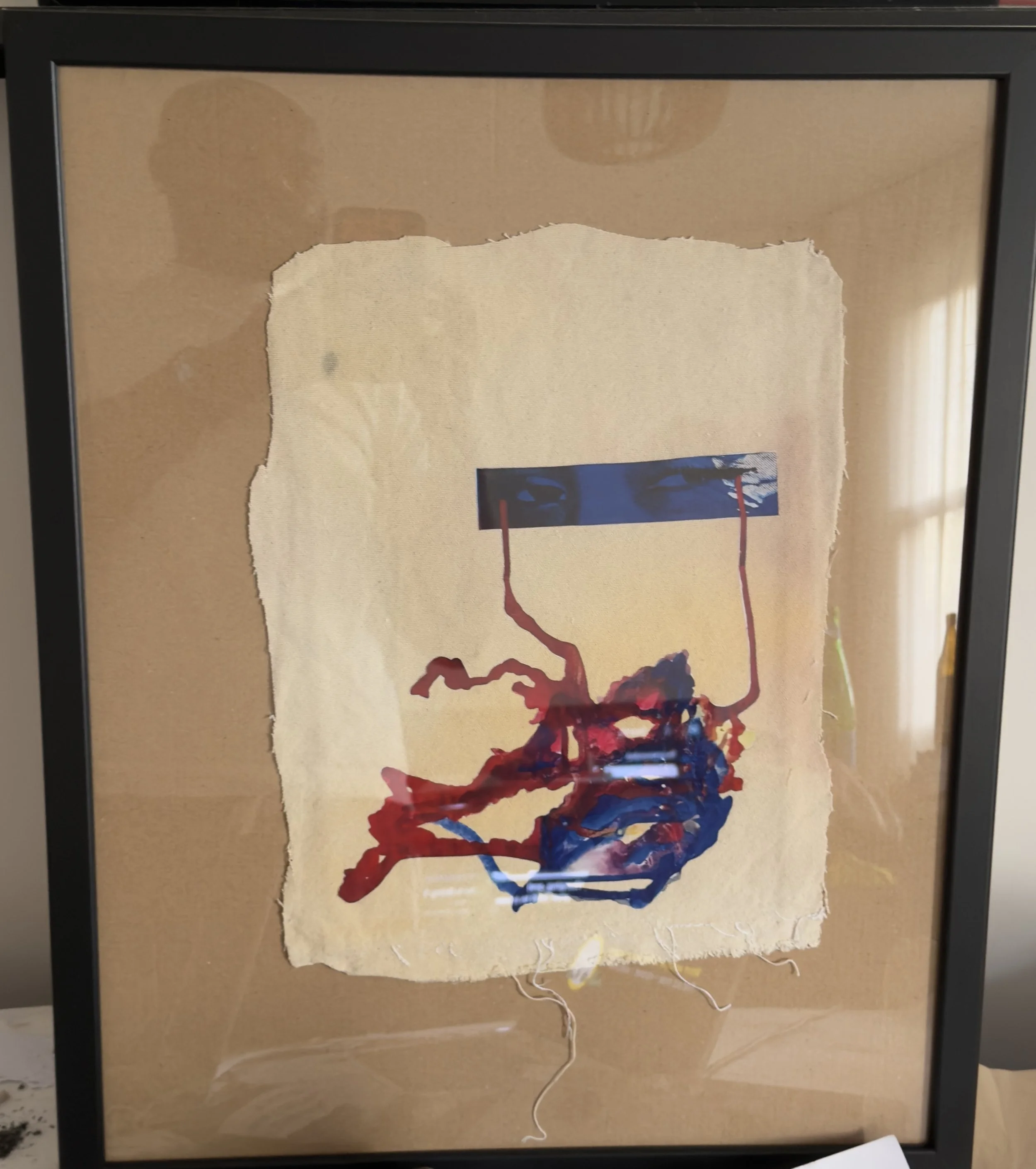
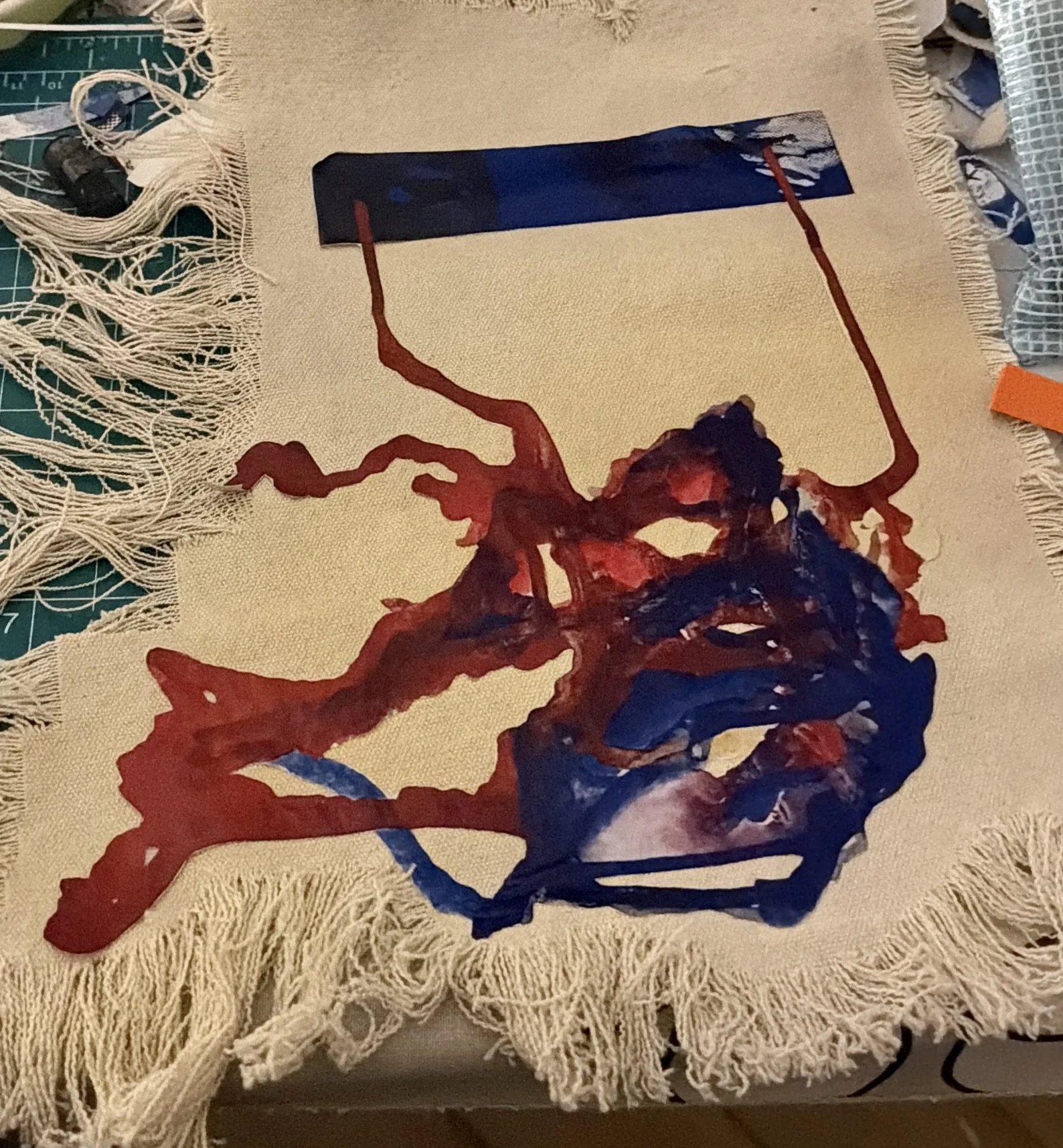
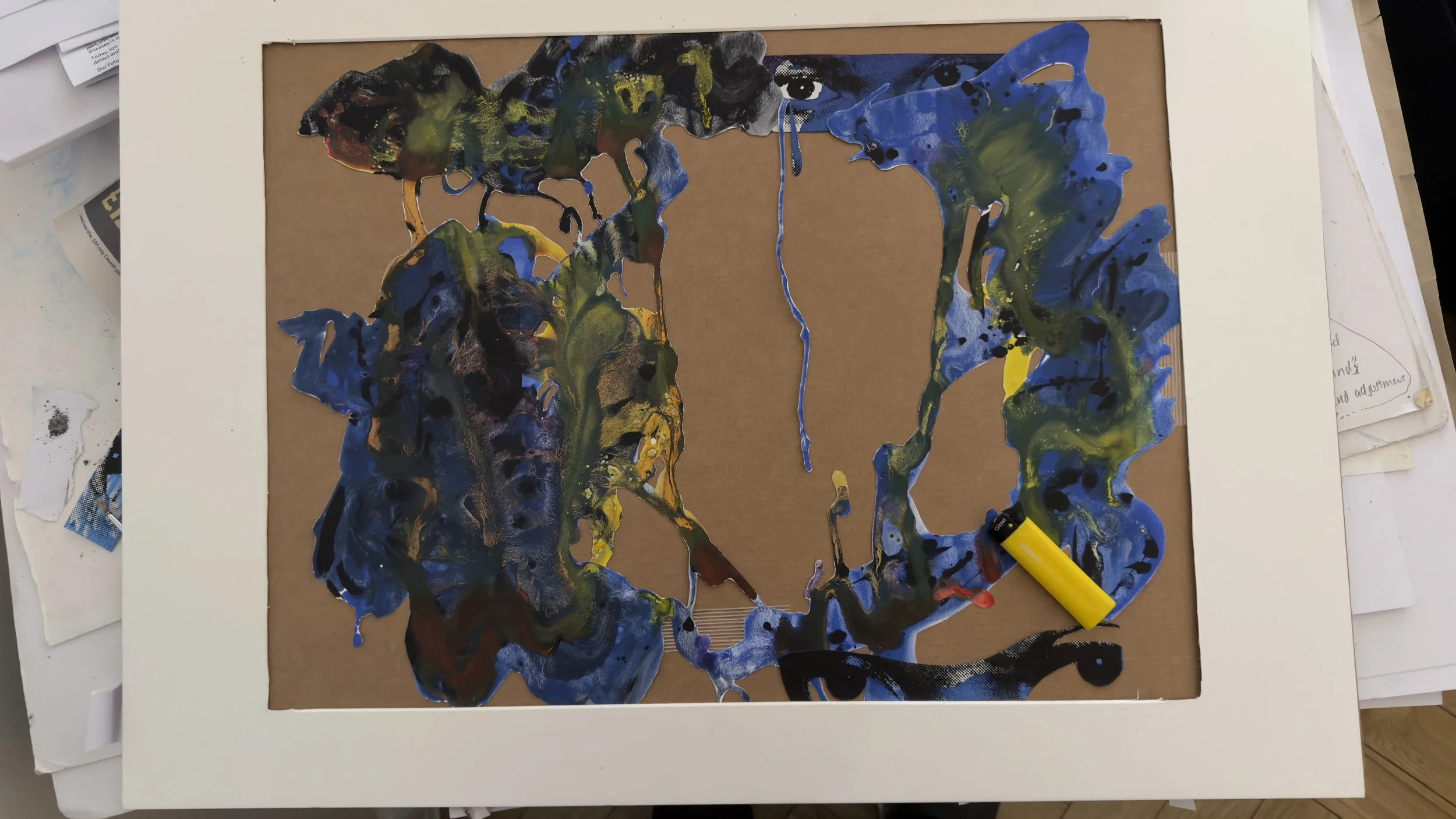
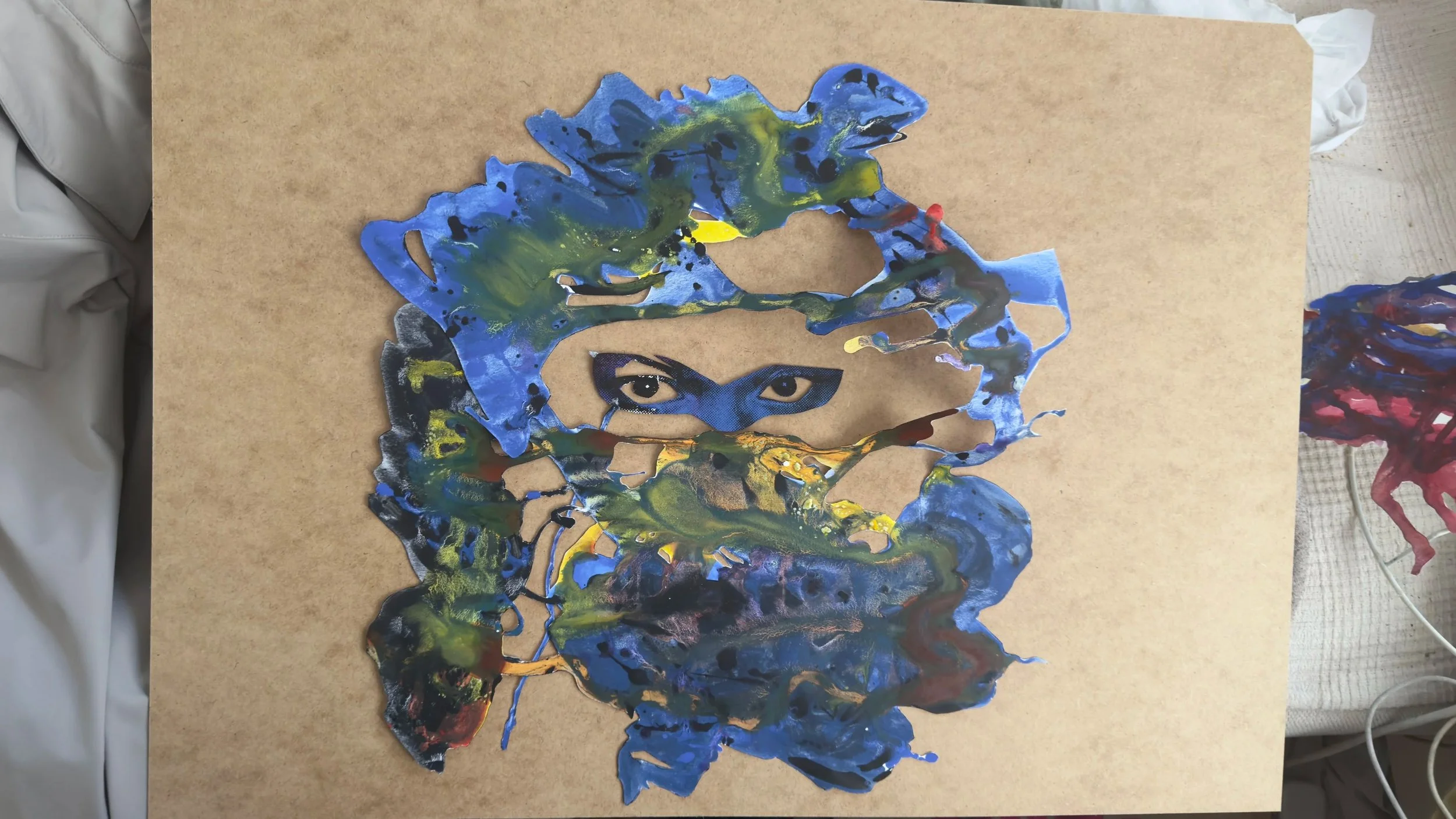
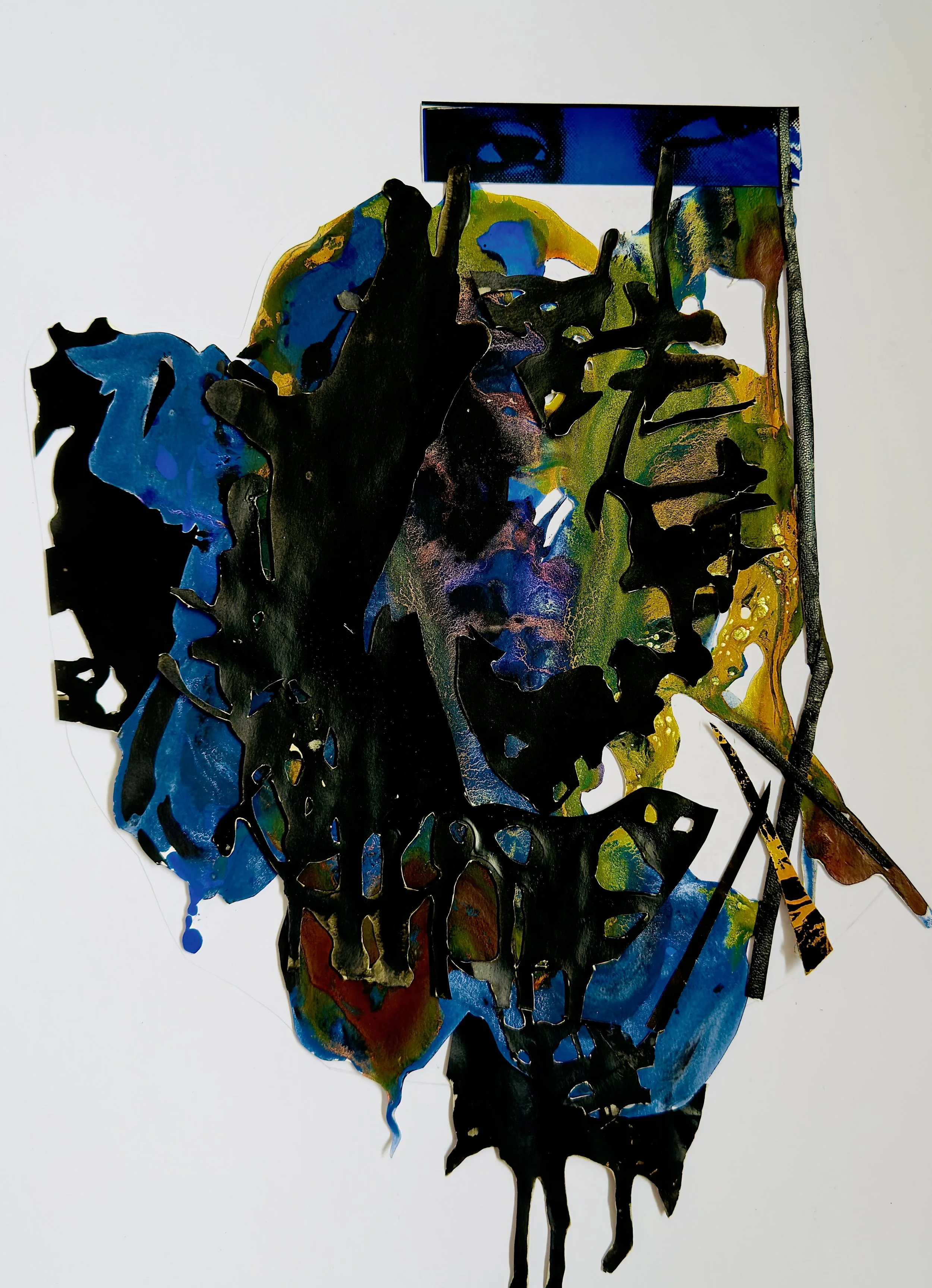
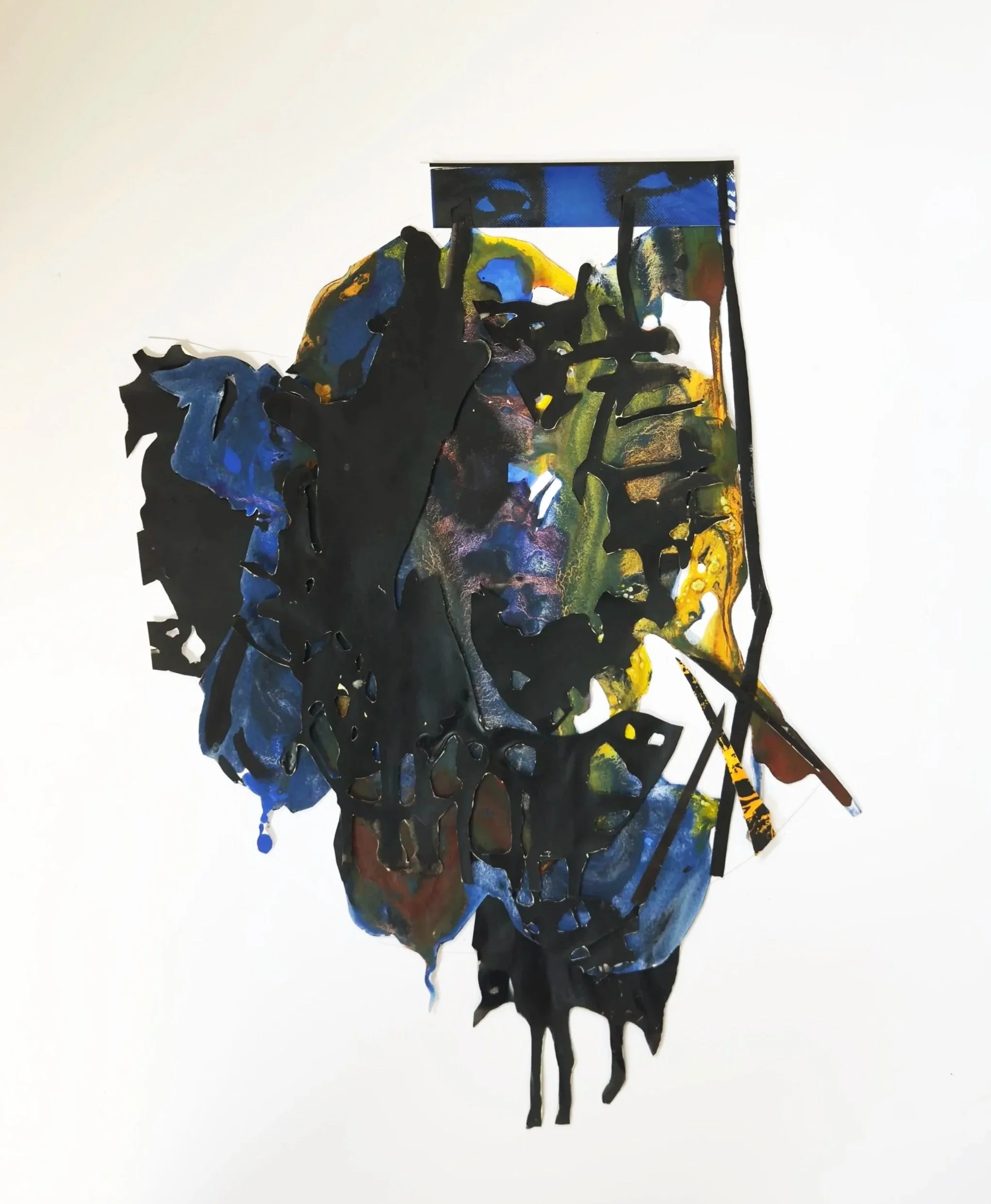
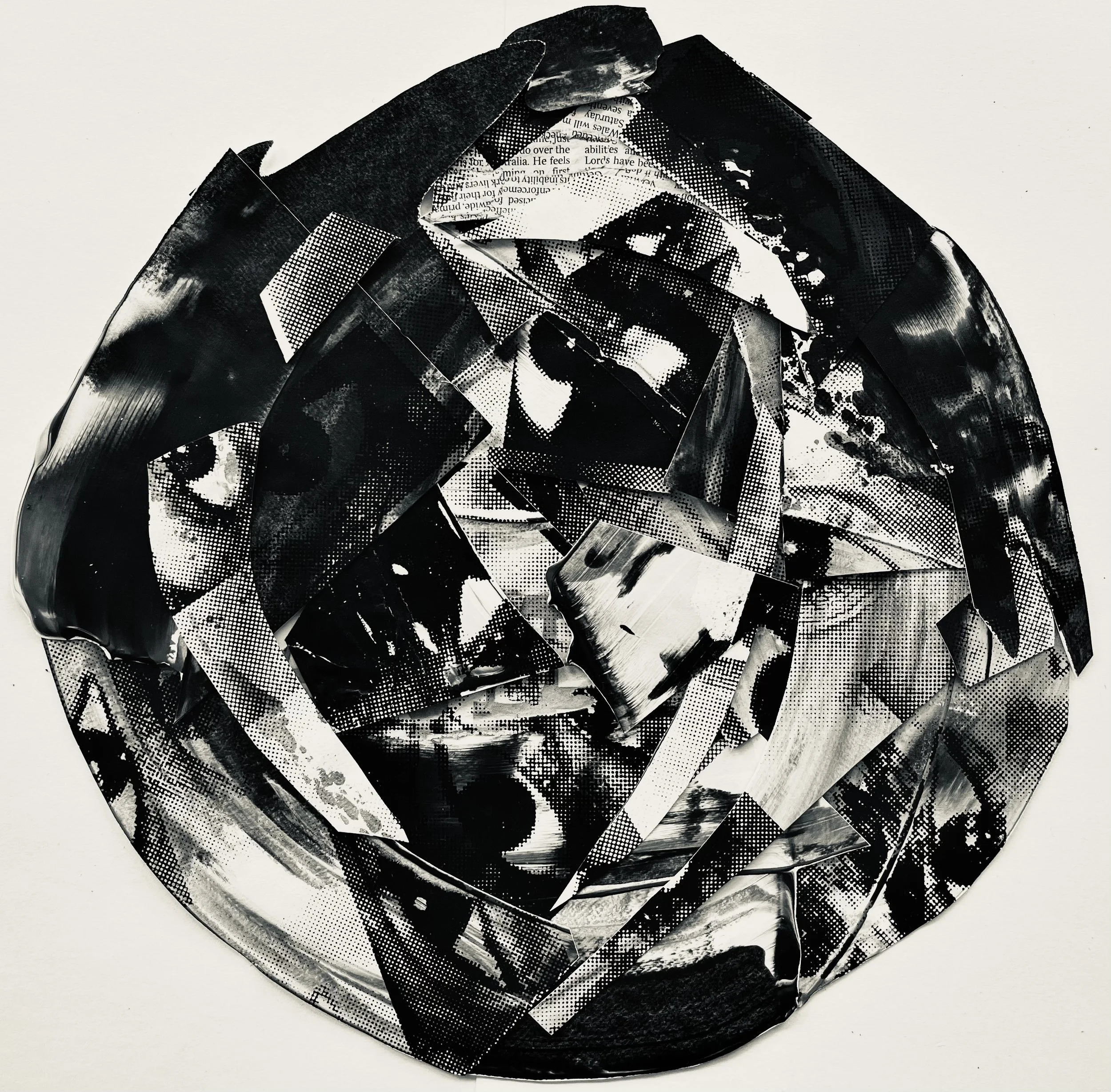
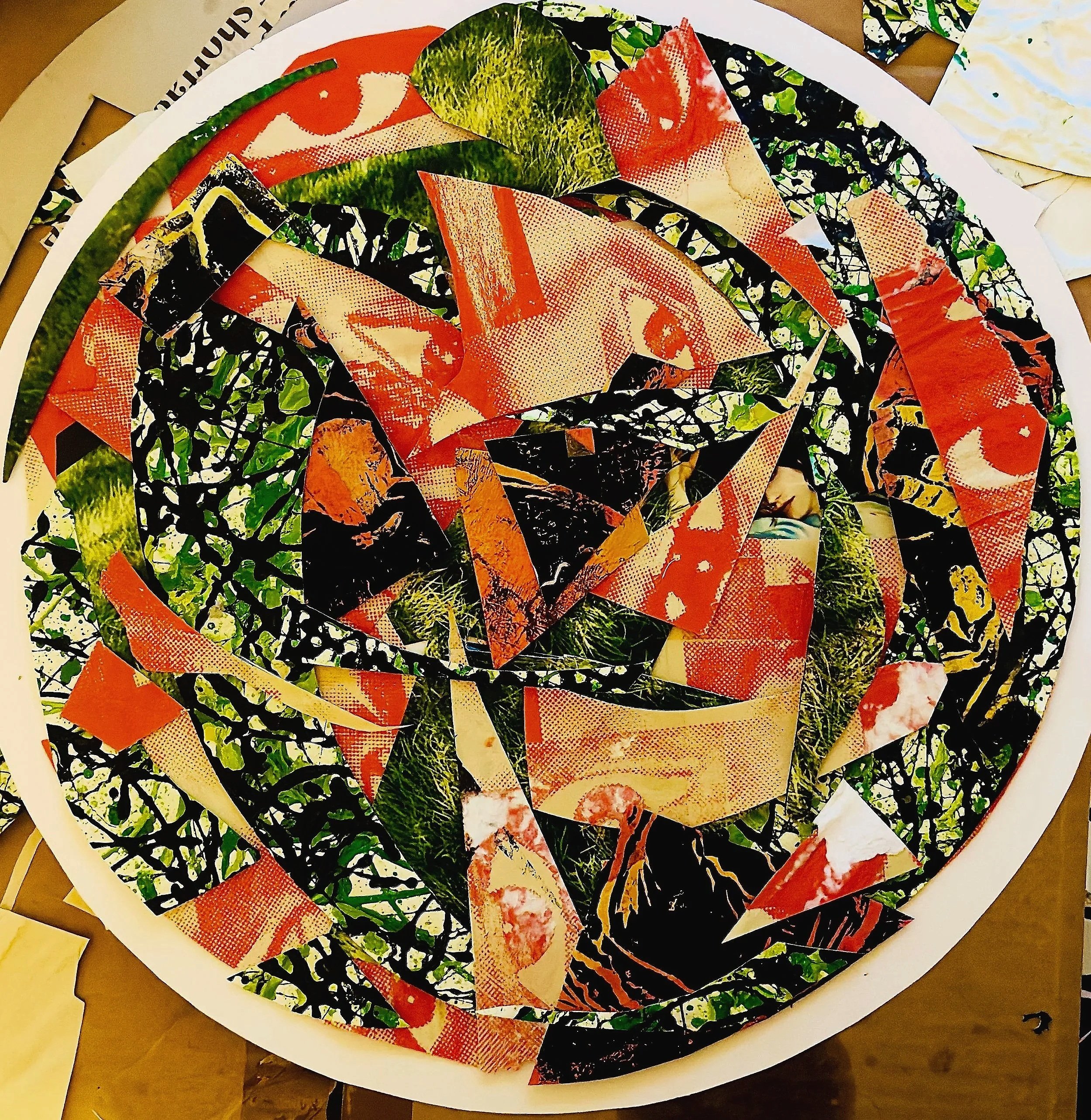
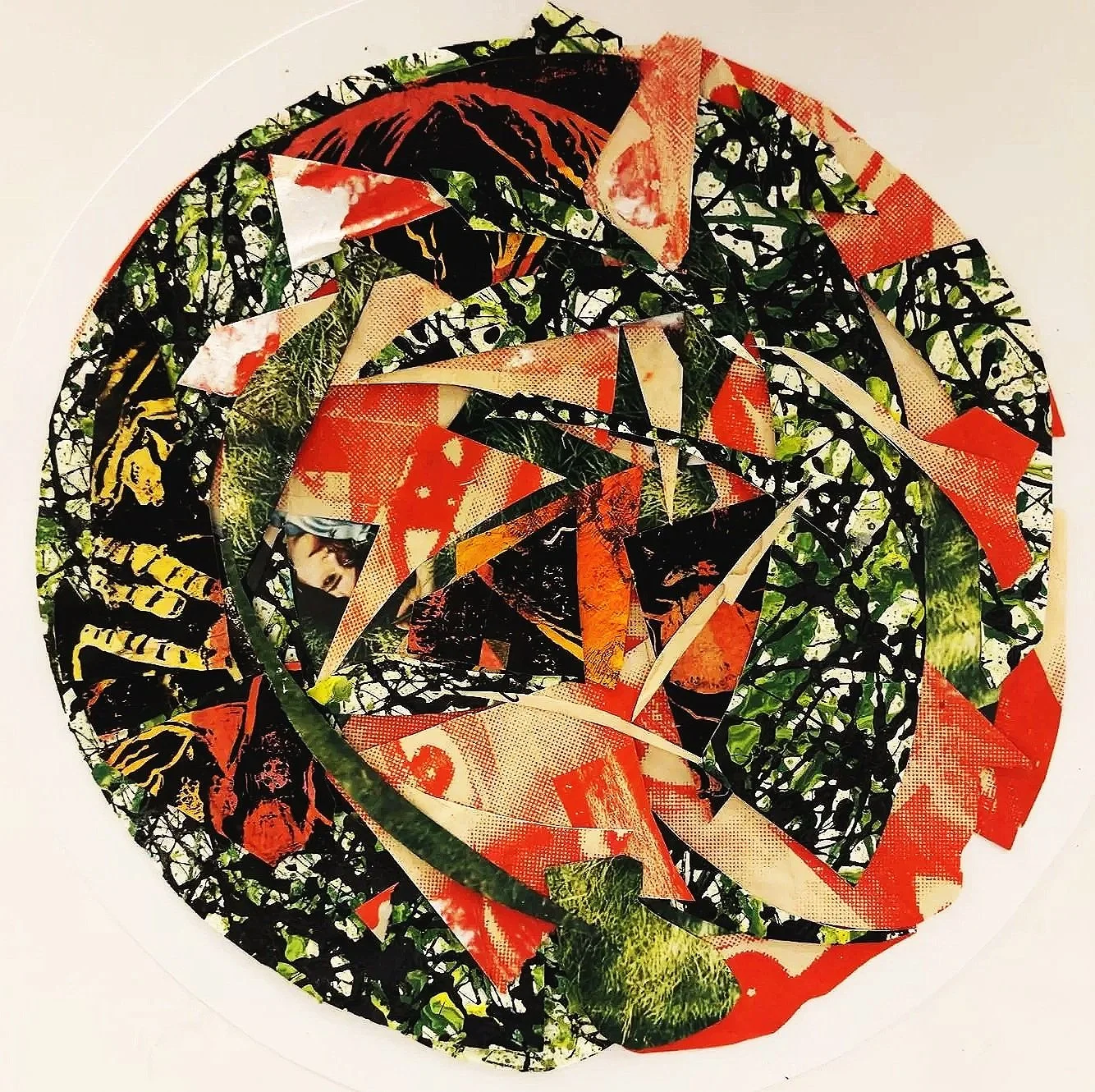
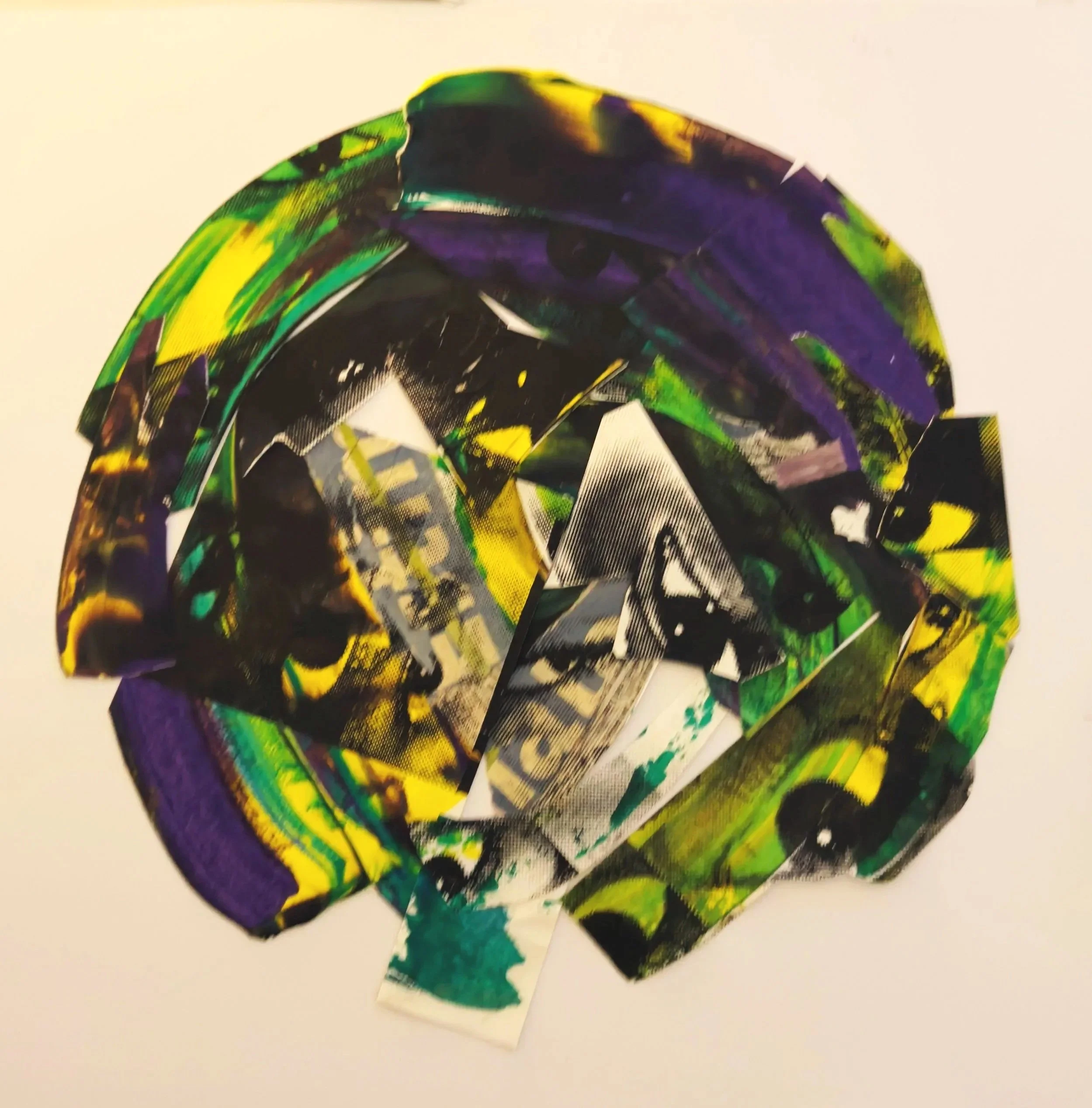
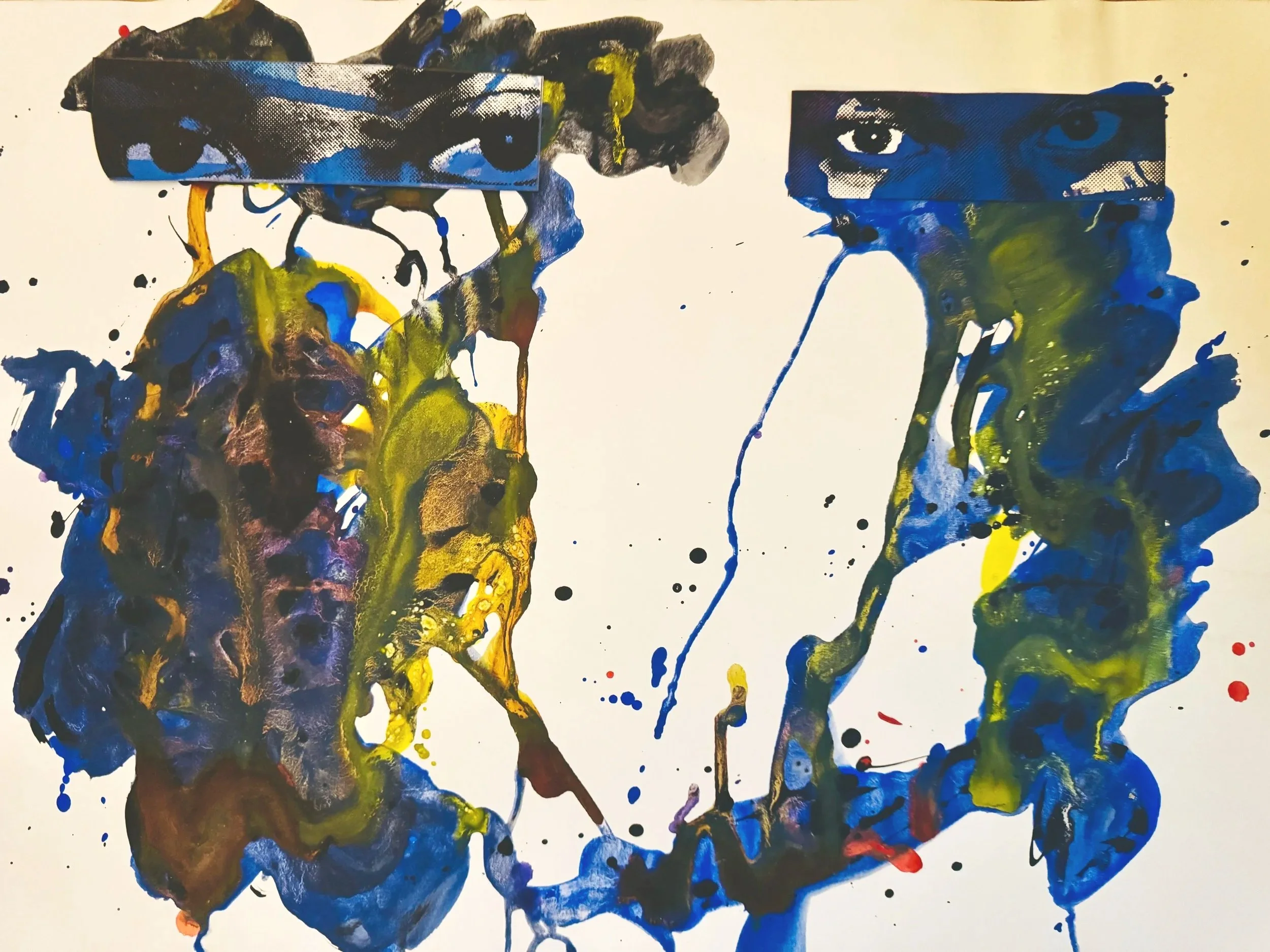
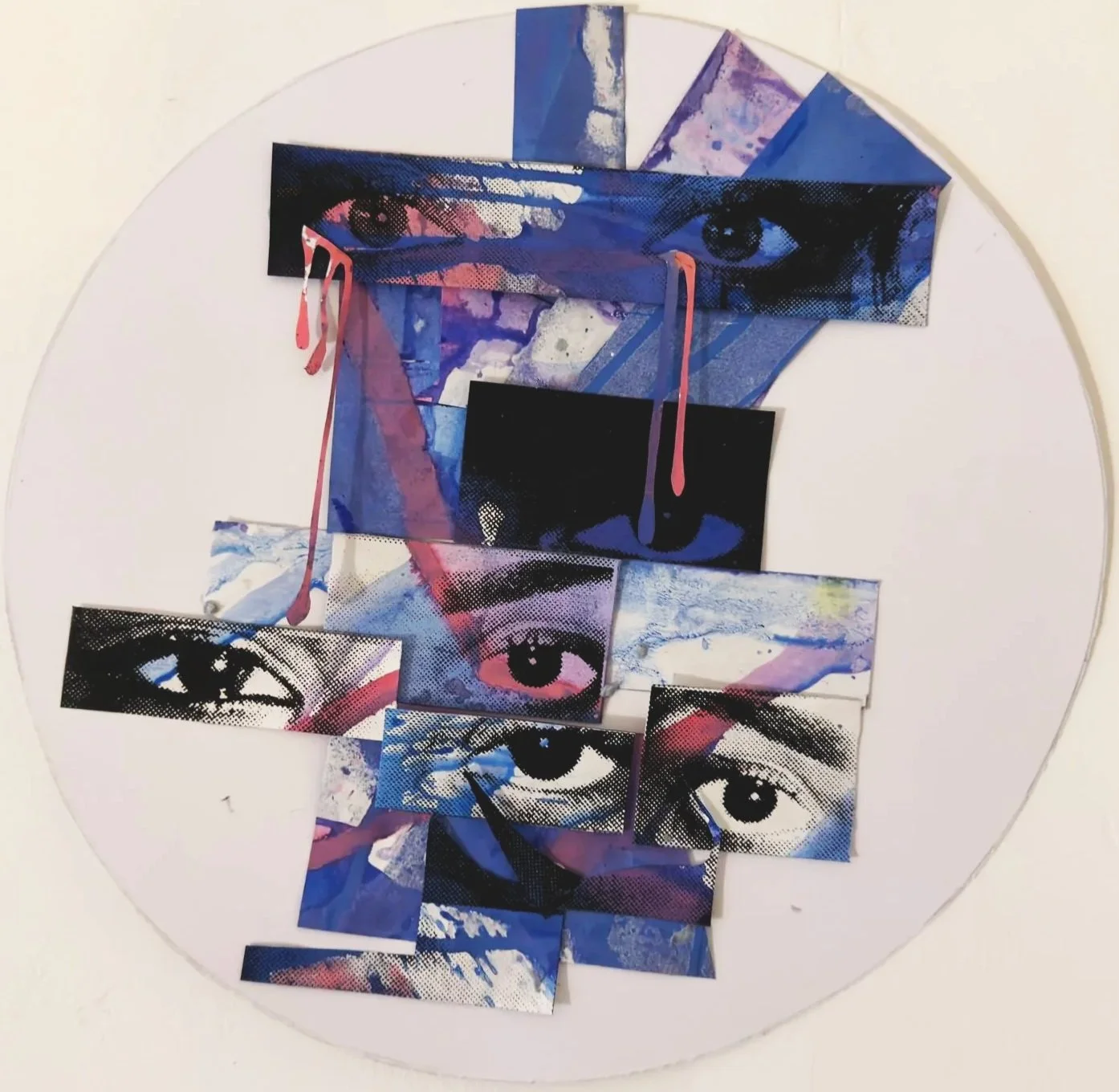
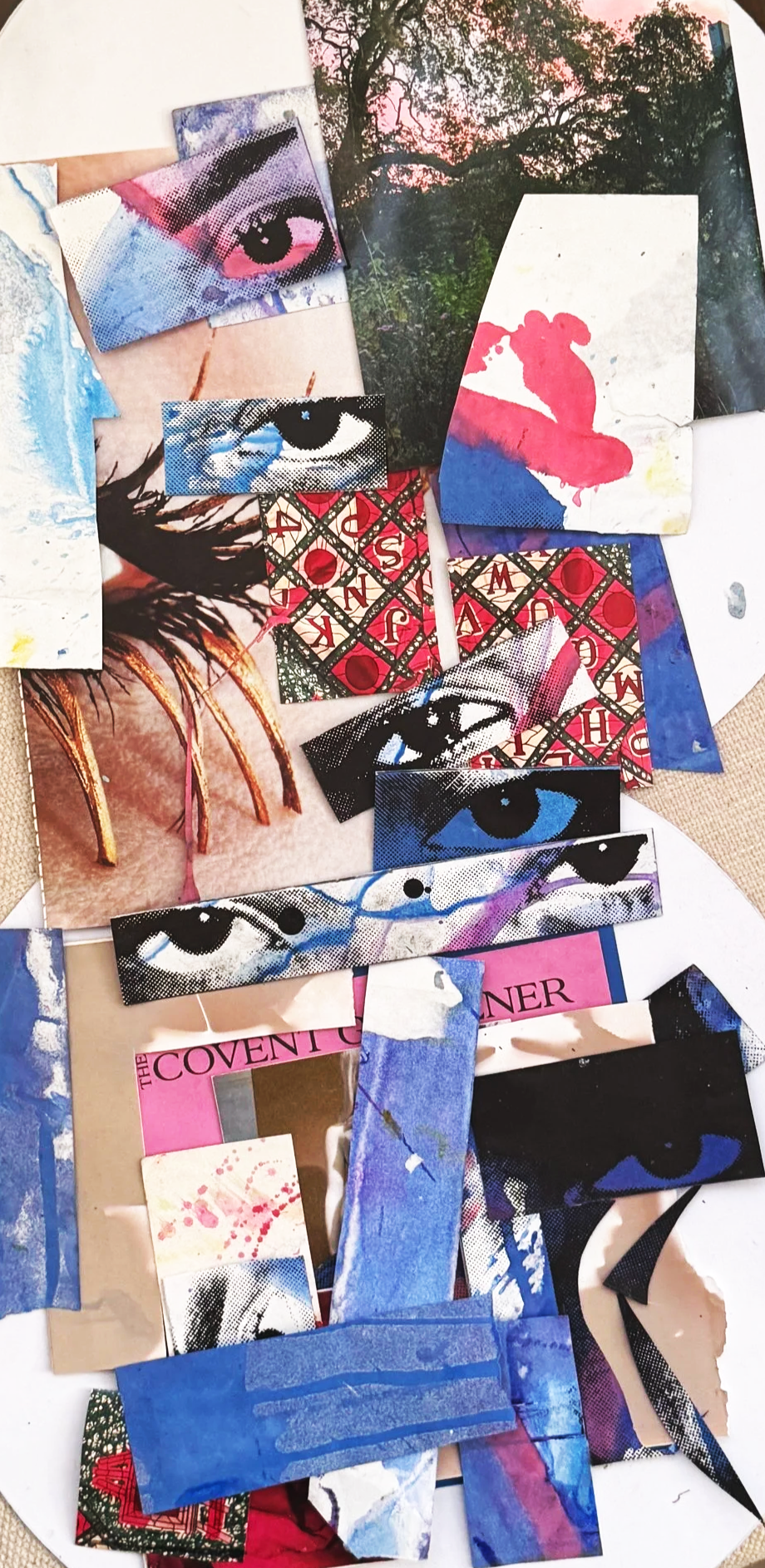
This piece is grounded in the Look, a concept from the French philosopher Jean-Paul Sartre, describing the moment another person's gaze turns you from a subject into an object. Sartre saw shame as the natural response to that shift — being looked at is what makes you feel exposed, categorised and held in place by someone else's judgement. I became interested in how that feeling appears in public life: the guilt attached to taking time away from work, claiming support when it is needed, or the pressure to appear productive even when struggling. These experiences shape behaviour but are difficult to measure. I wanted to explore whether collage could make them visible in a different way.

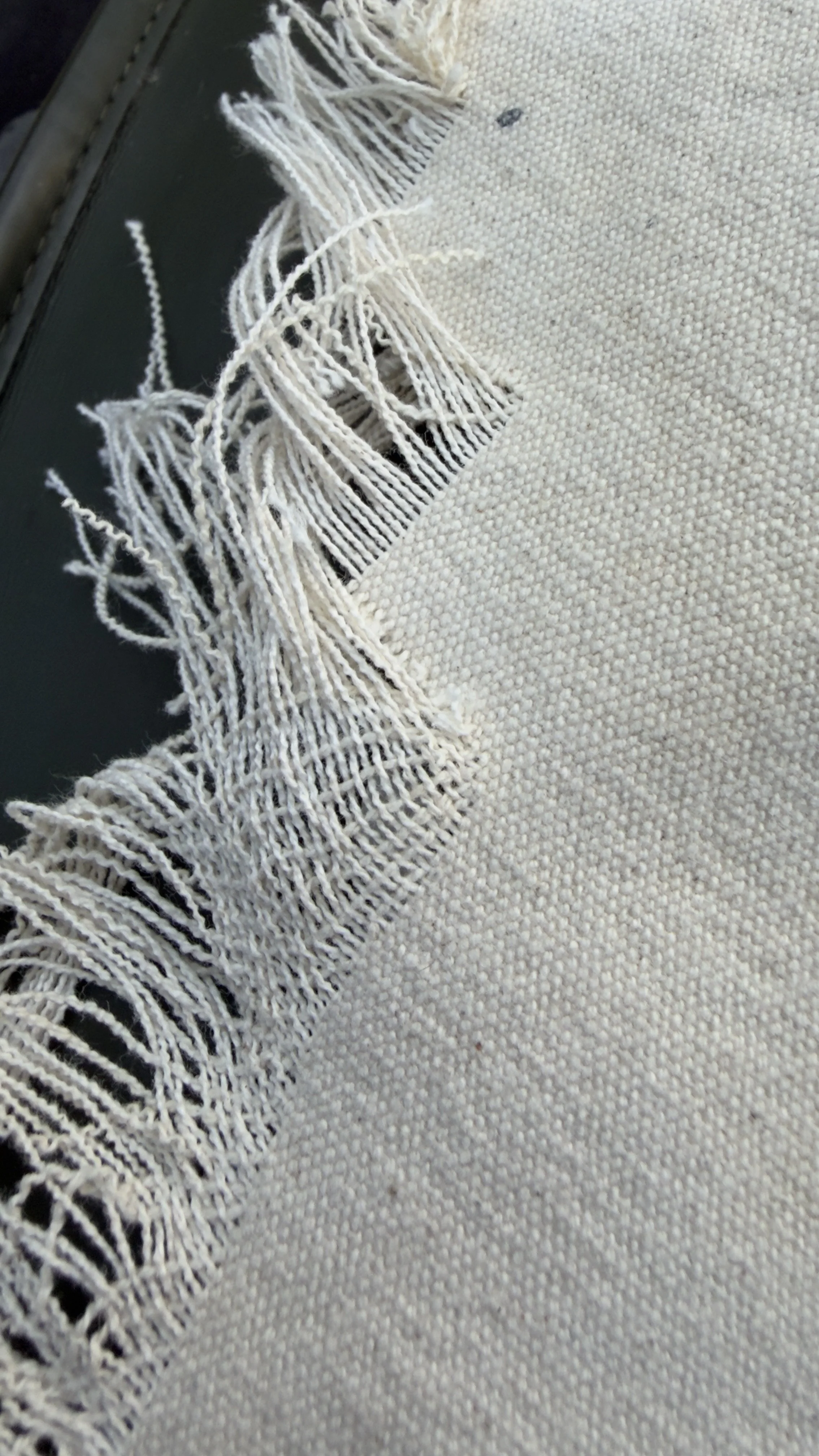
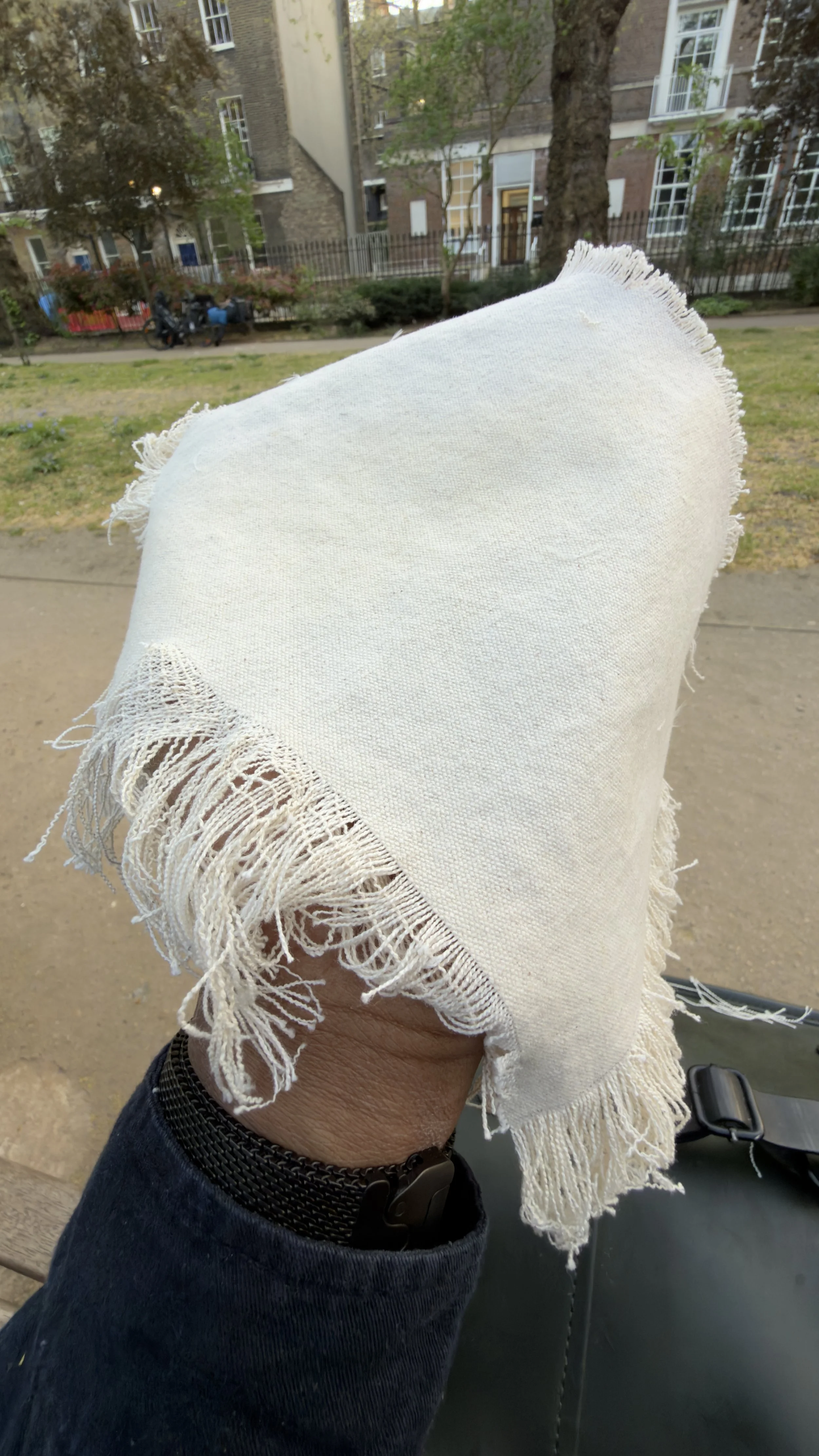
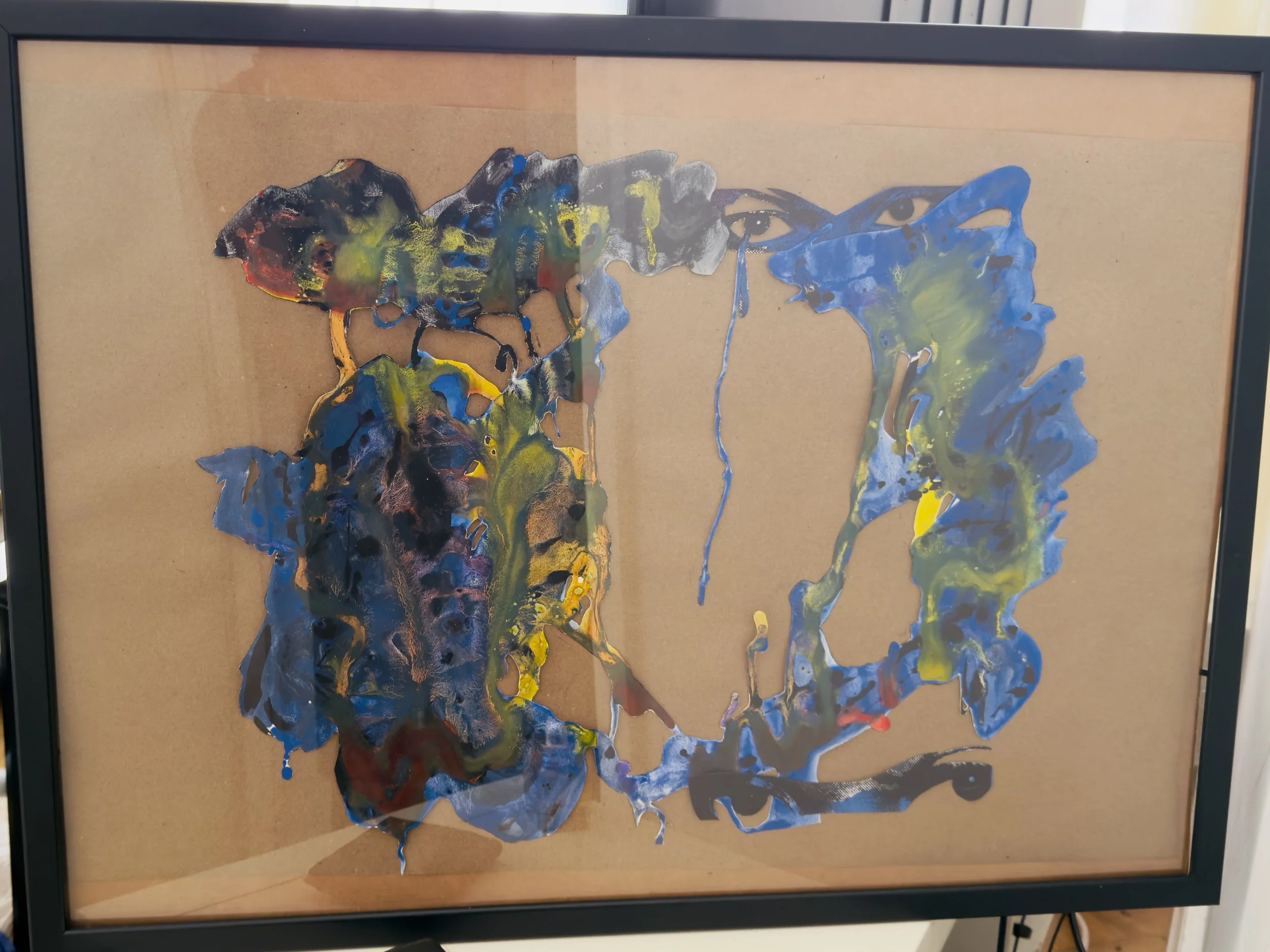
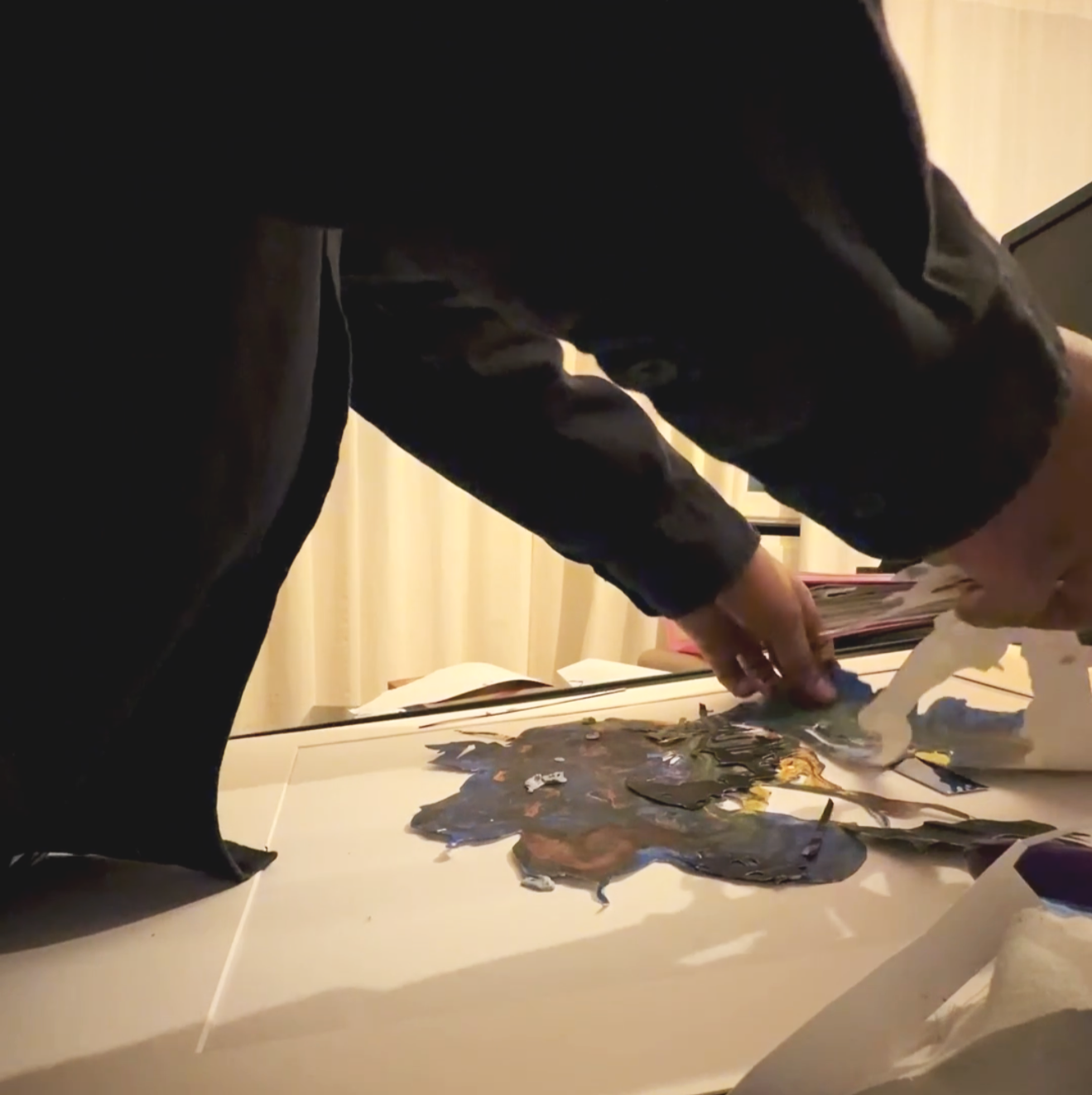
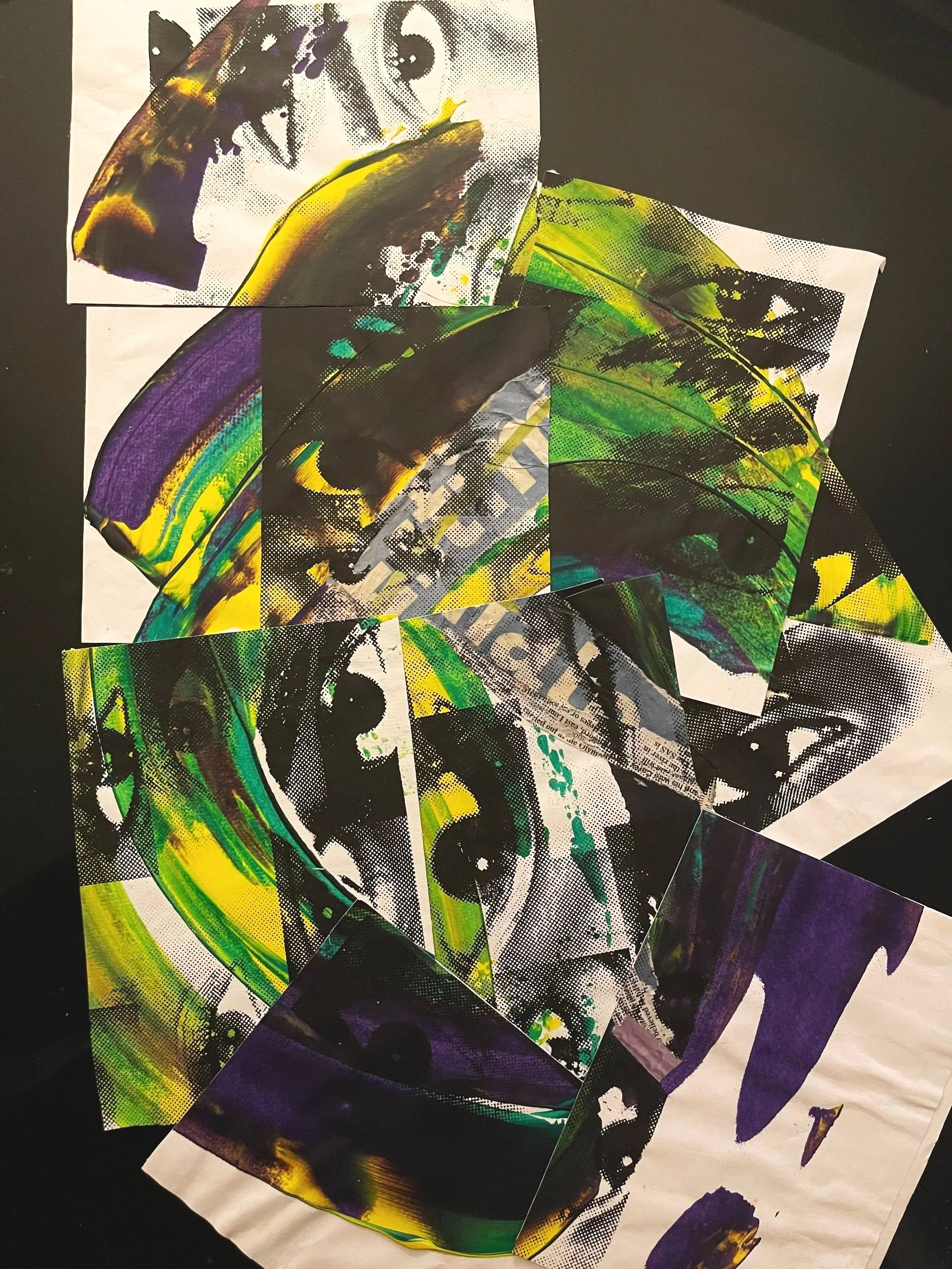
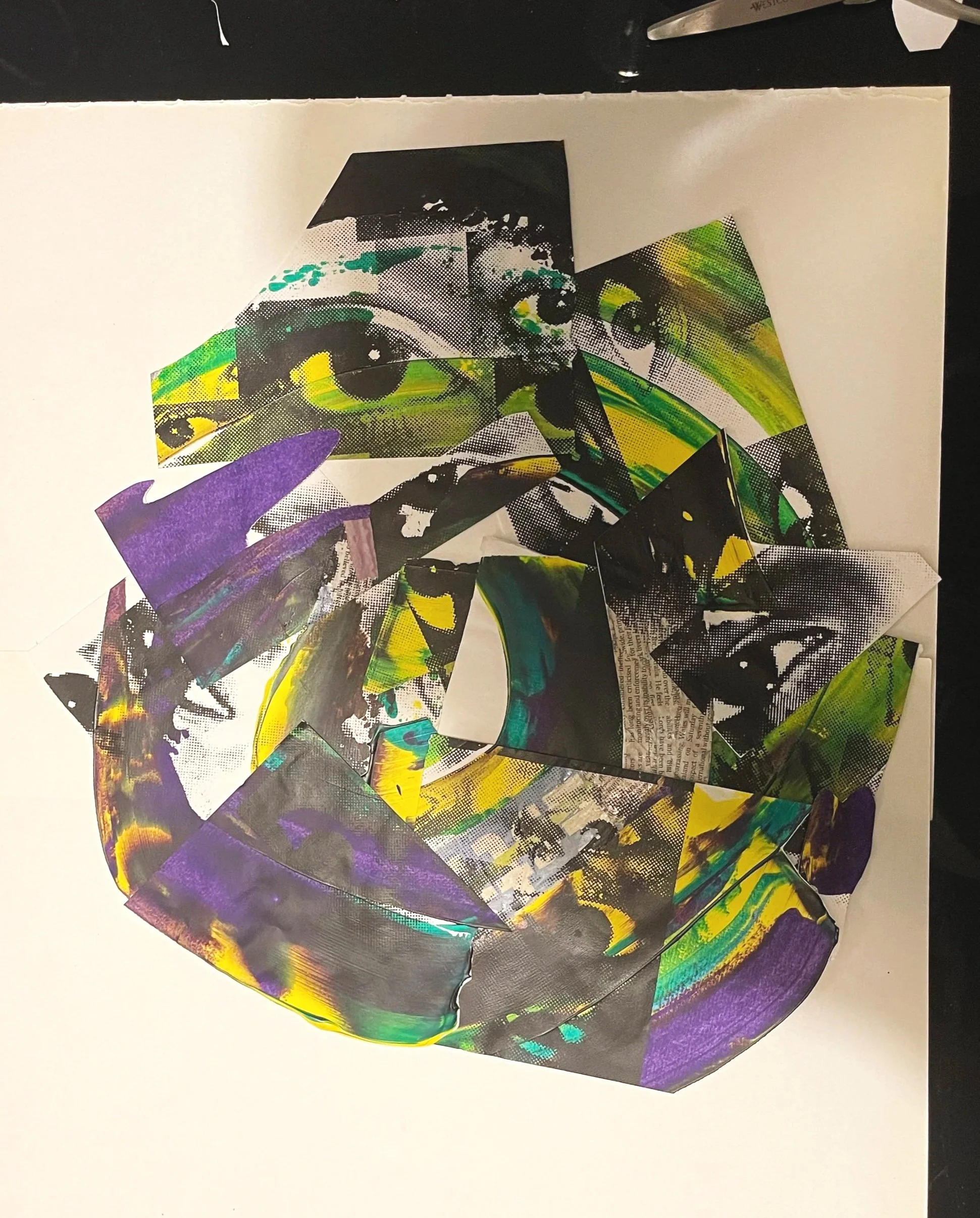
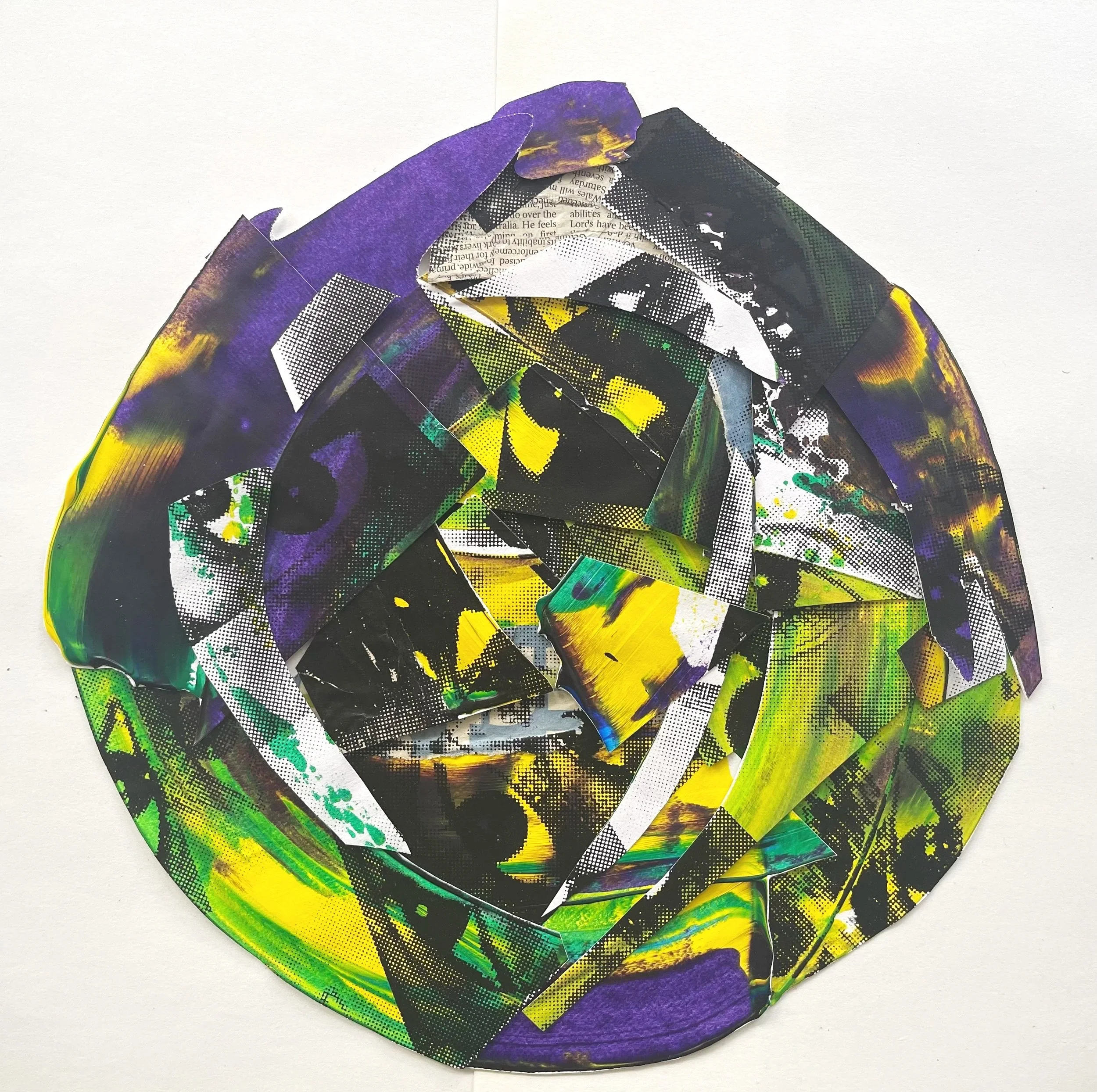
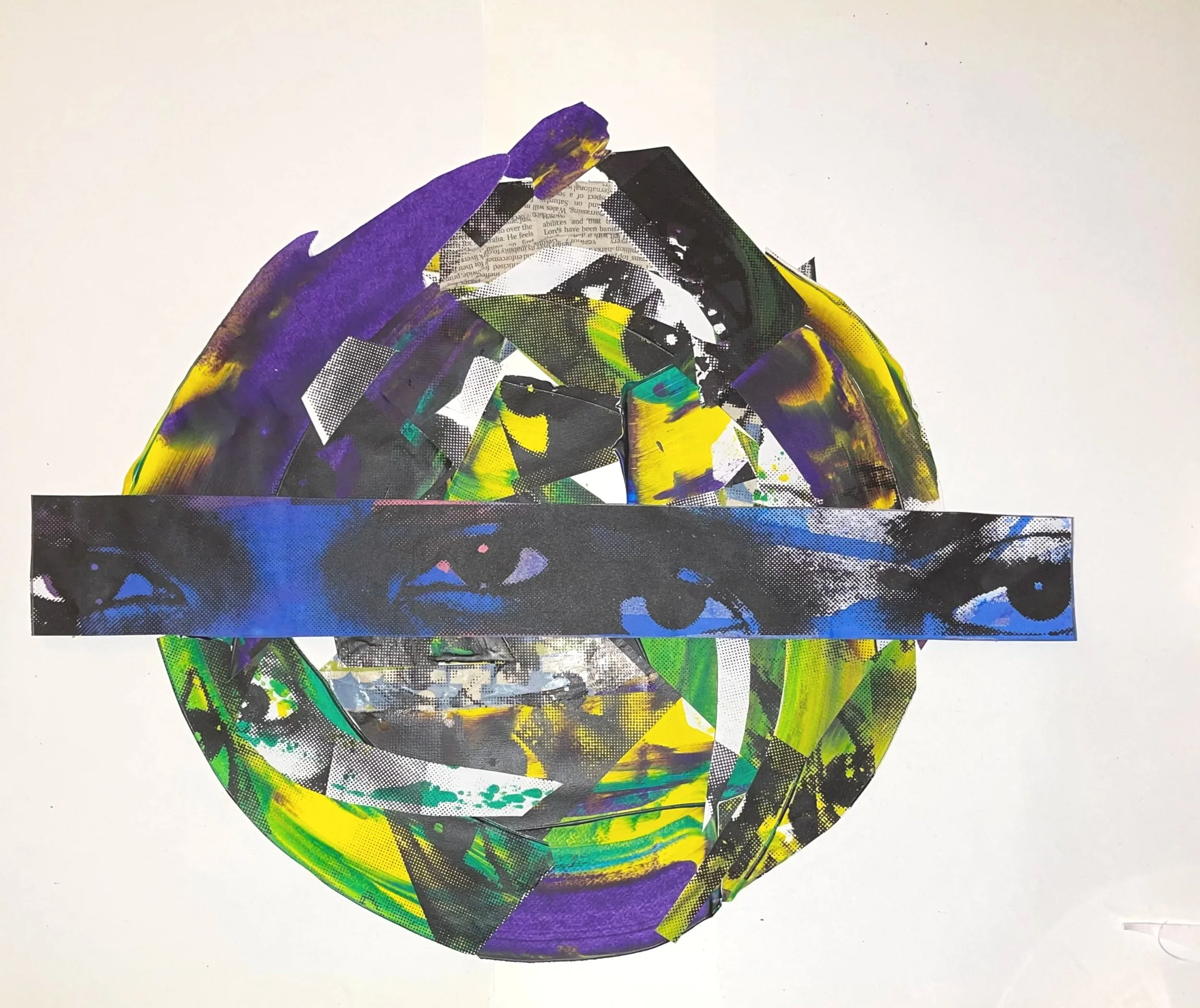
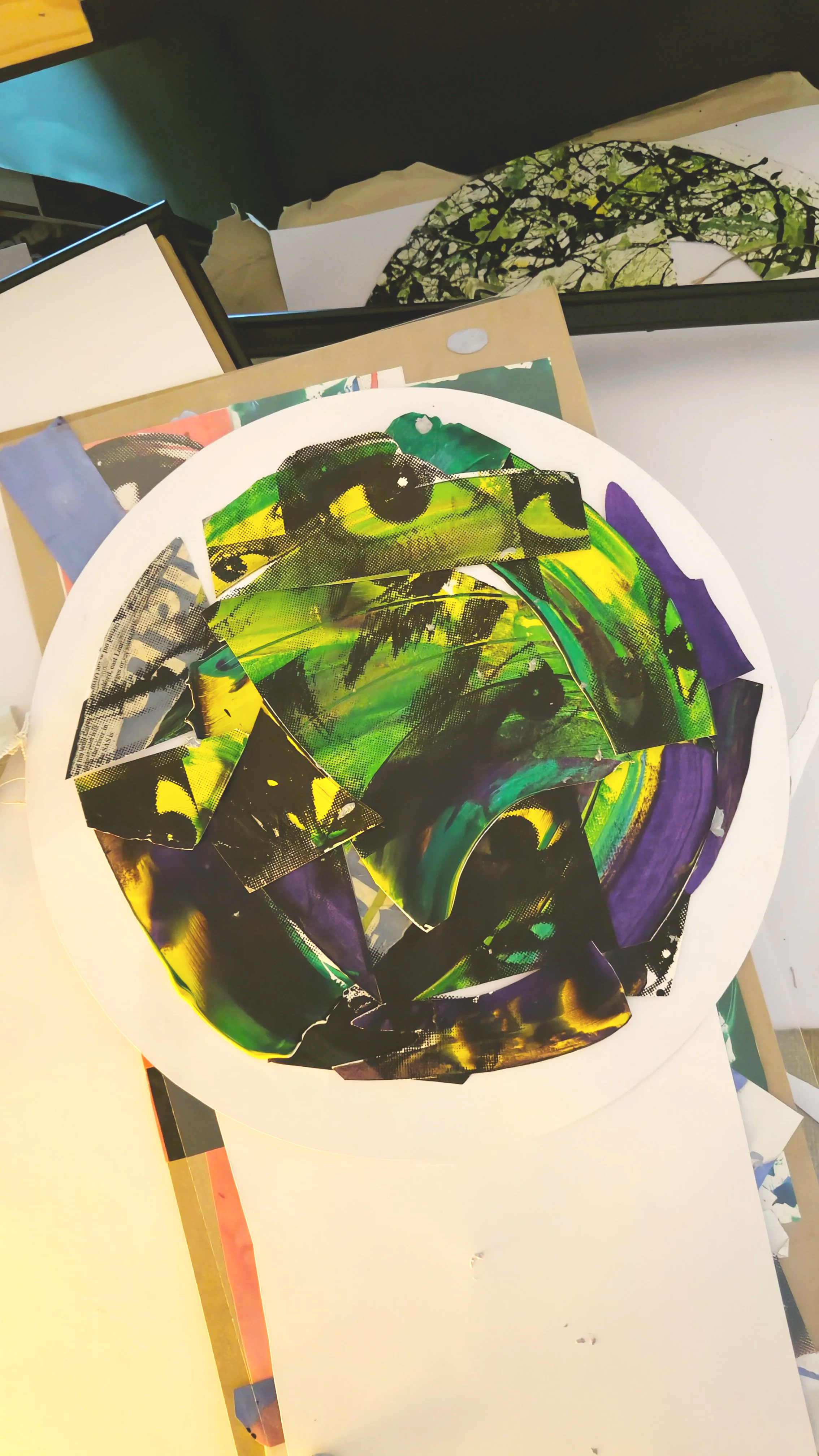
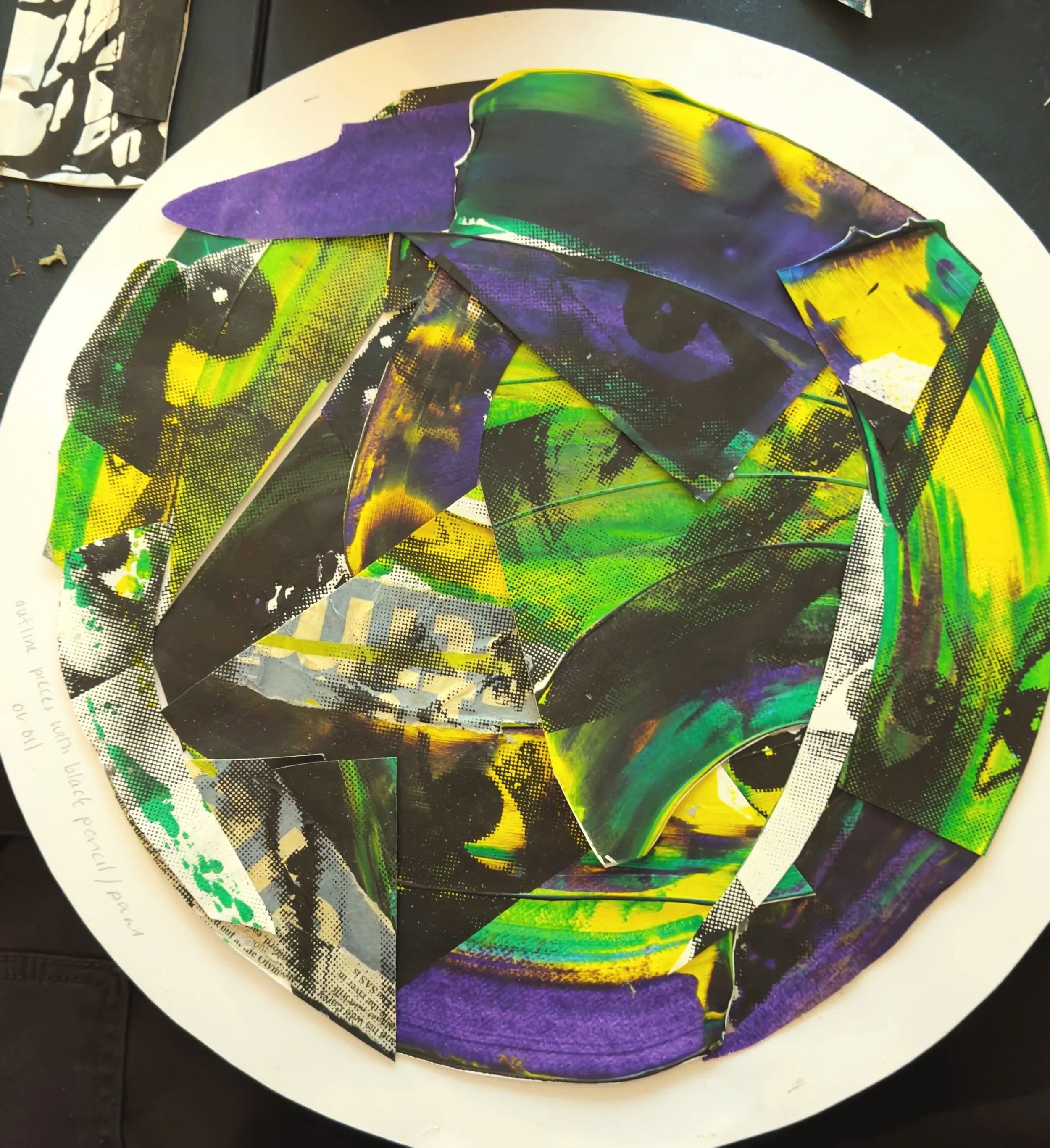
The work evolved through several versions before resolving. It began as an ink painting with a single pair of eyes before expanding into multiple compositions. Eventually I cut away most of the original surface, allowing the remaining fragments to fall into a loose cascade. Rather than building the image through addition, it emerged through removal.

The composition still feels unresolved. I want to extend the visual journey beyond the current 50 × 70 cm format into architectural-scale work of up to 4 × 6 metres, allowing the viewer to physically move through the image rather than simply look at it. At that scale, the work shifts from something viewed at a distance to an environment that surrounds the viewer.

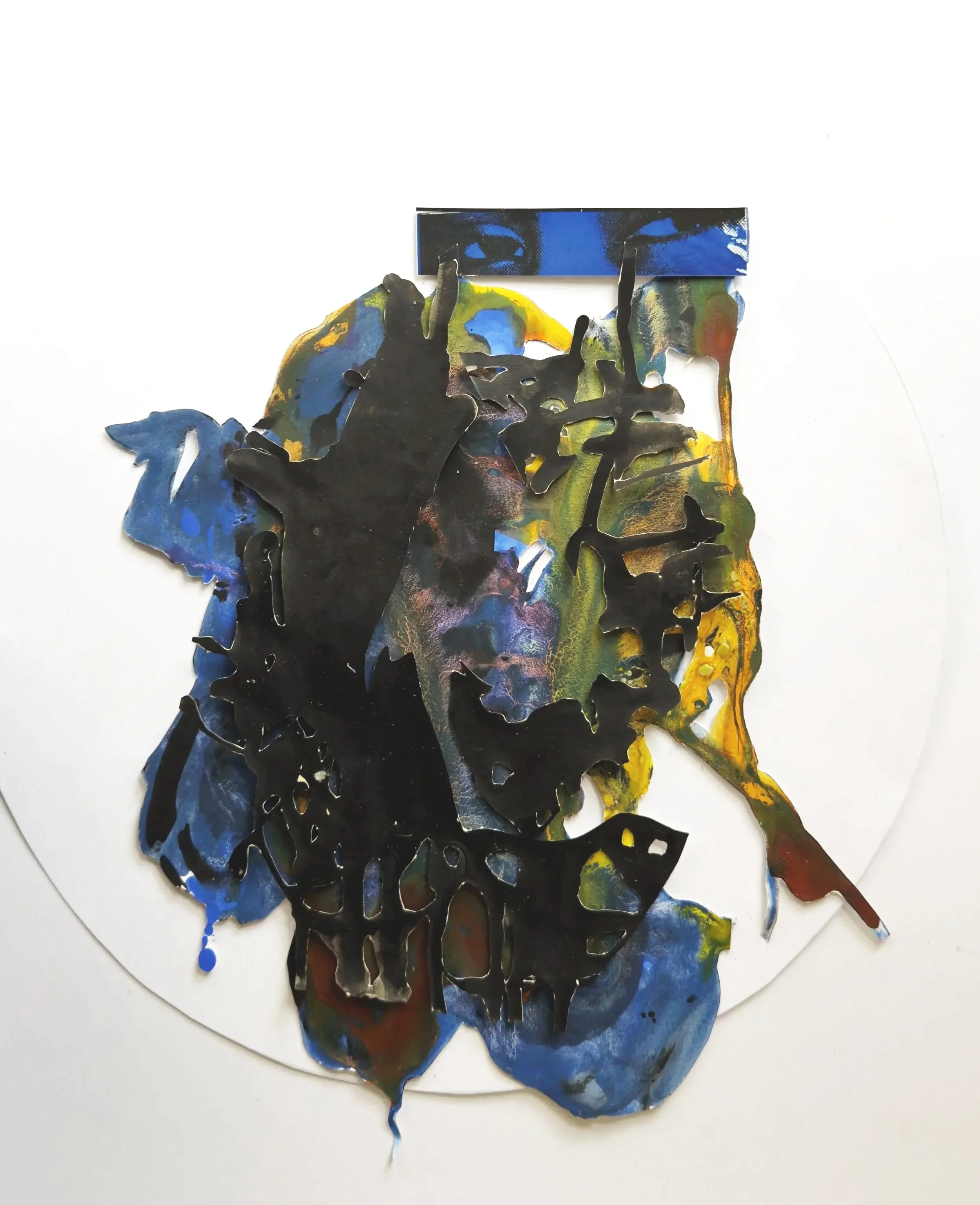
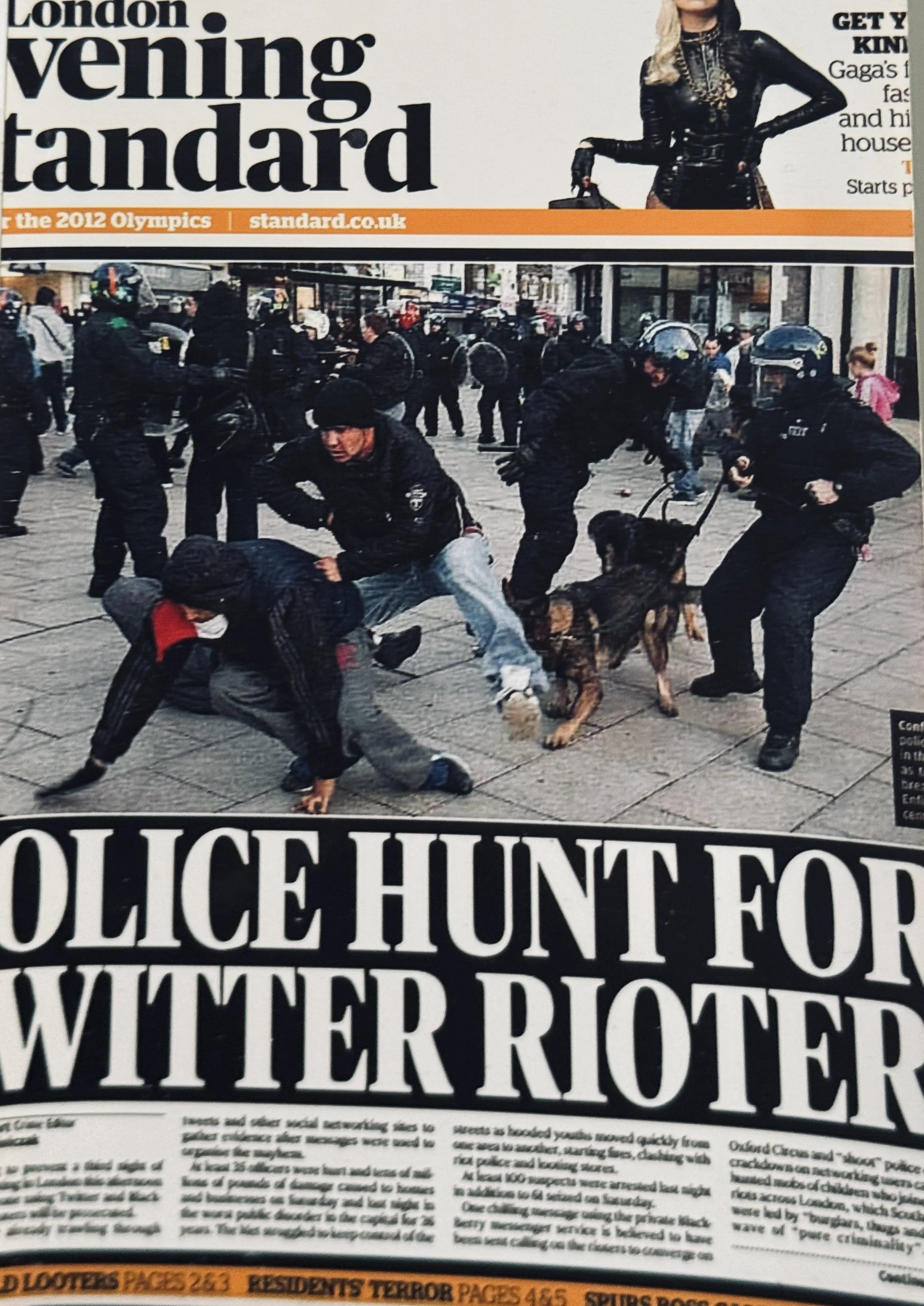
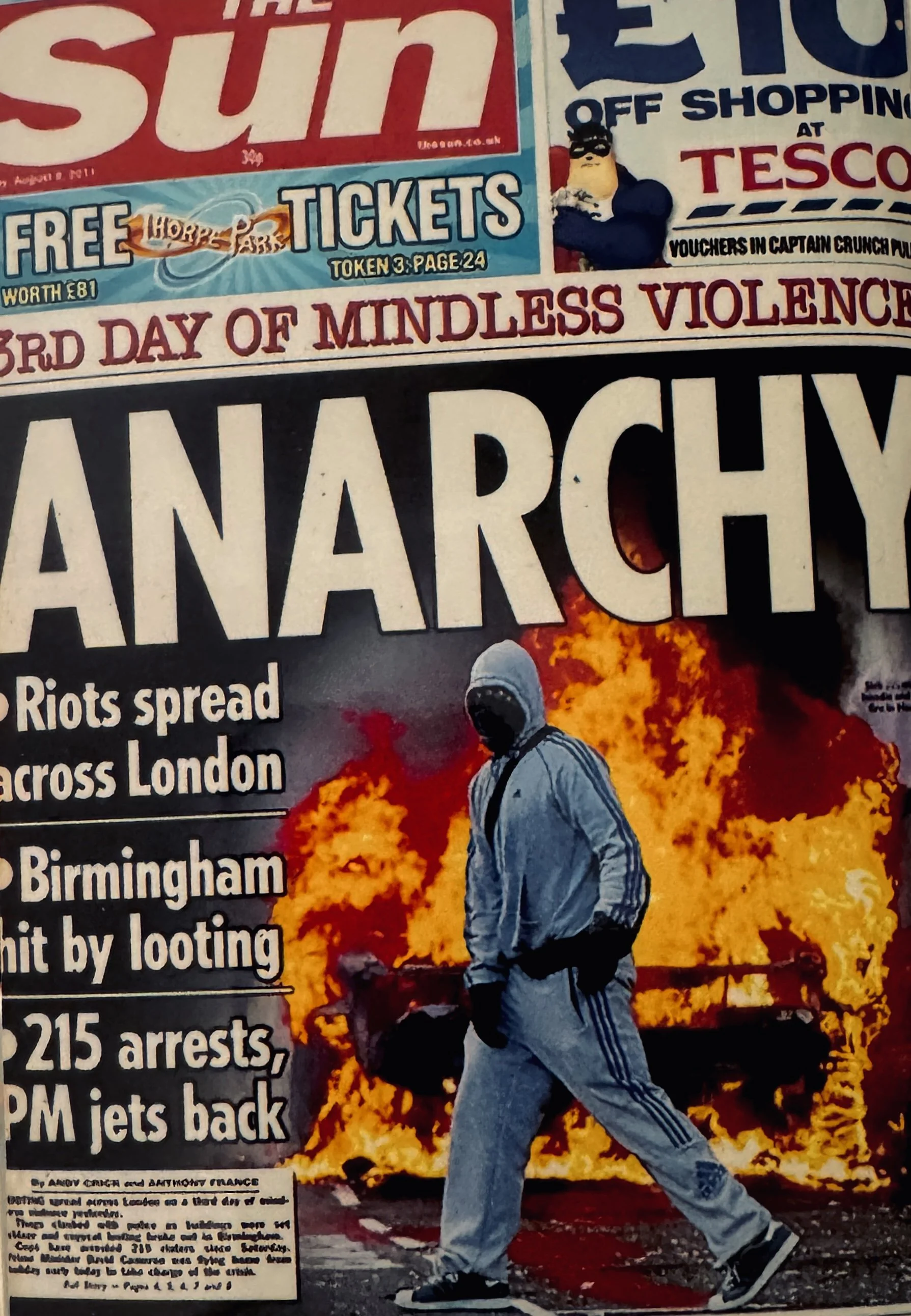
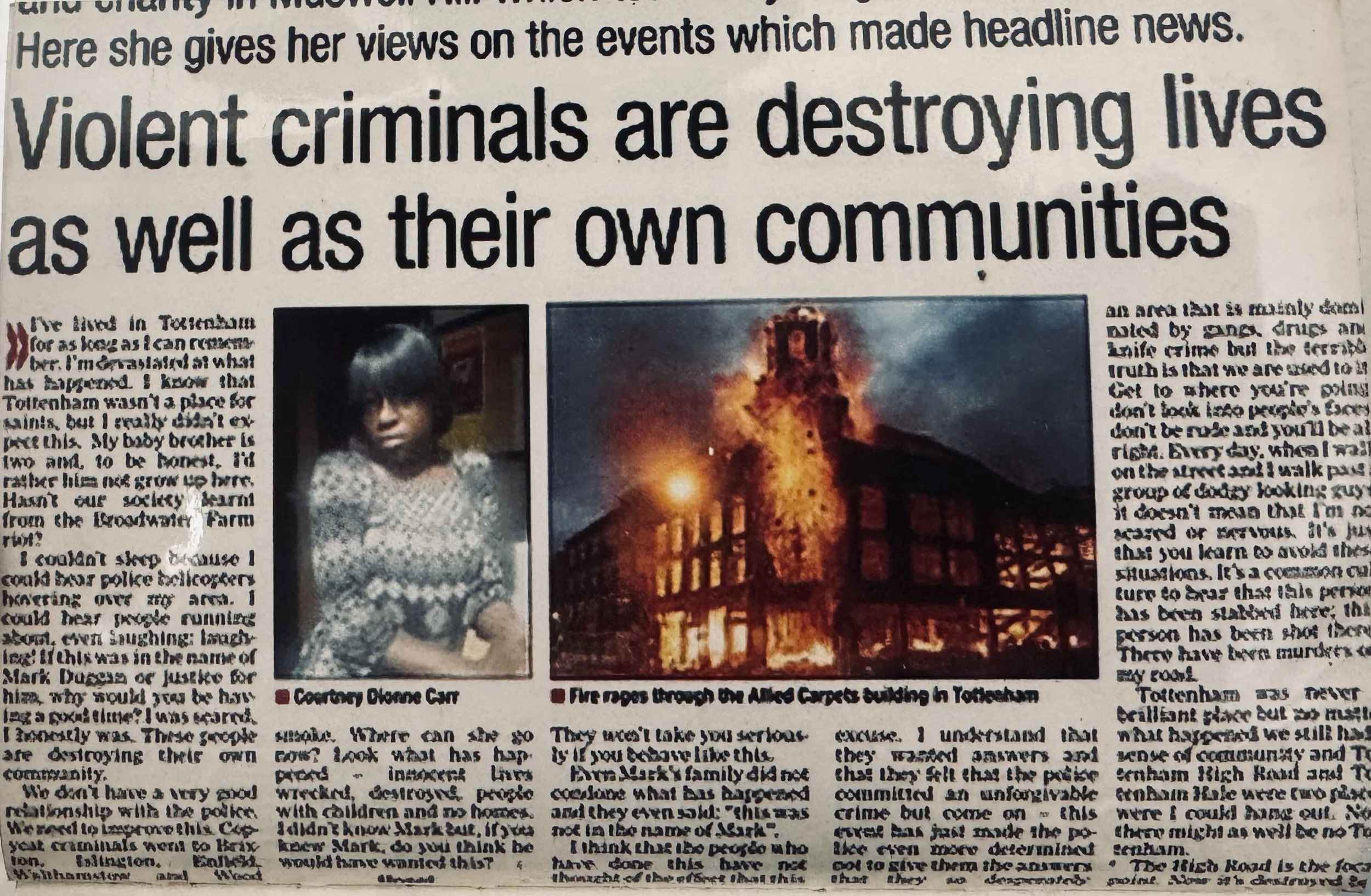
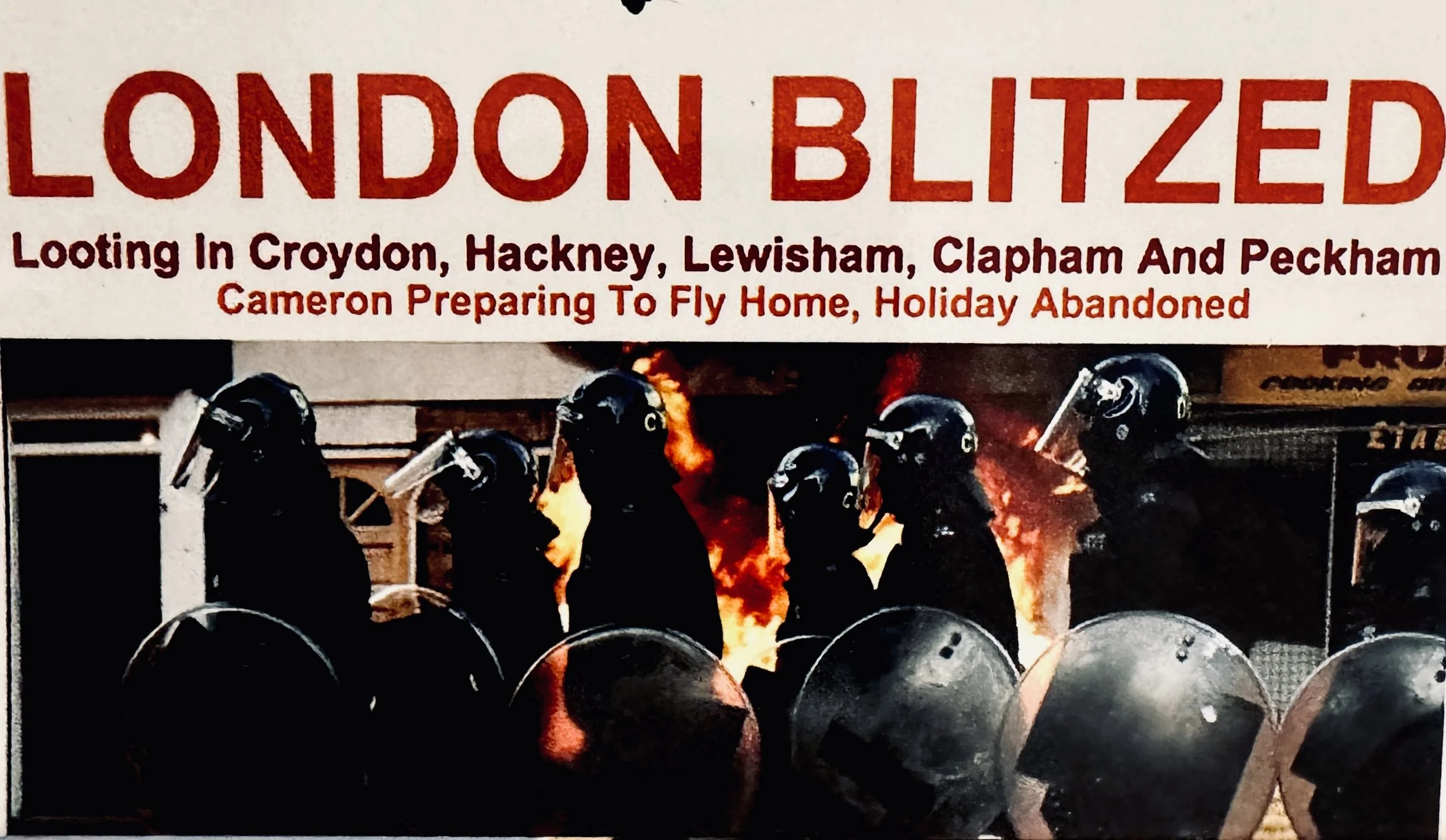
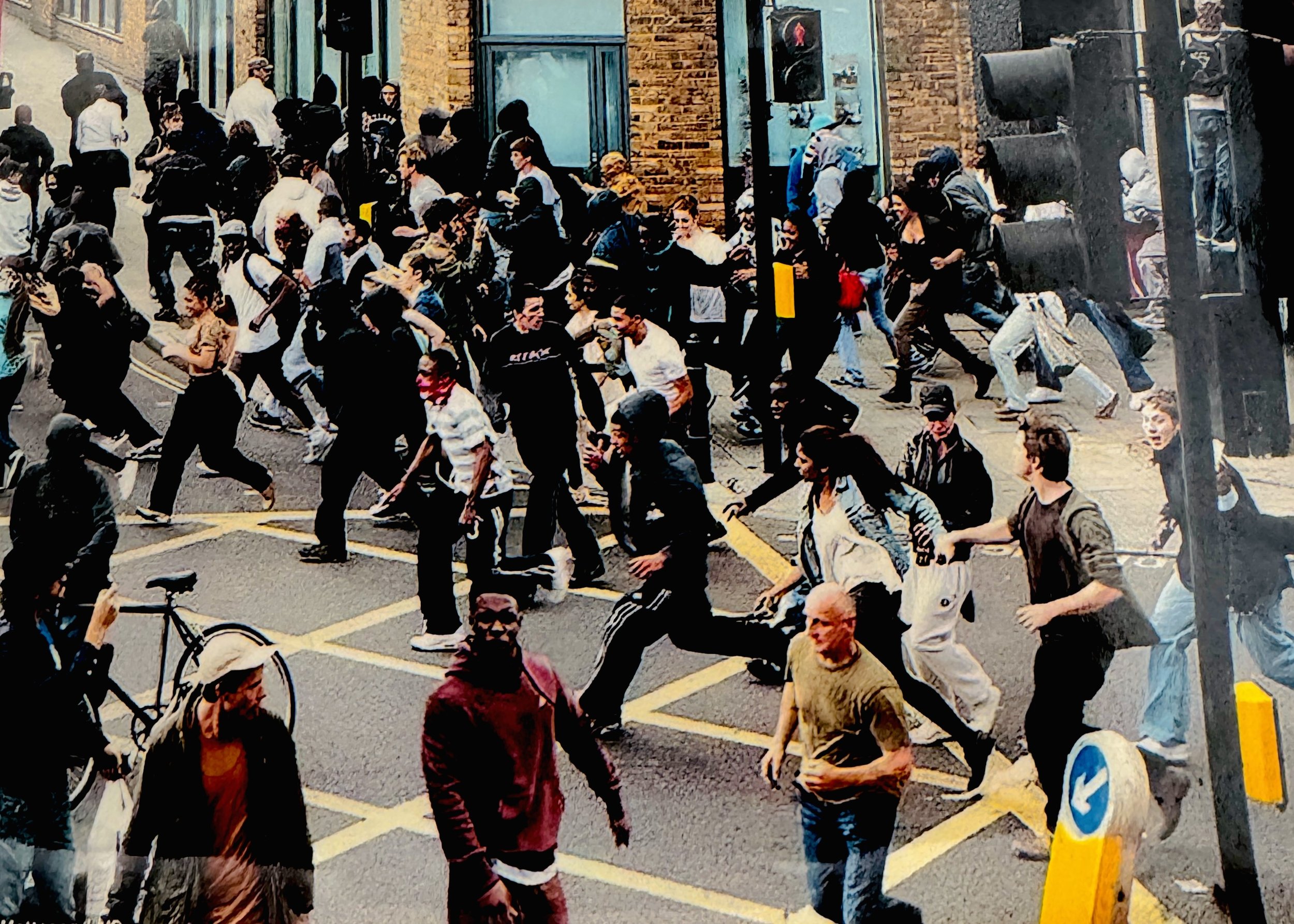
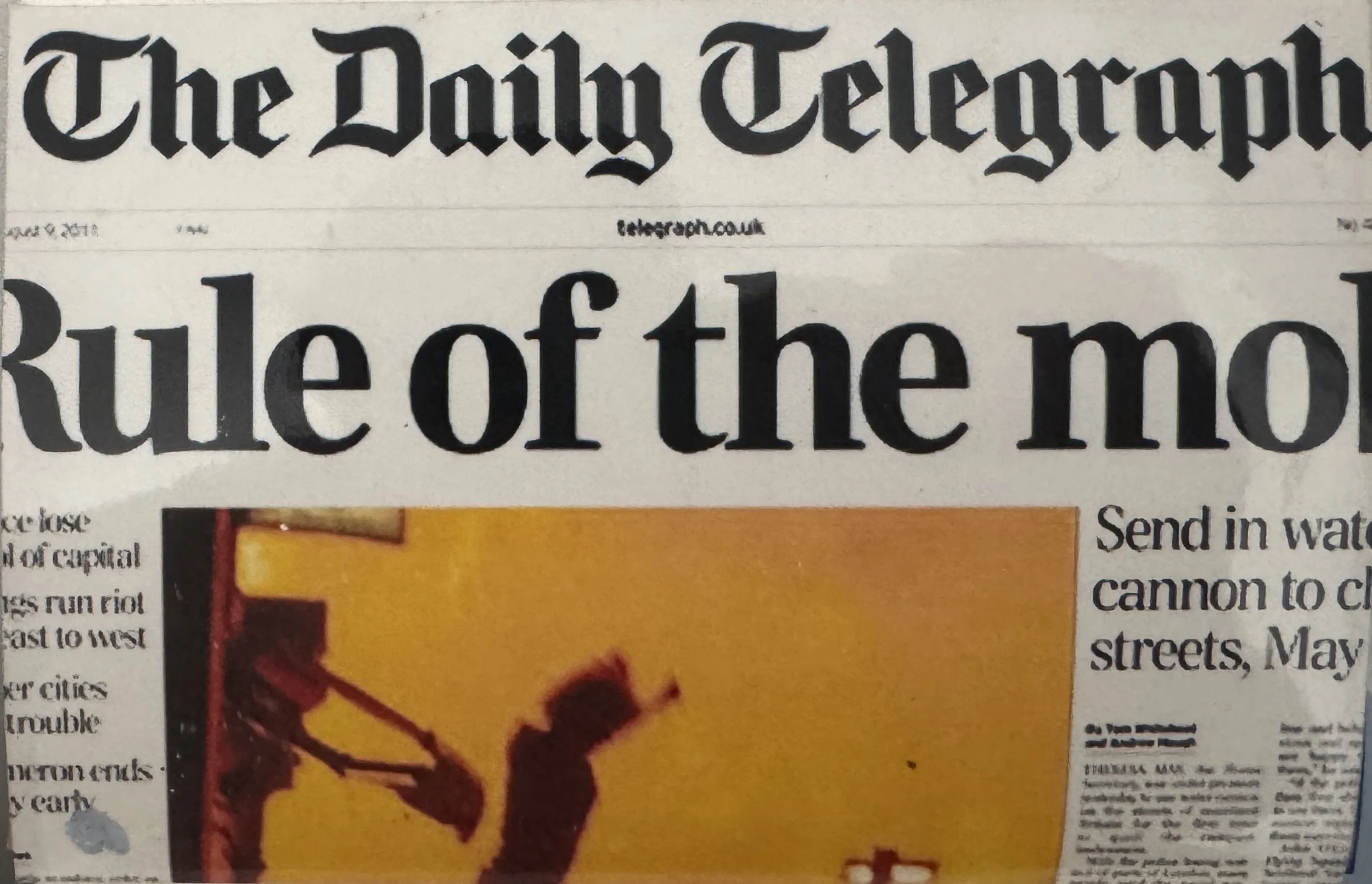
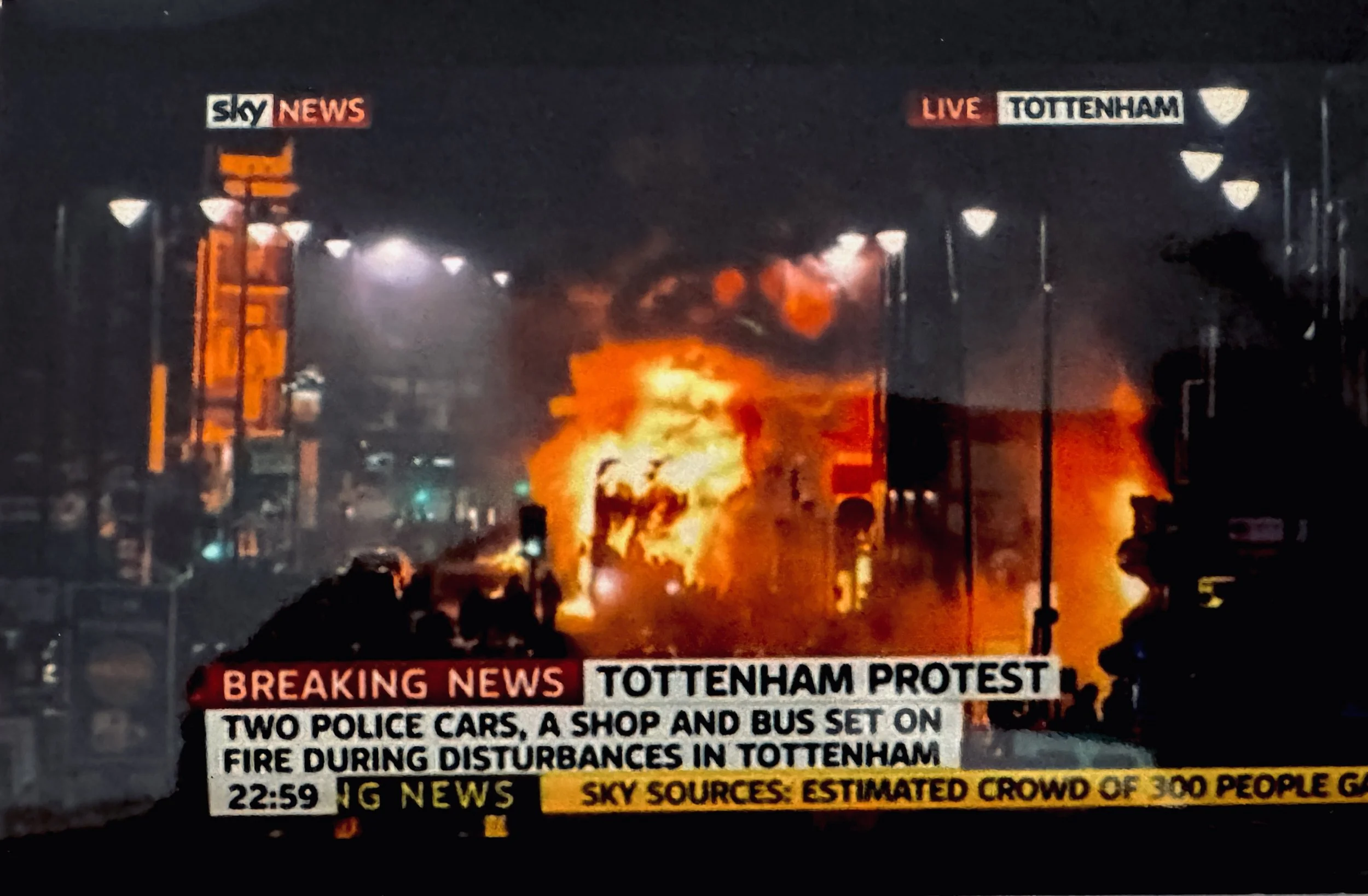
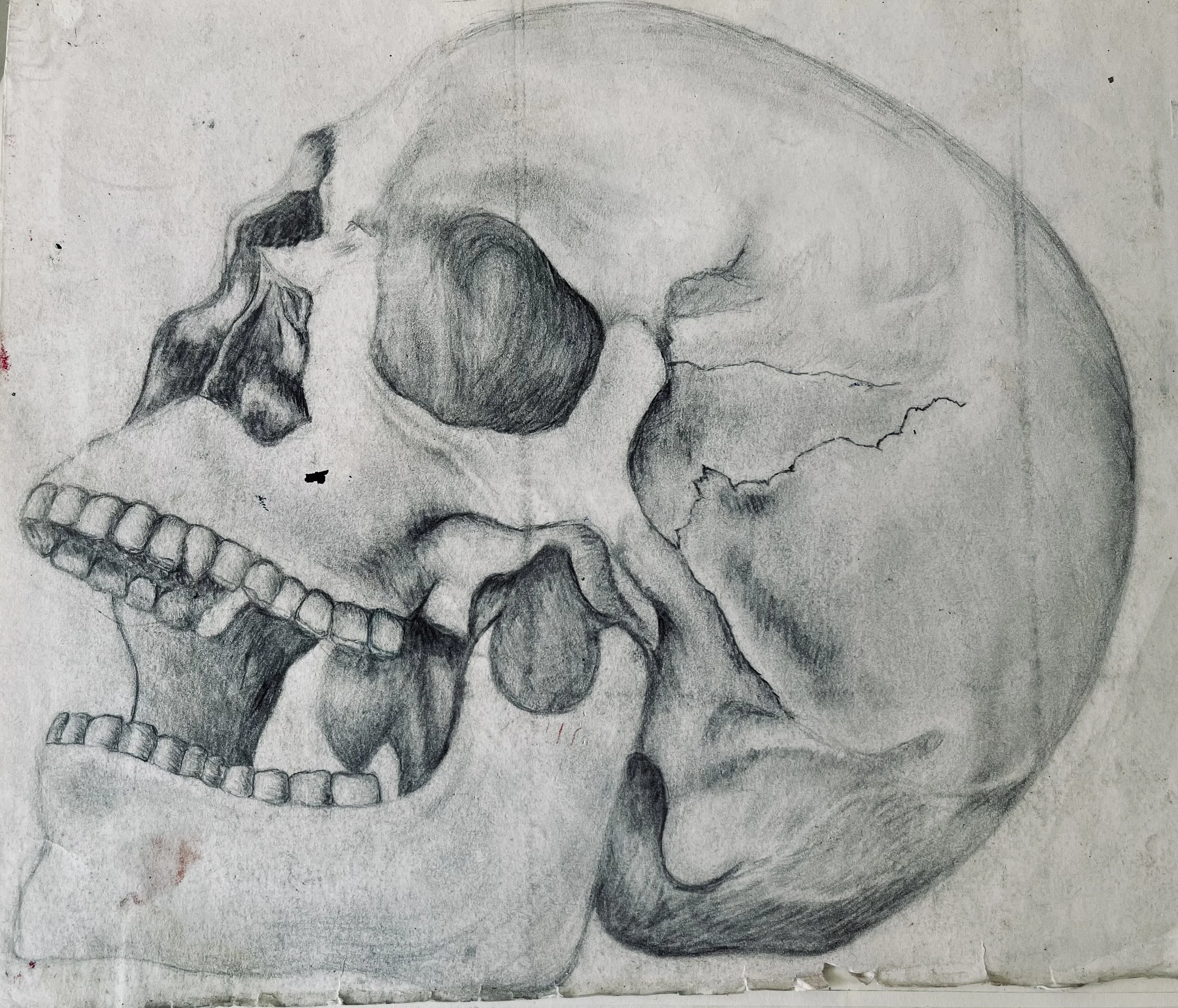
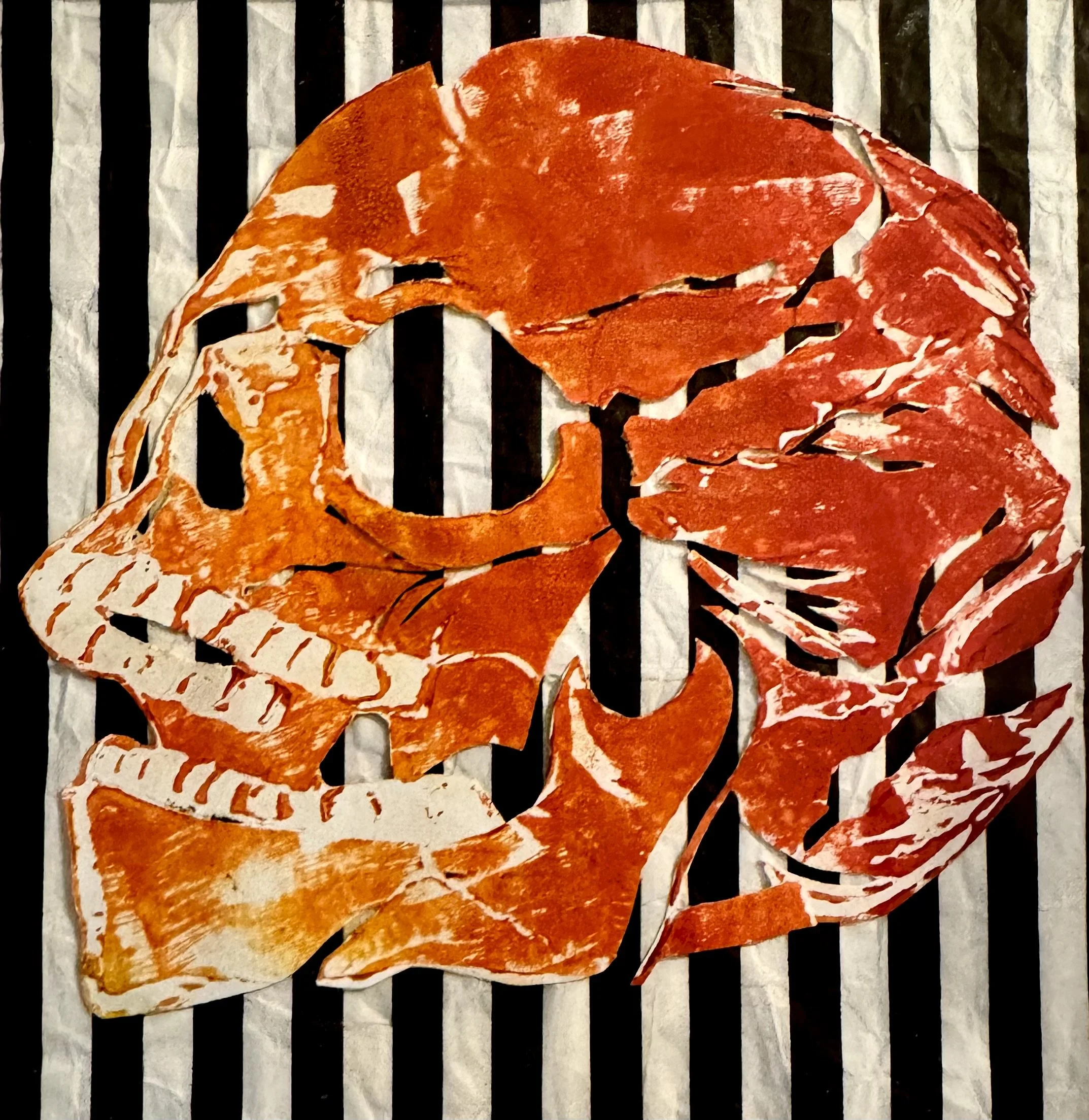
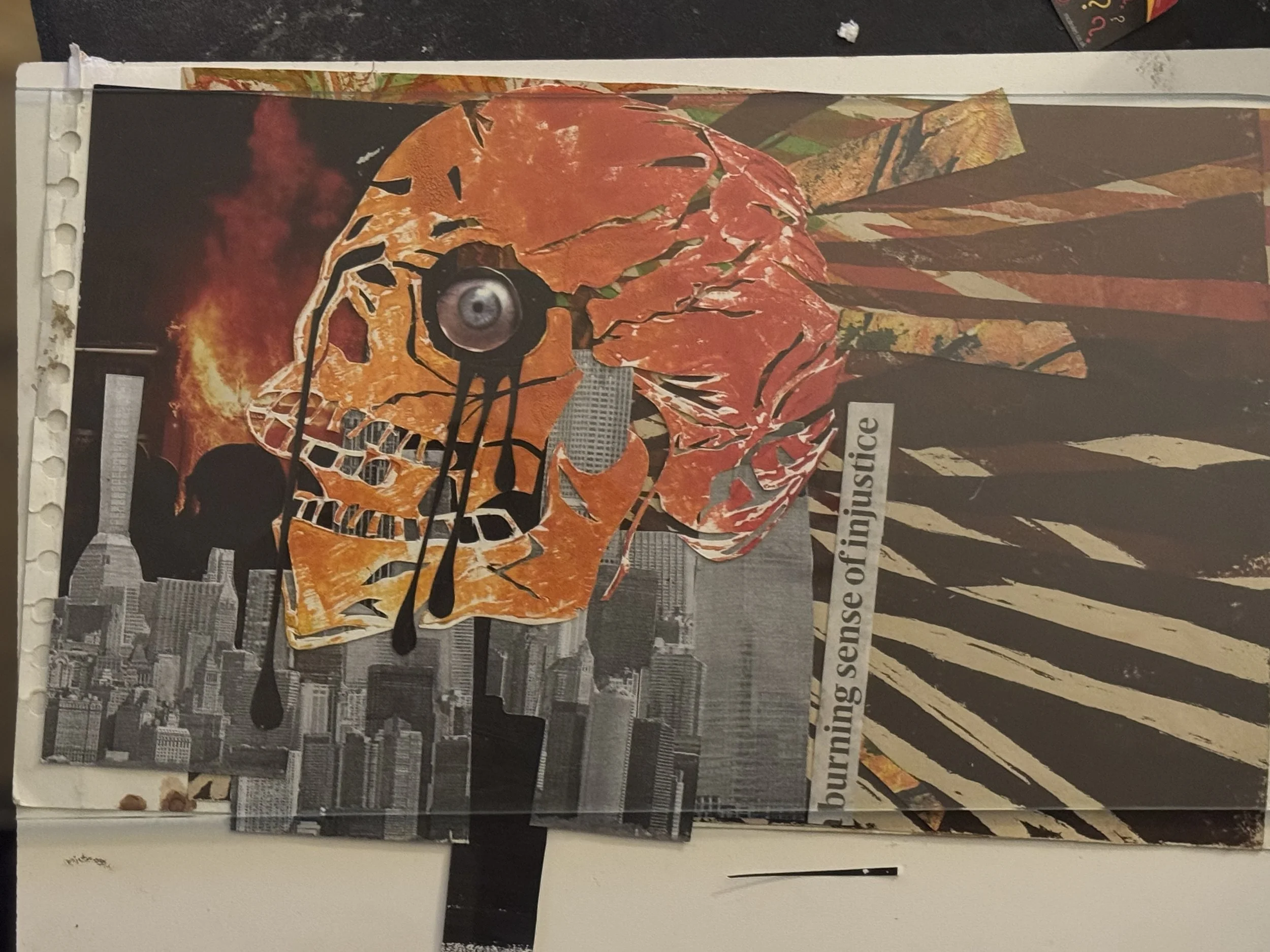
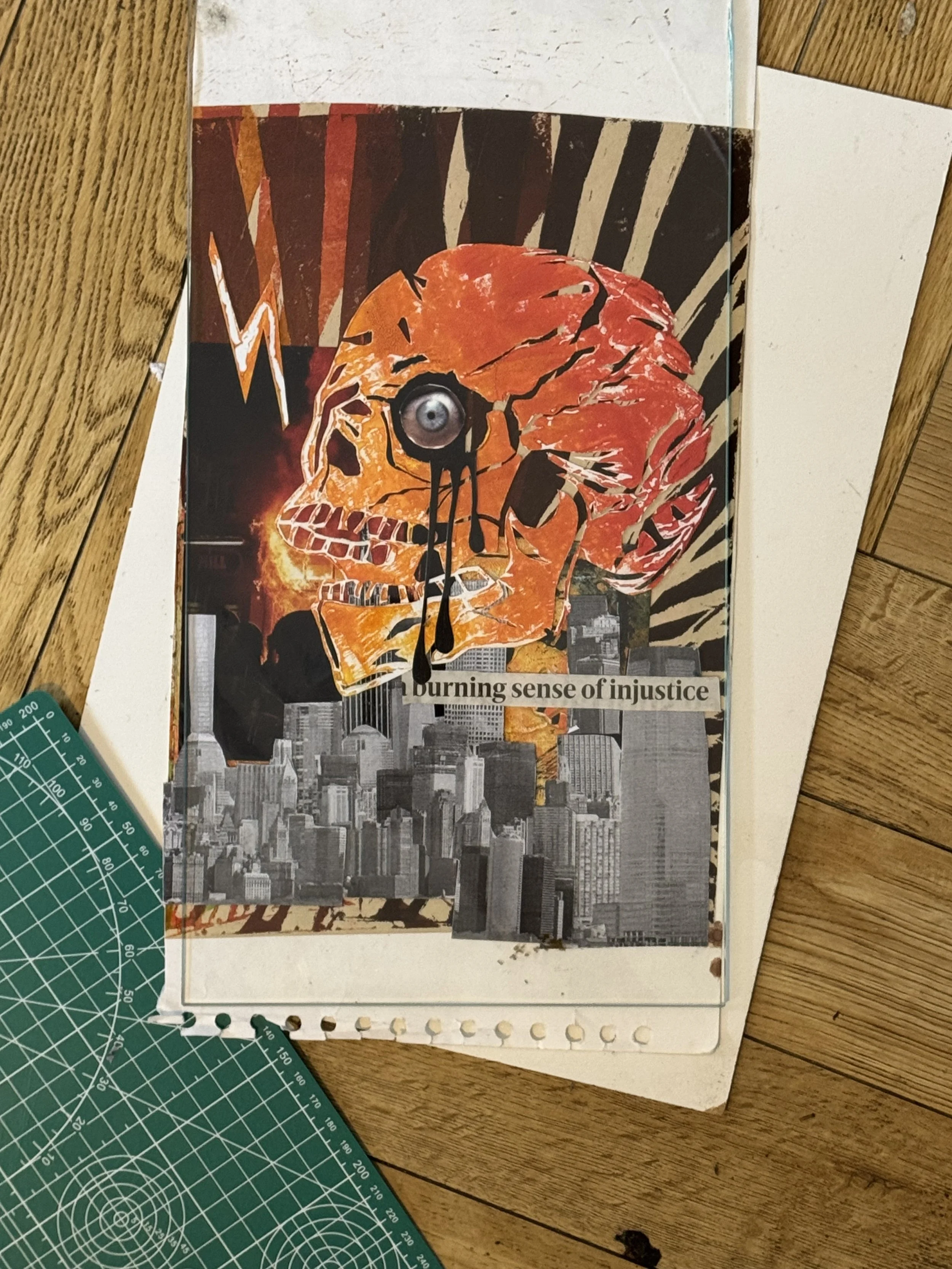
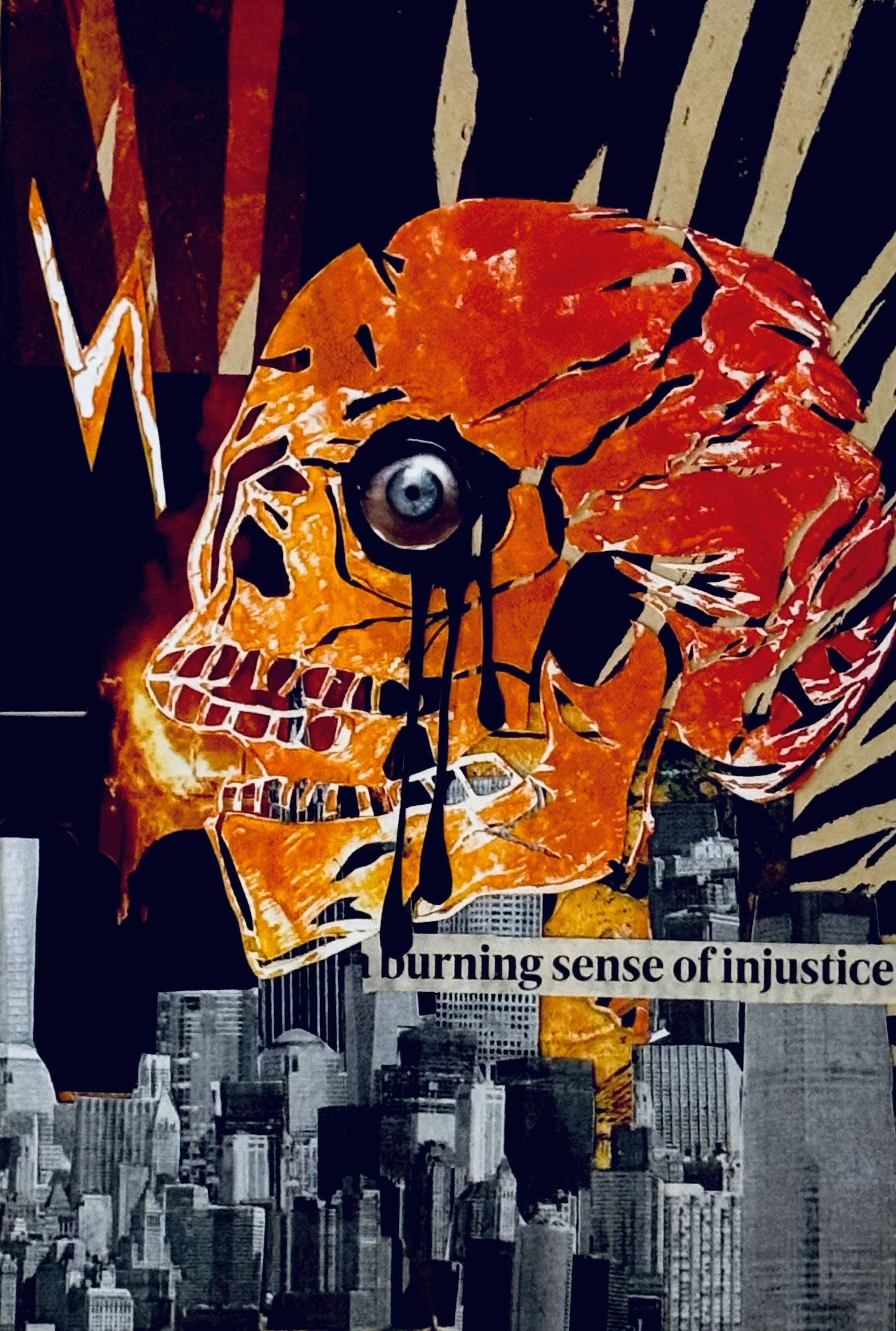
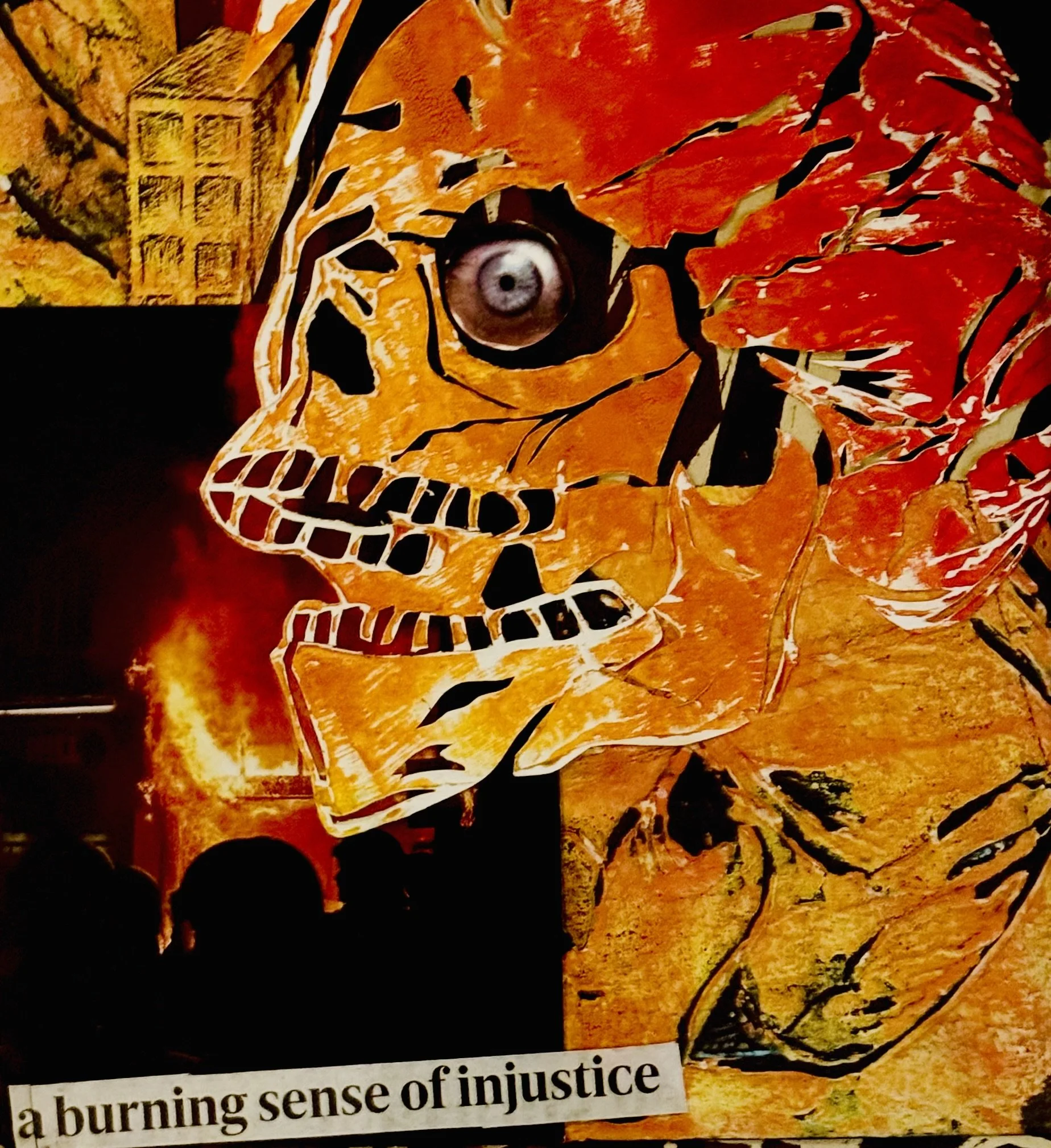
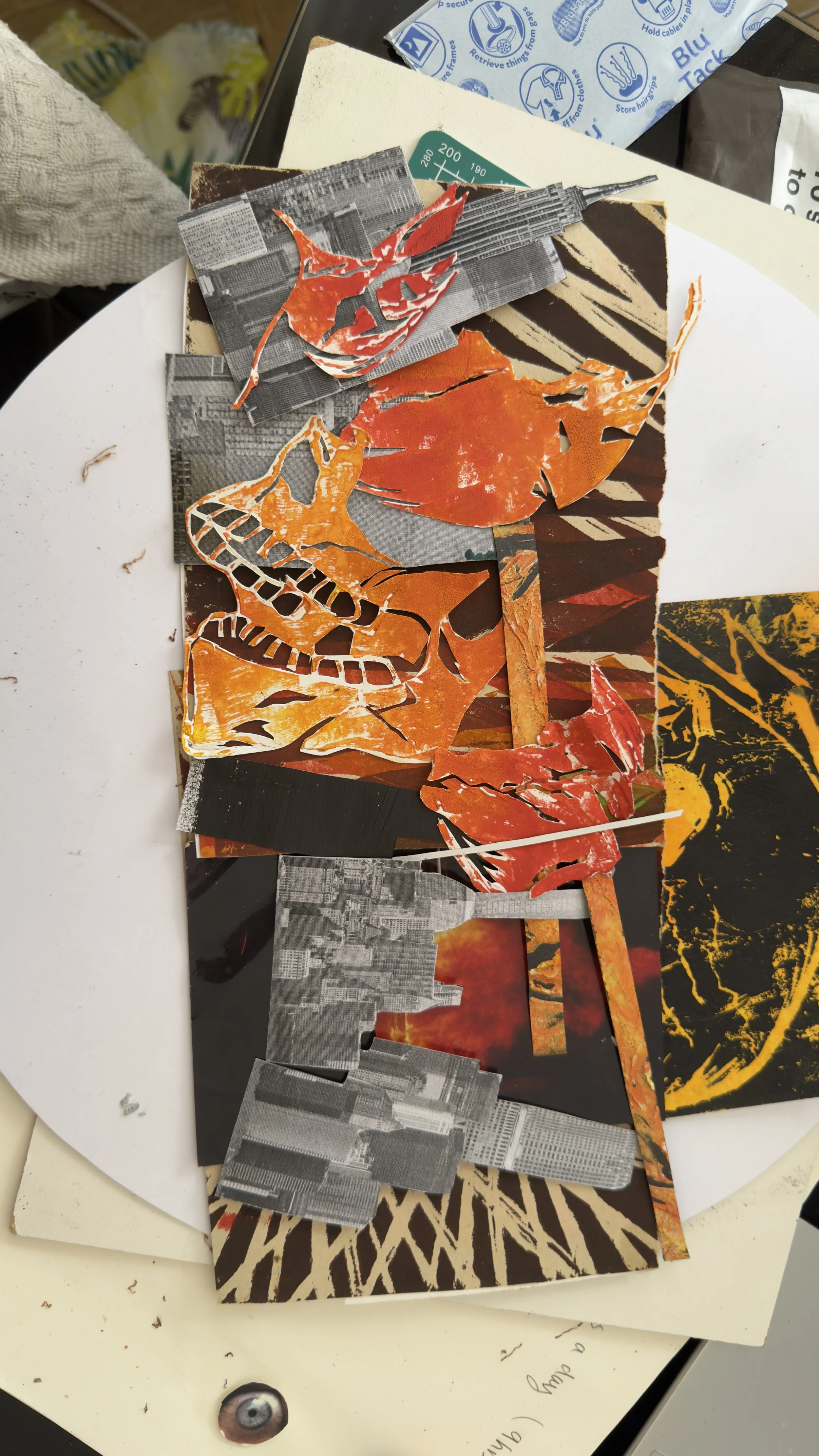
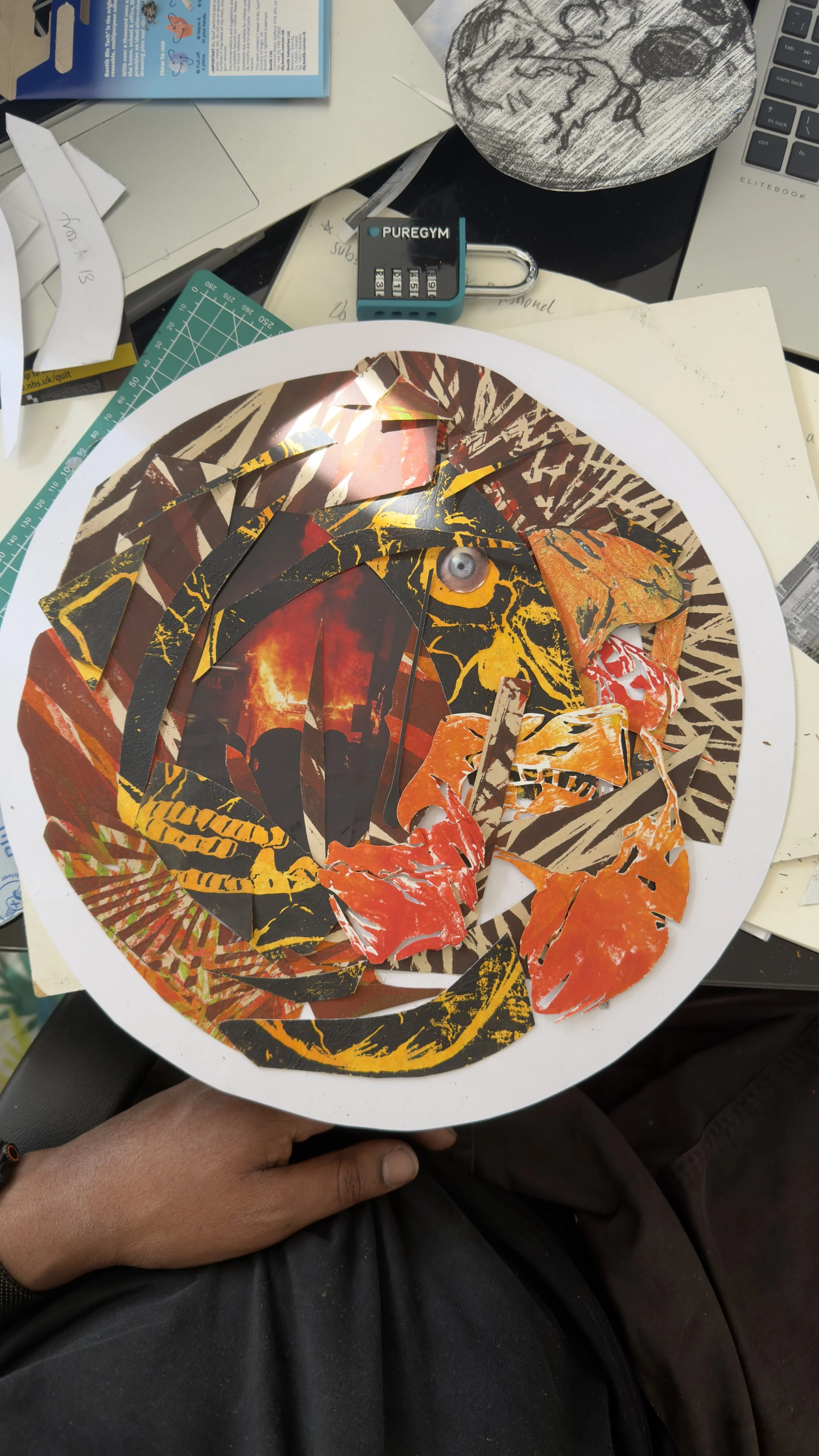
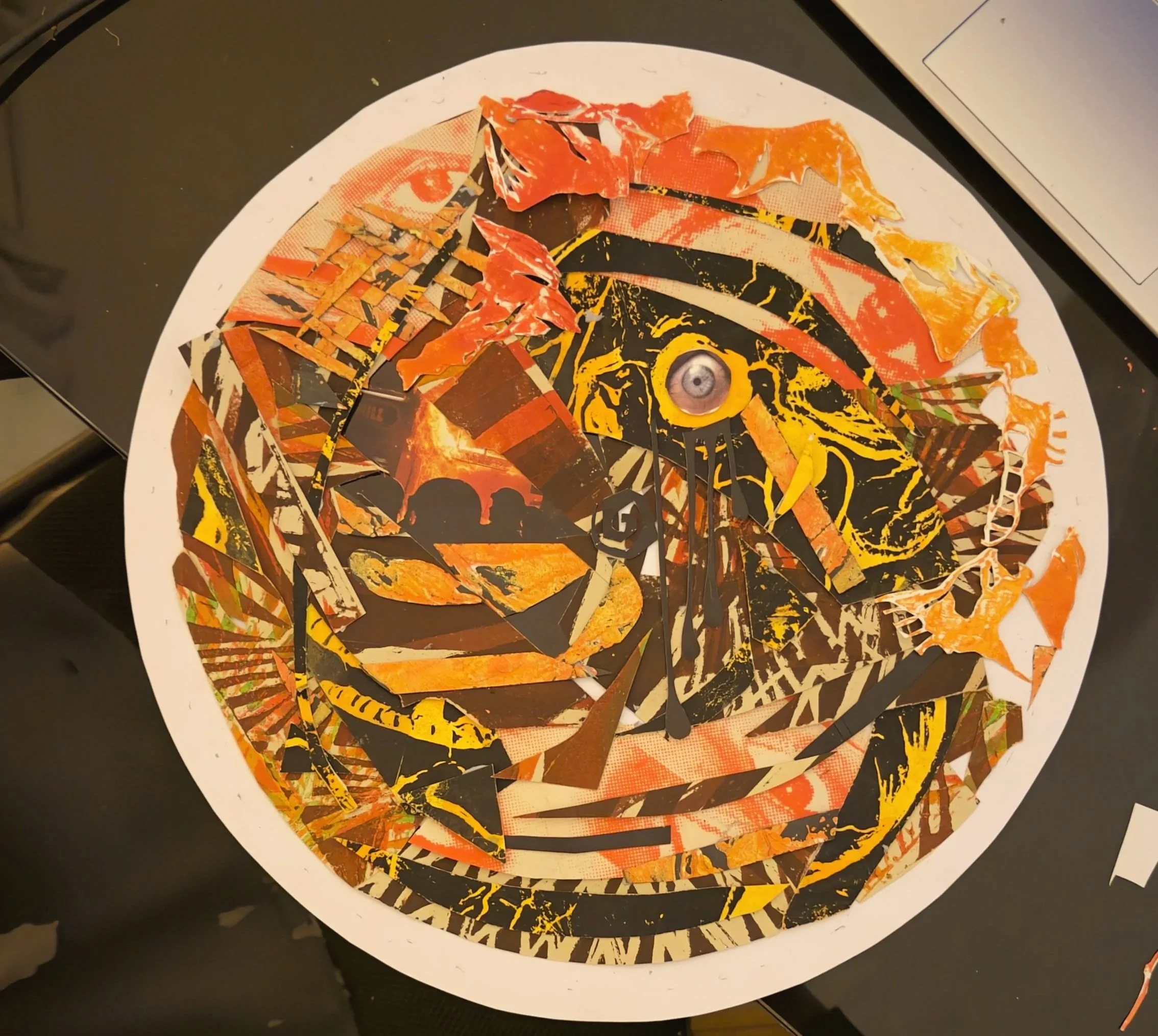
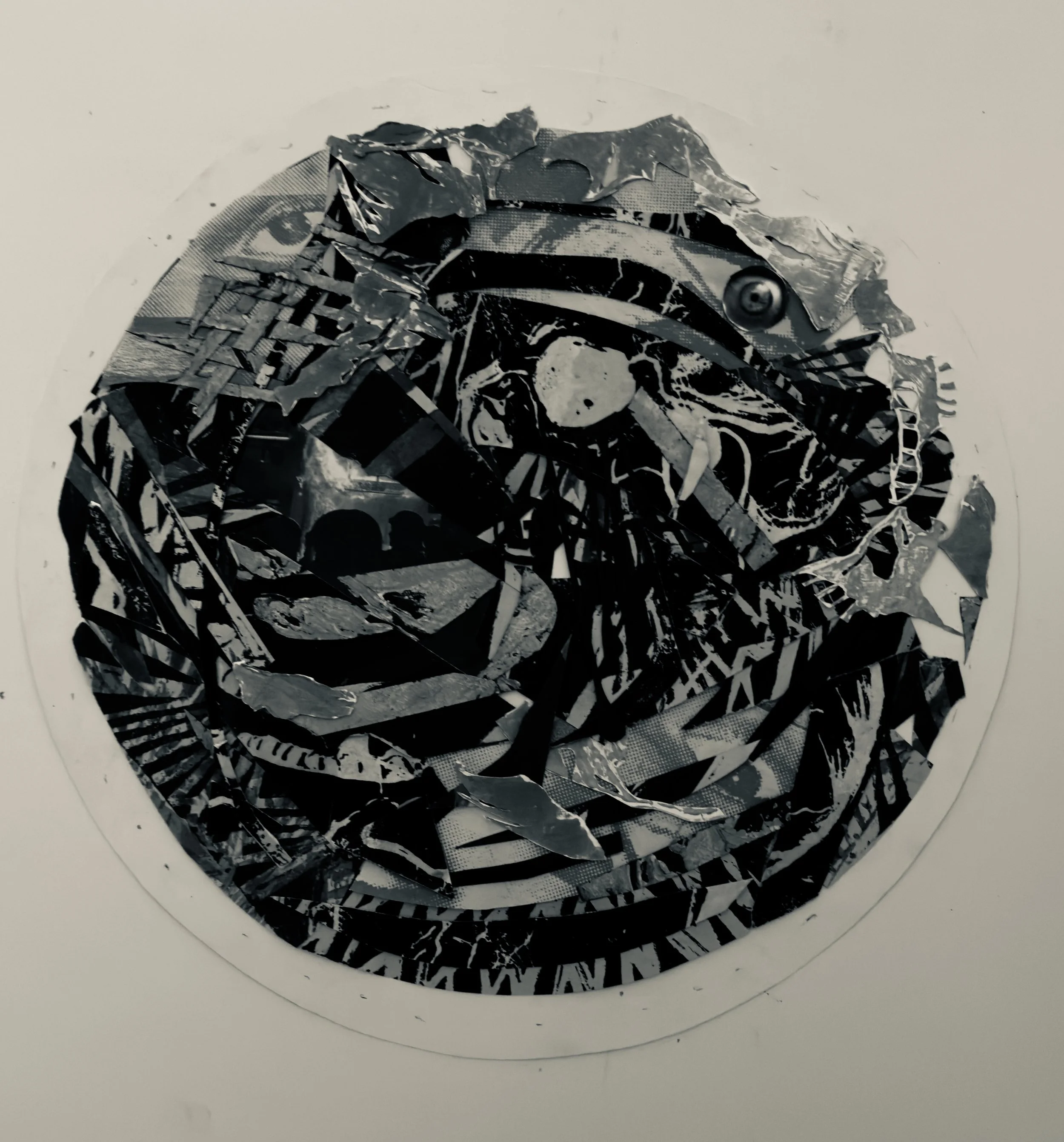
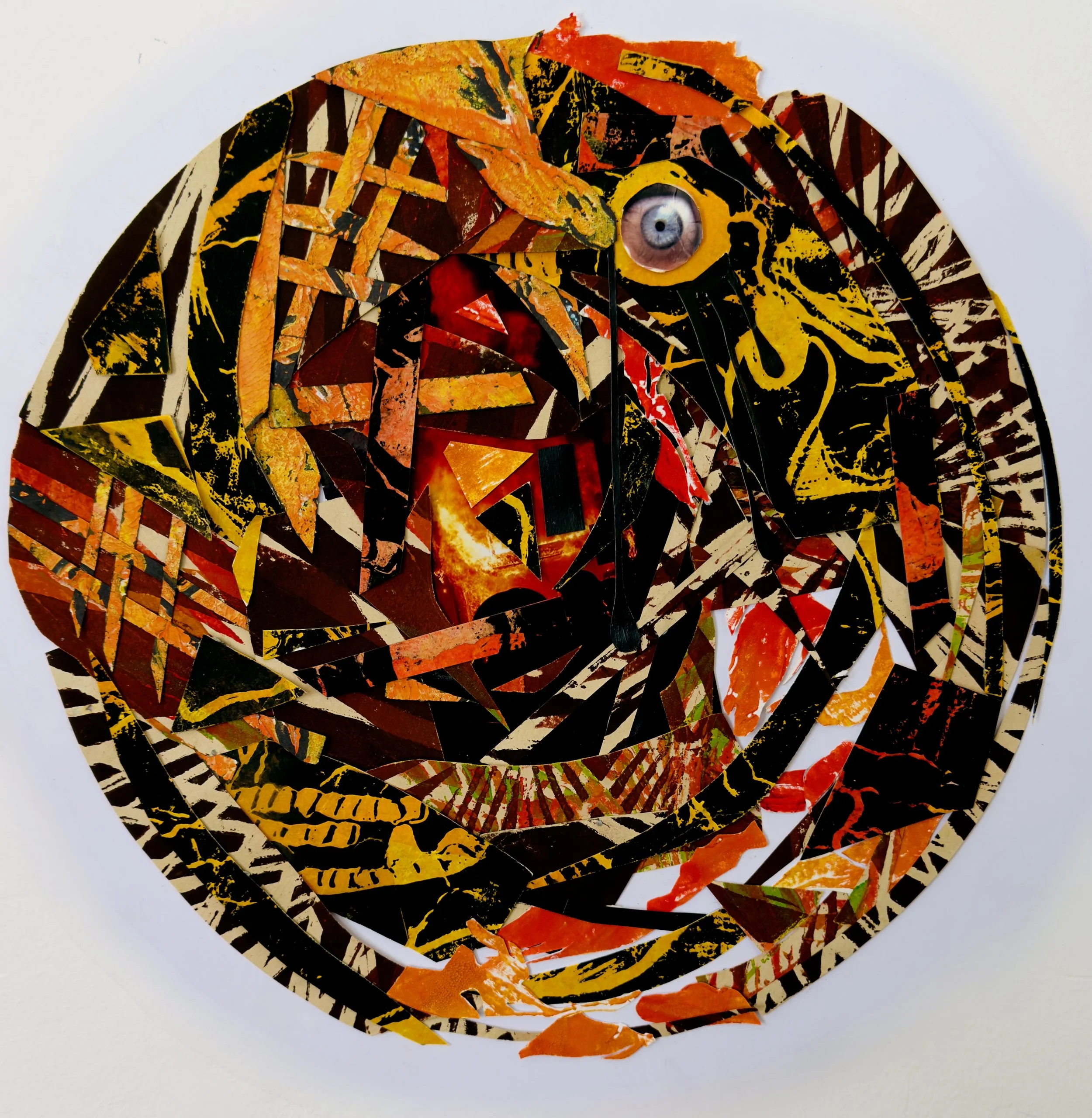
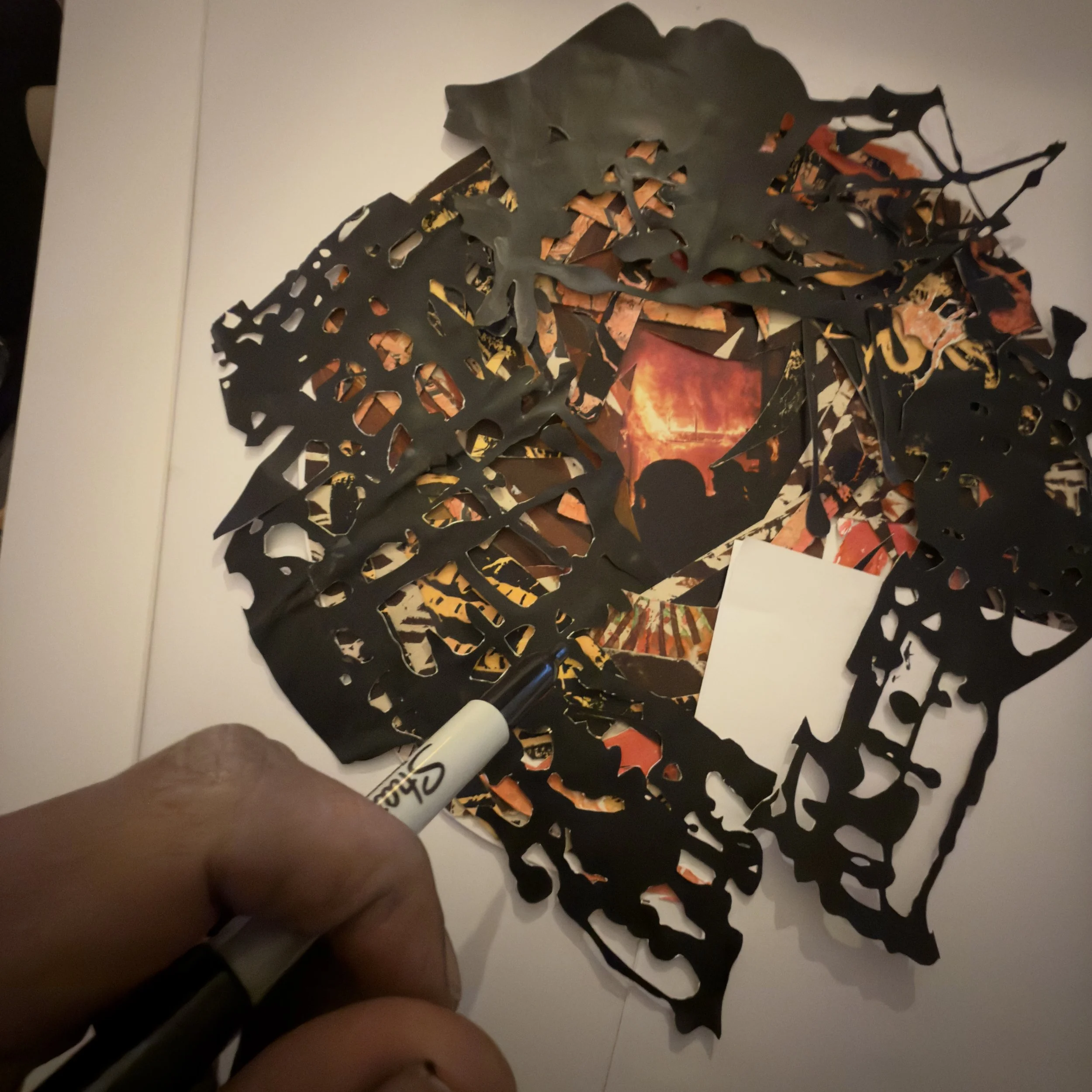
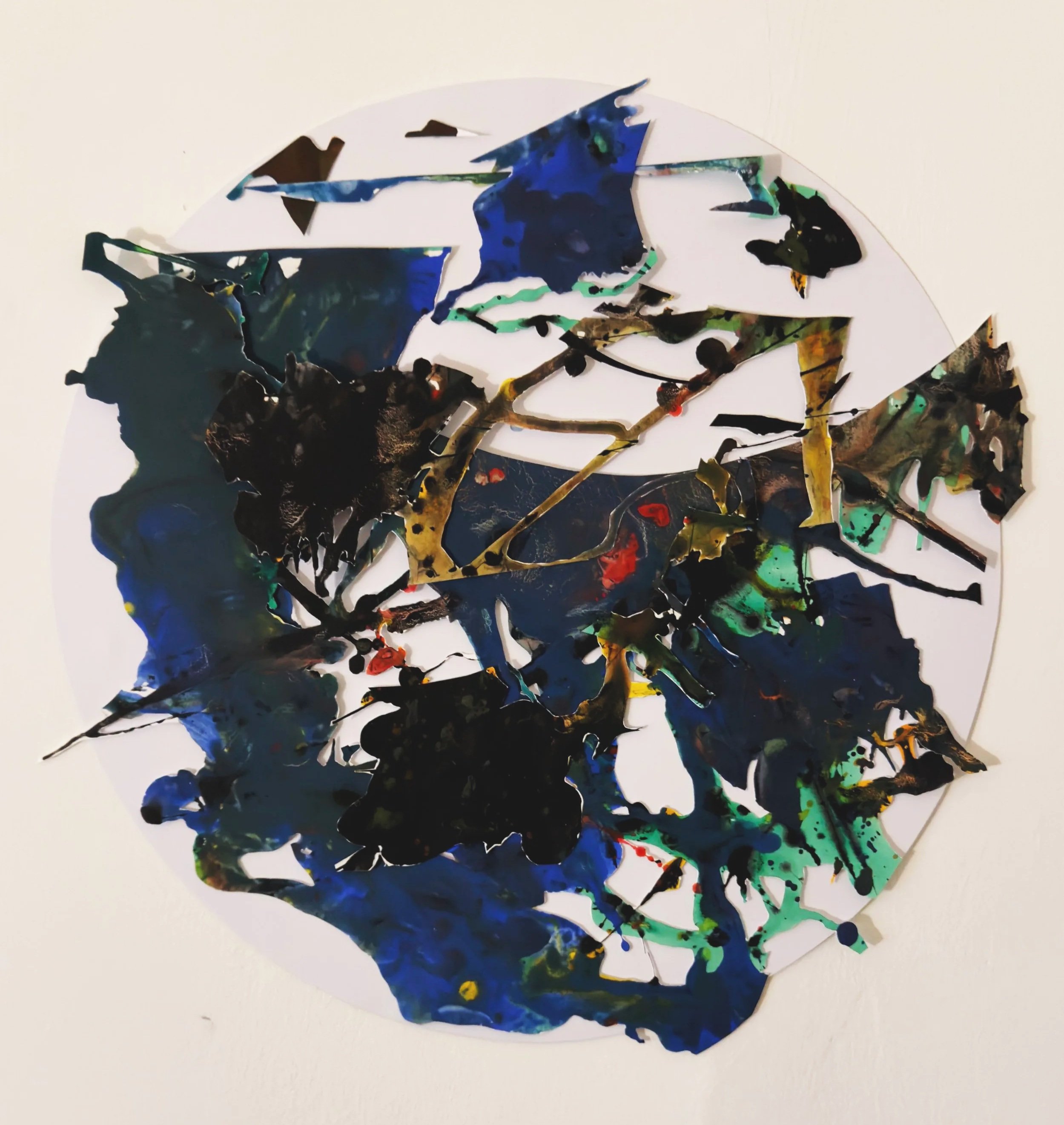
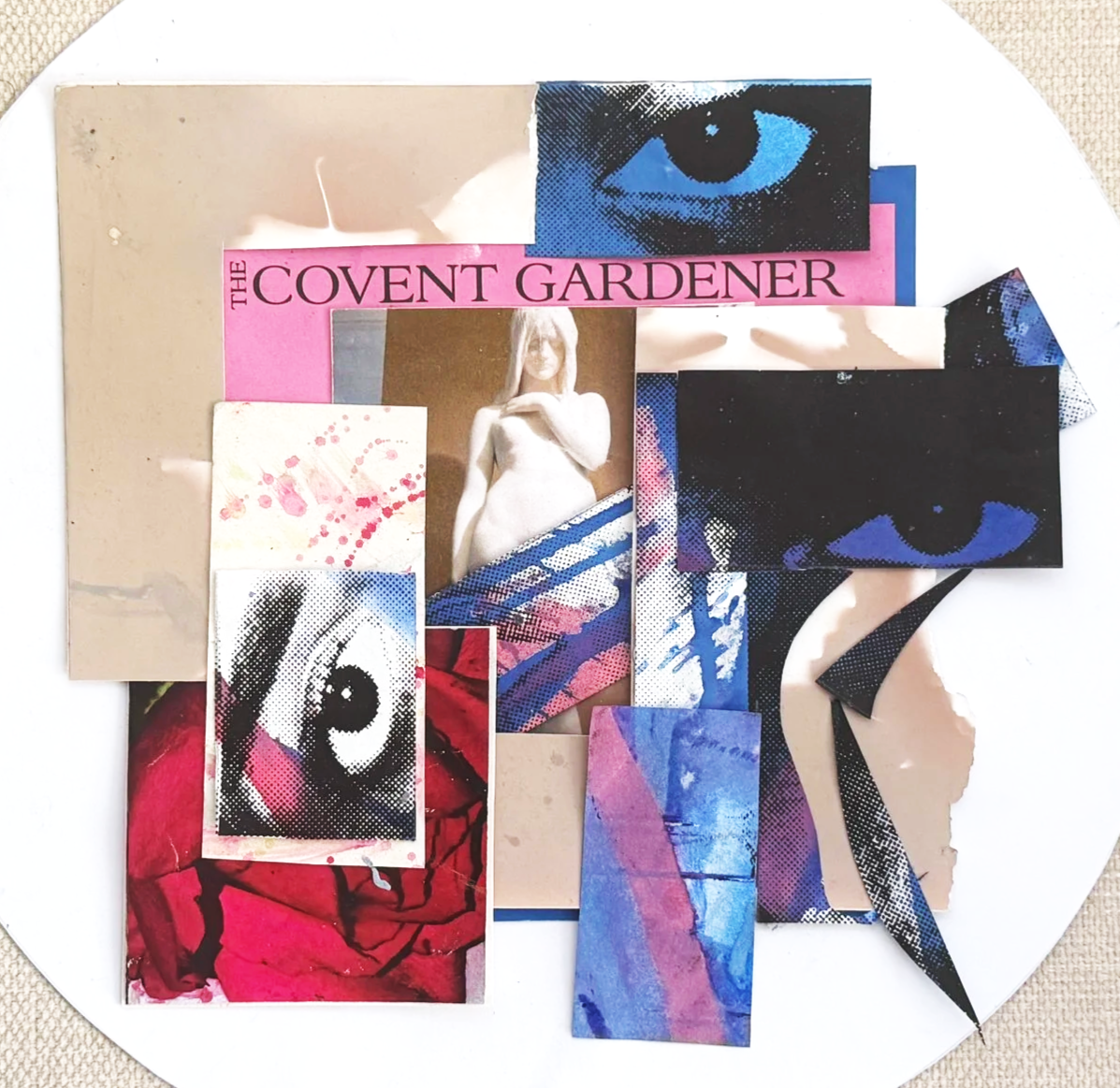
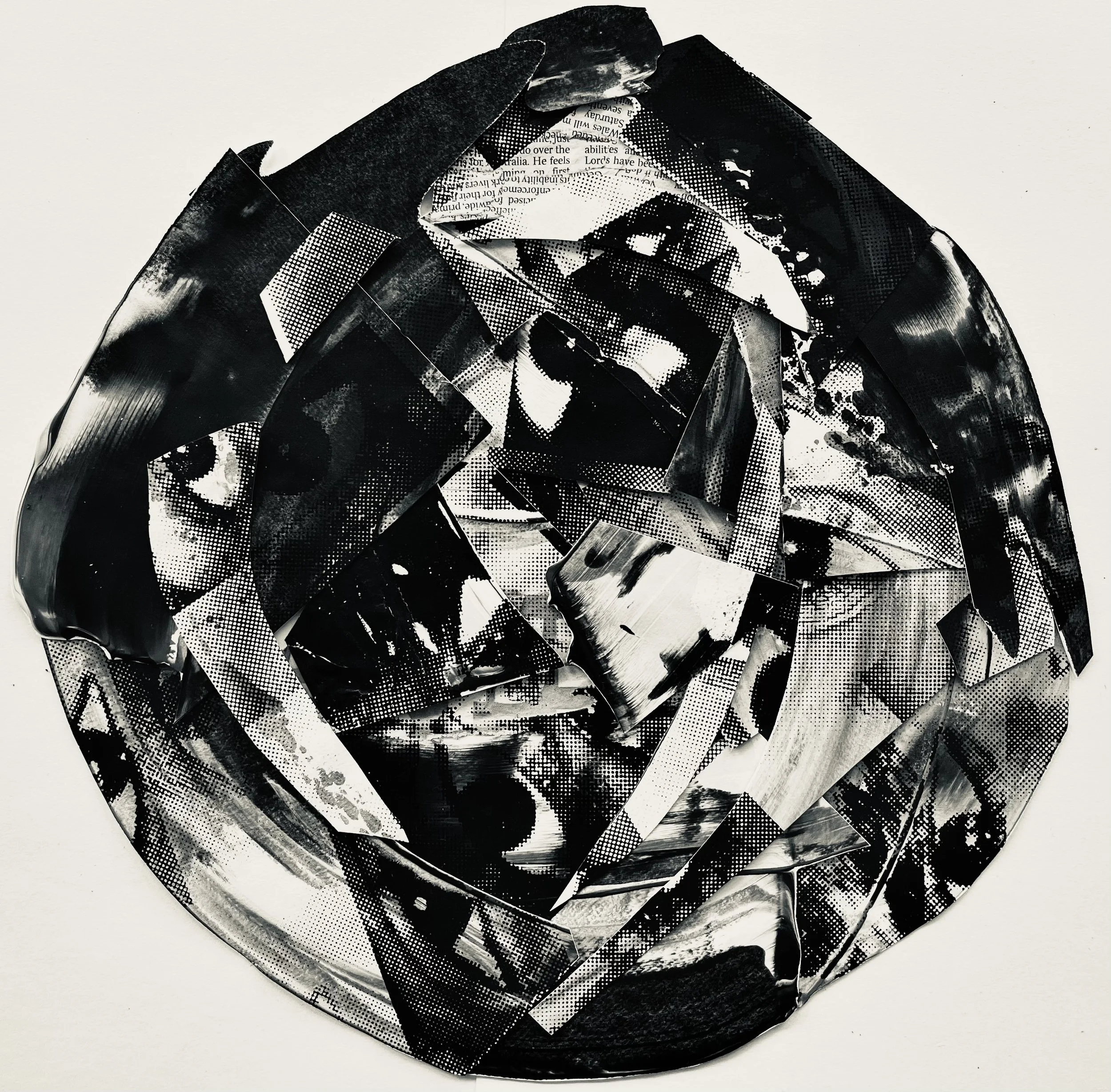
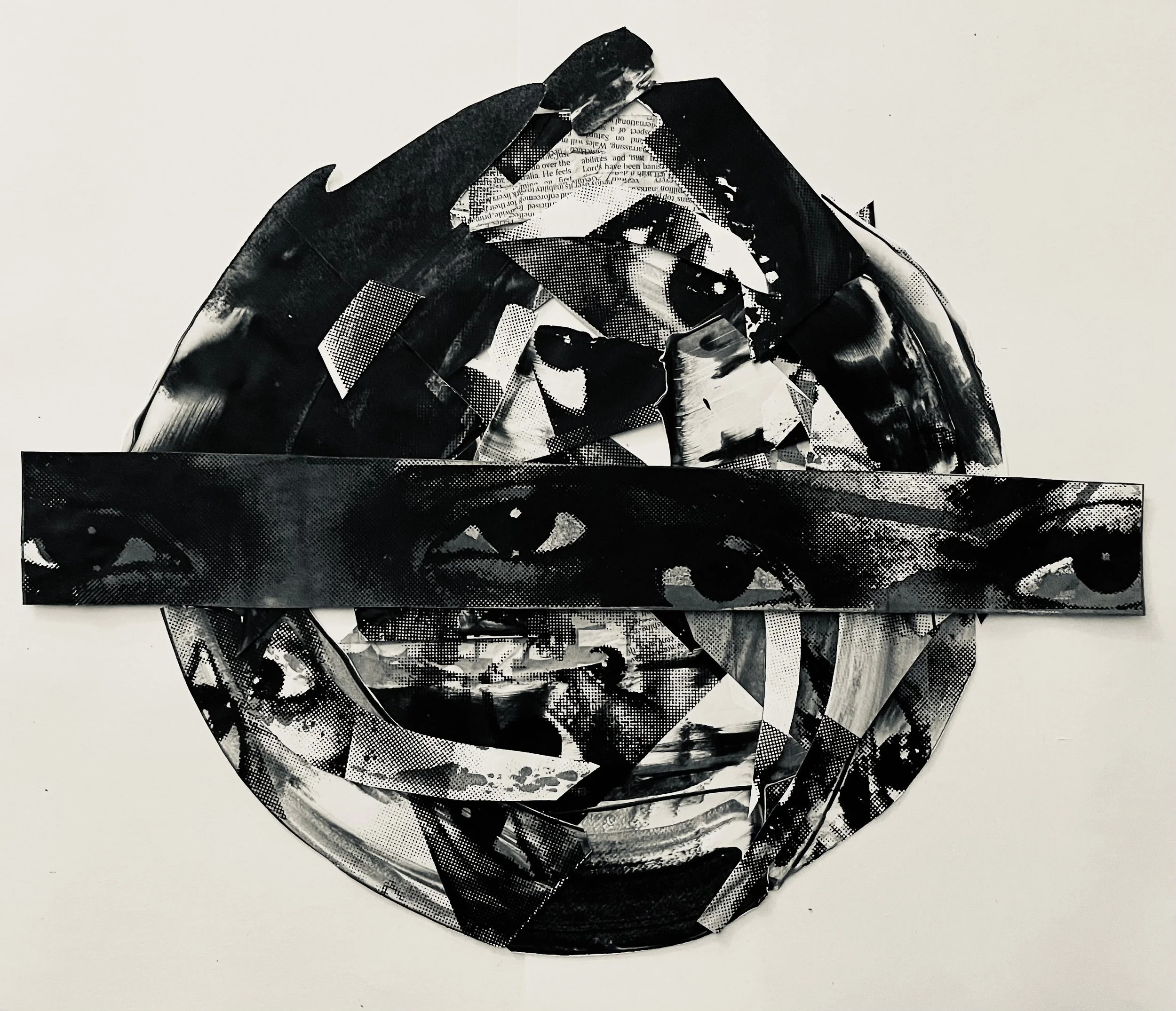
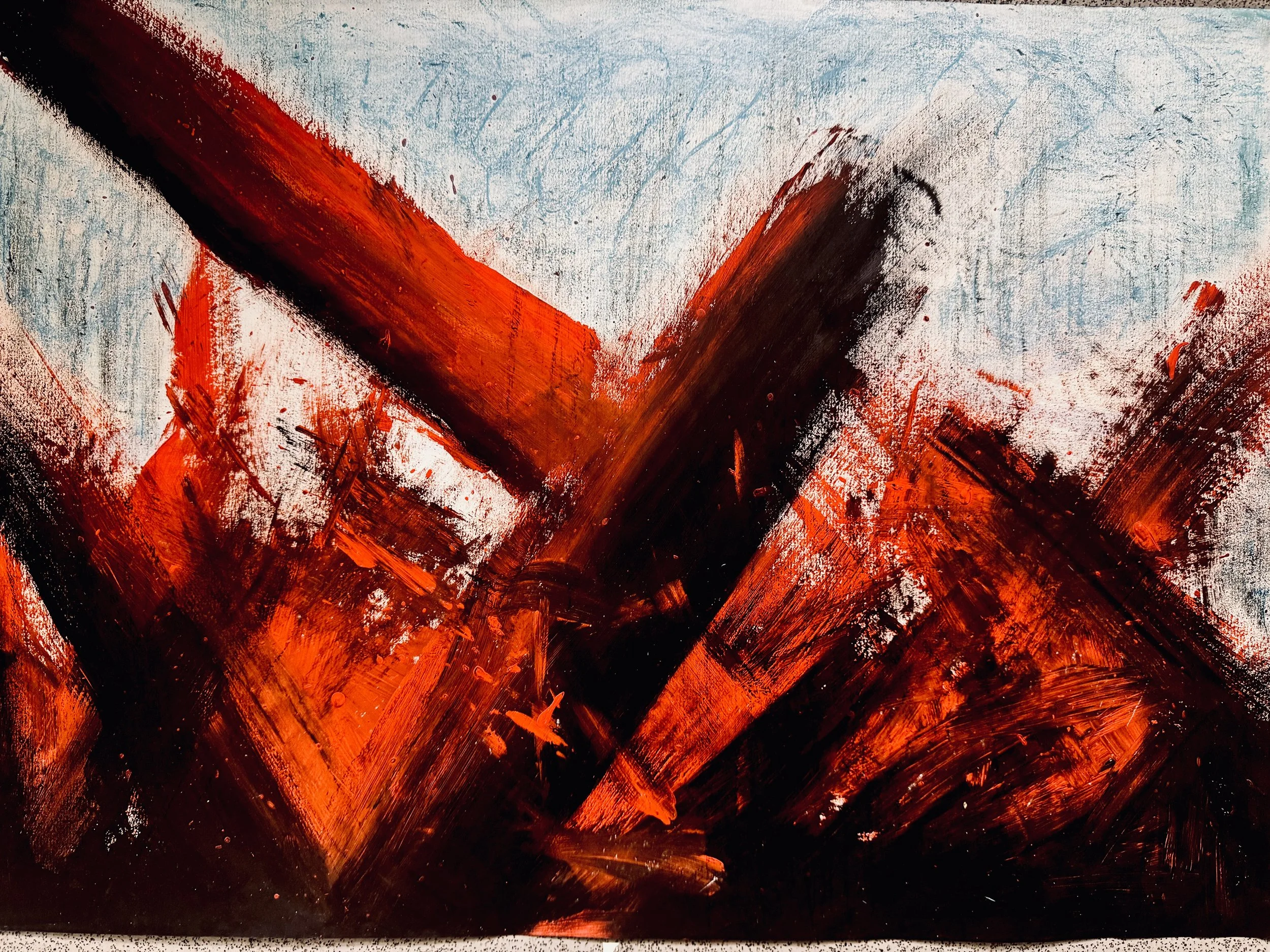
This collage began in 2024 around a skull, a fiery city skyline, riot police and the phrase a burning sense of injustice clipped from a newspaper. Much of the material had been gathered between 2012 and 2022, when I found myself repeatedly returning to riots, social unrest and the growing sense that economic and political institutions were no longer working for everyone. Over time the first version of the collage became too literal, so I returned to it repeatedly, cutting it apart and rebuilding it.

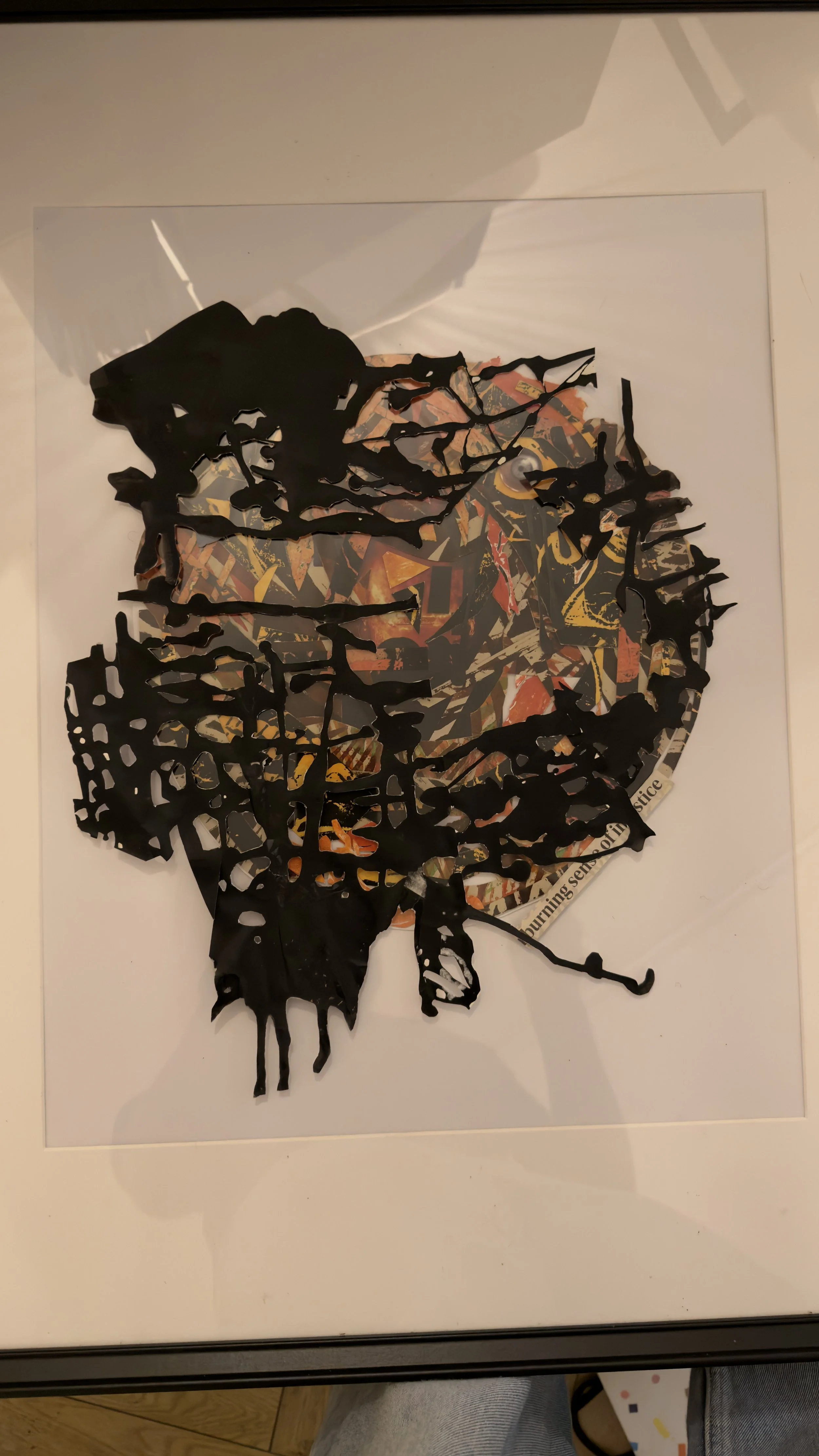
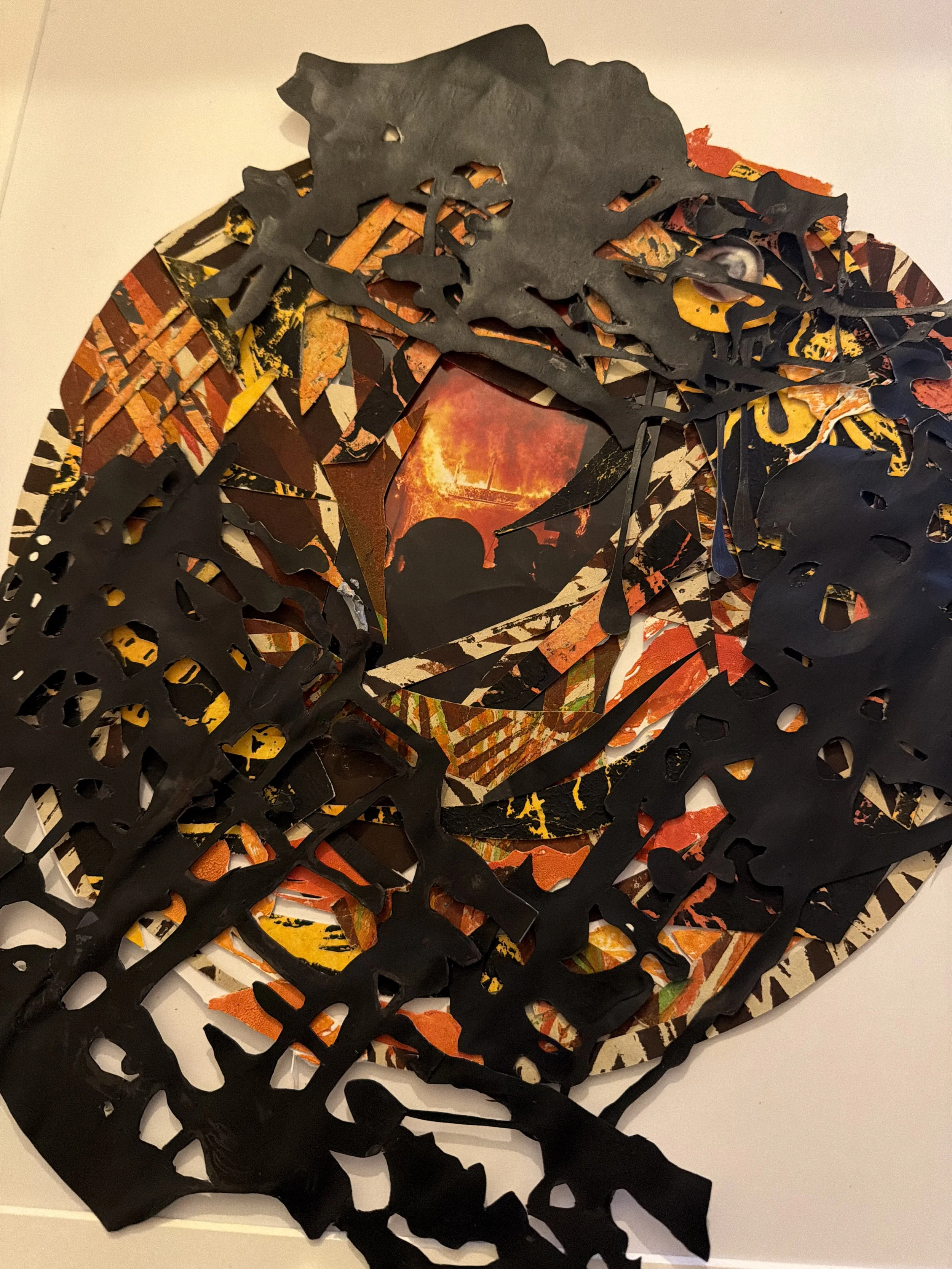
While rebuilding it, I found myself returning to news coverage of the riots in the UK during 2025 and 2026. Rather than depicting a single event, I became interested in how feelings of injustice accumulate, circulate and pull people into collective action. Whether those feelings are justified is a separate question. During the final days before the Paxton Centre exhibition, a dense black layer transformed the work. At different moments it suggested smoke, crowds, barriers, camouflage and squid ink—a defensive cloud that obscures as much as it reveals. The ambiguity made the piece stronger, shifting it away from explaining unrest and towards the emotional conditions that allow it to take hold.

More than anything, this piece changed my relationship with collage. I realised I was willing to destroy work I already considered successful if it pushed the idea further. The finished image contains several earlier versions beneath its surface, making reconstruction part of the final work itself.

A Burning Sense of Injustice

Mixed-media collage on paper

50 × 70 cm

2026

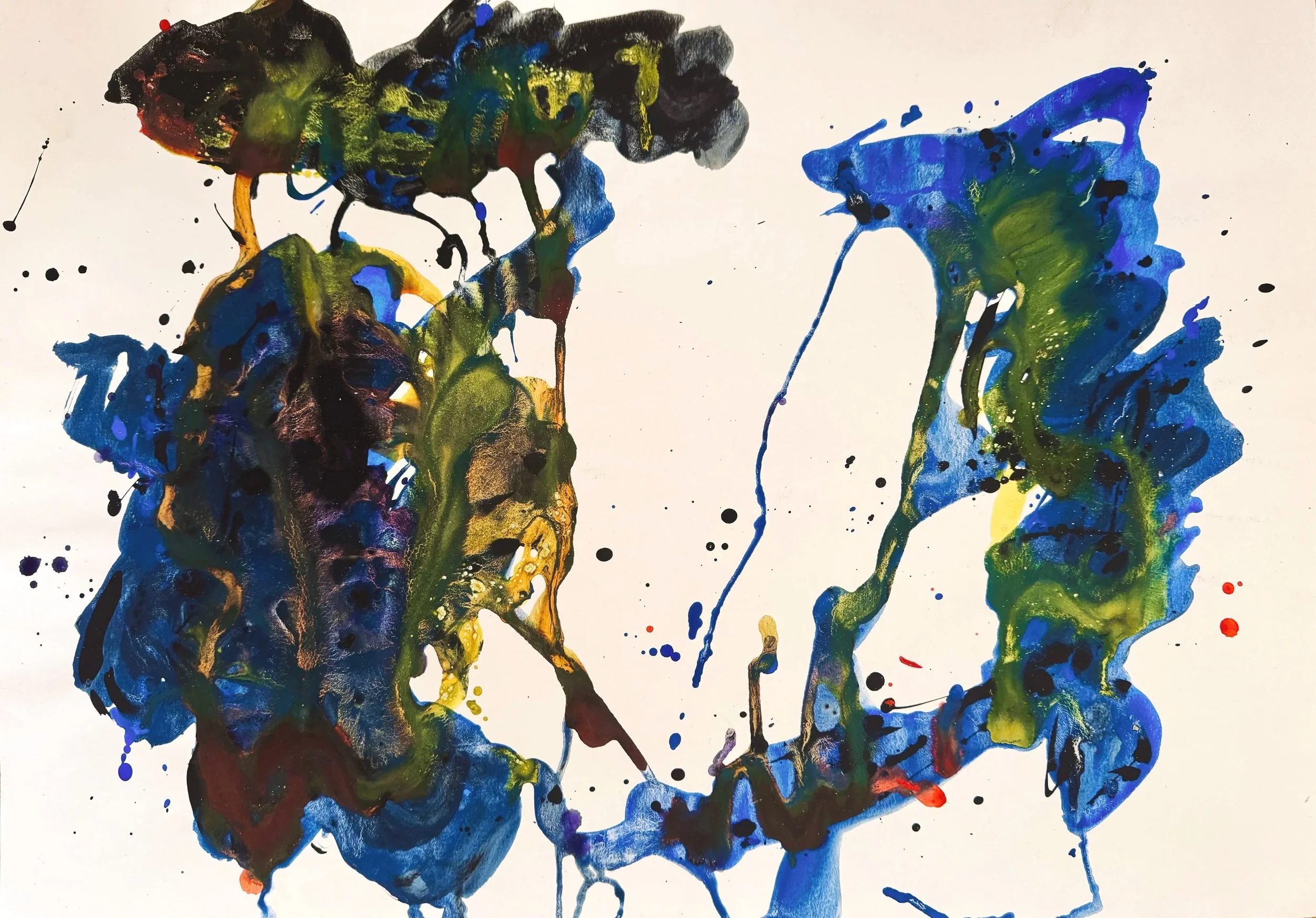
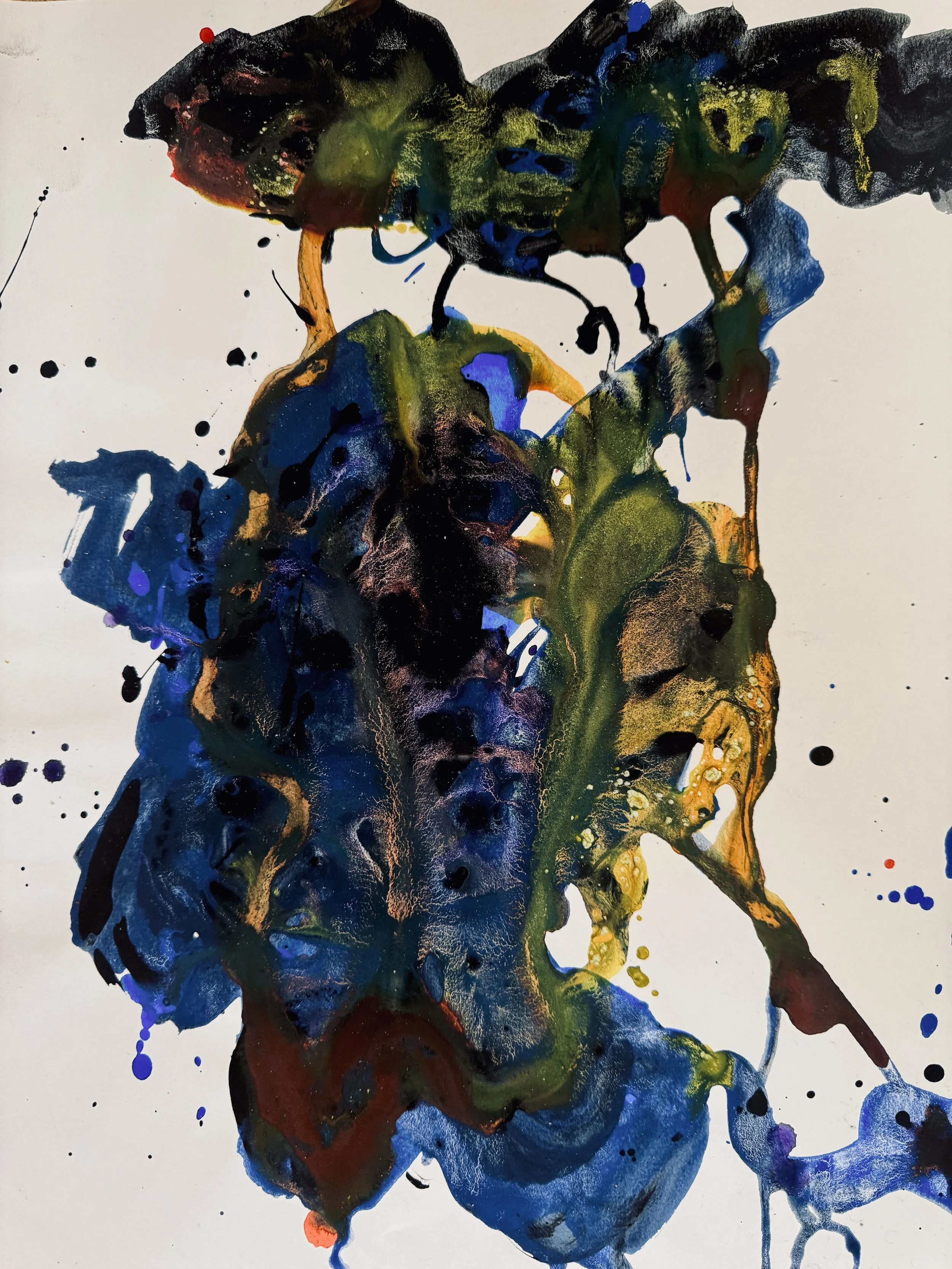
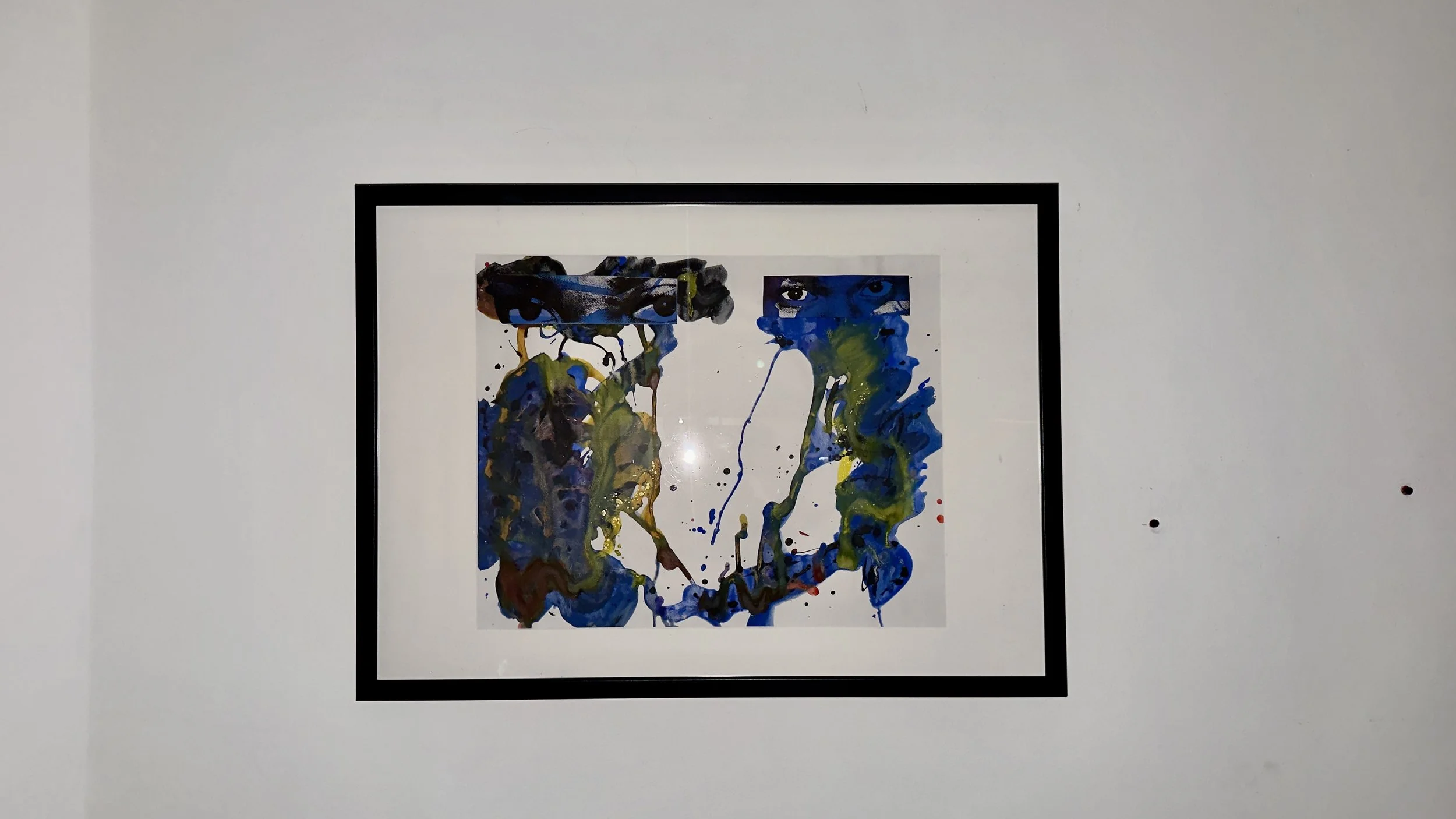
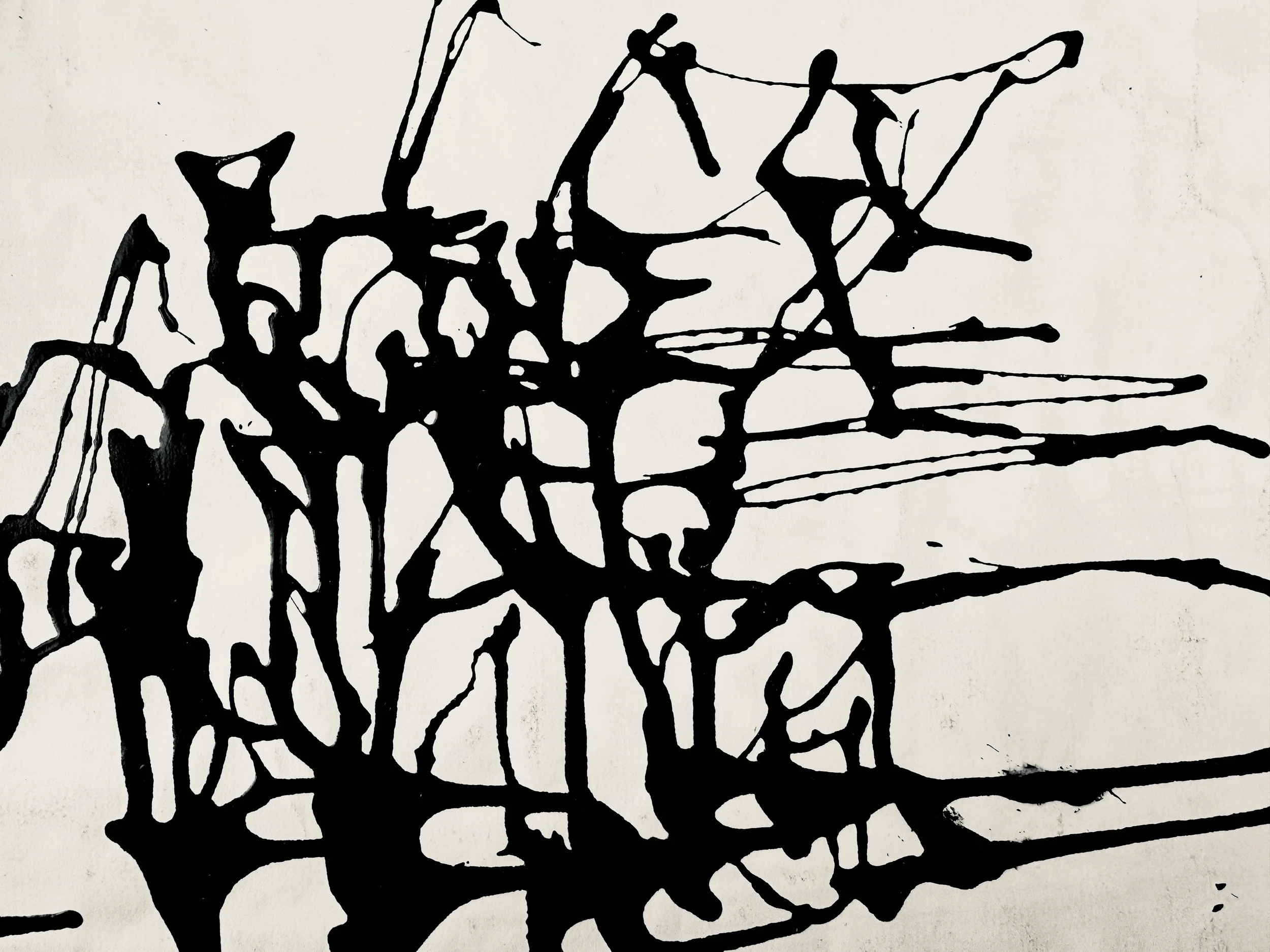
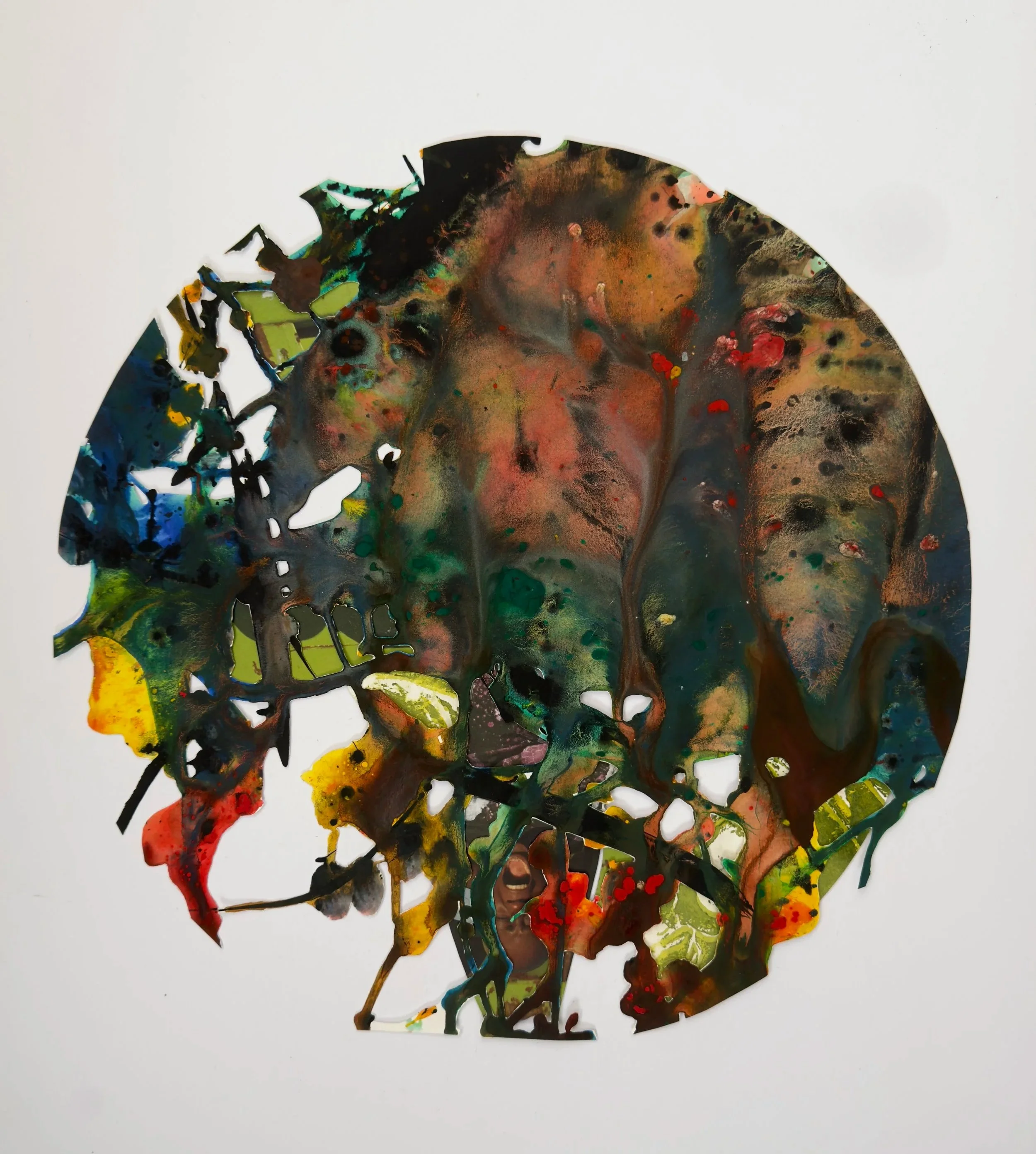
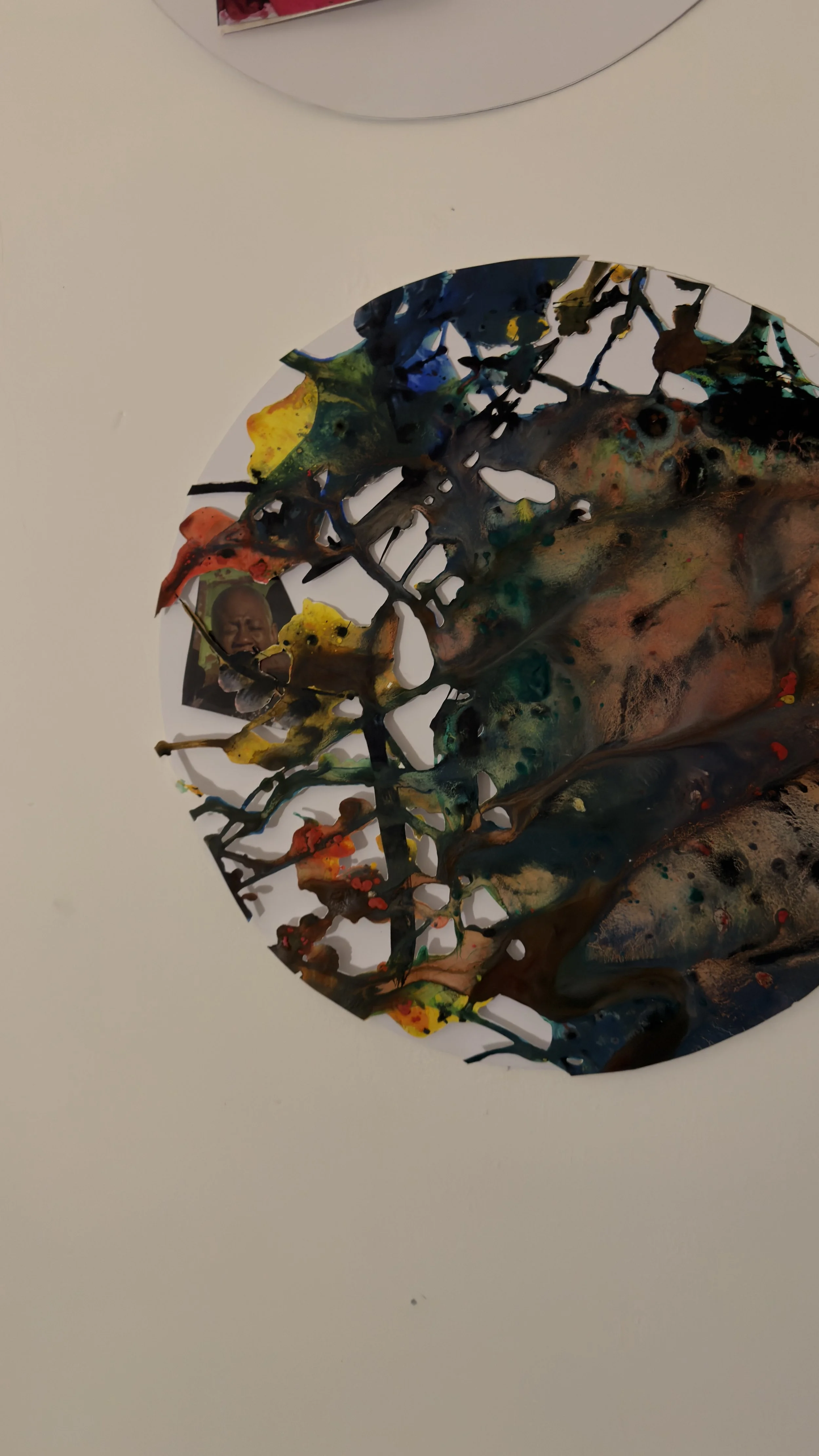
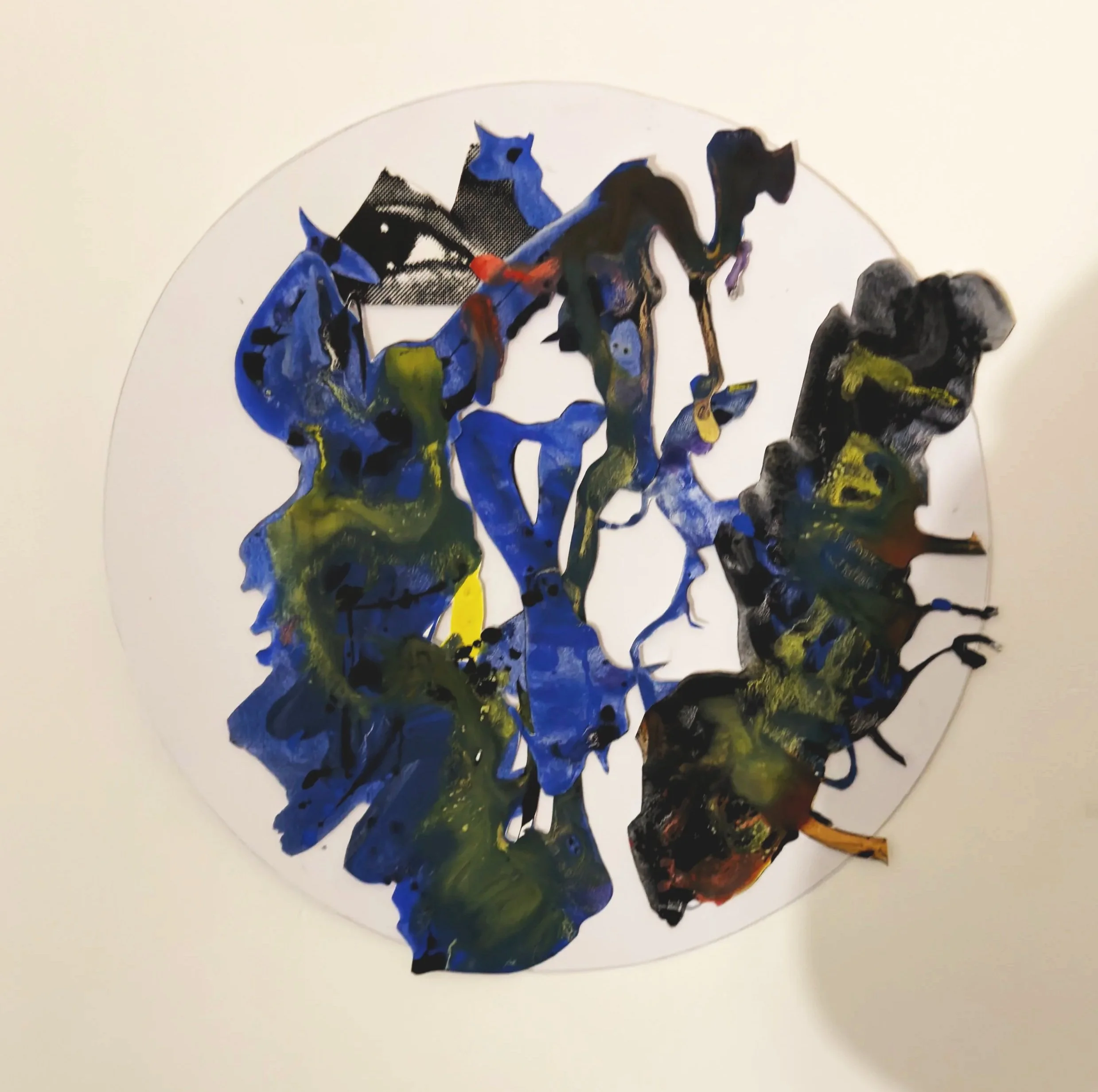
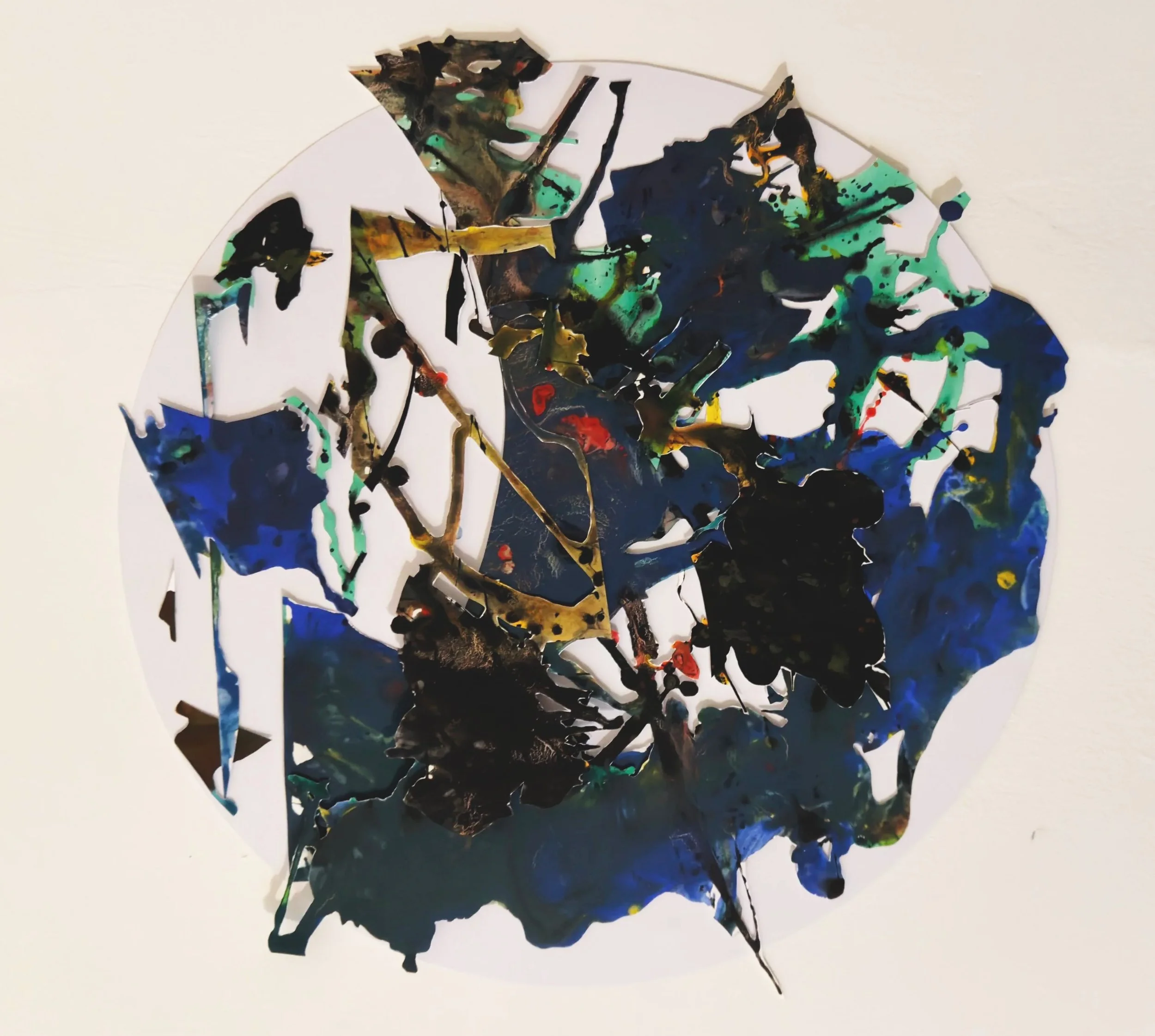
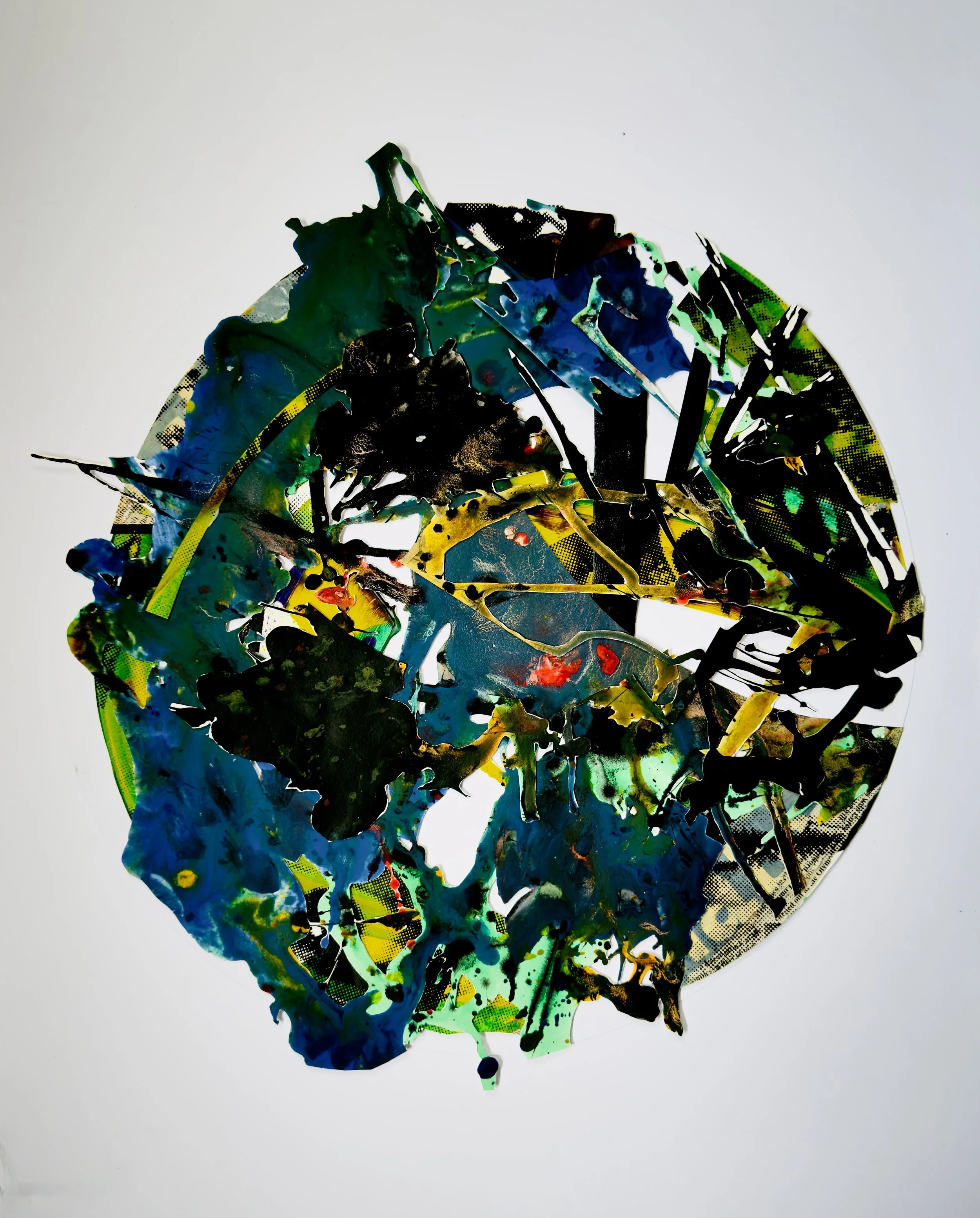
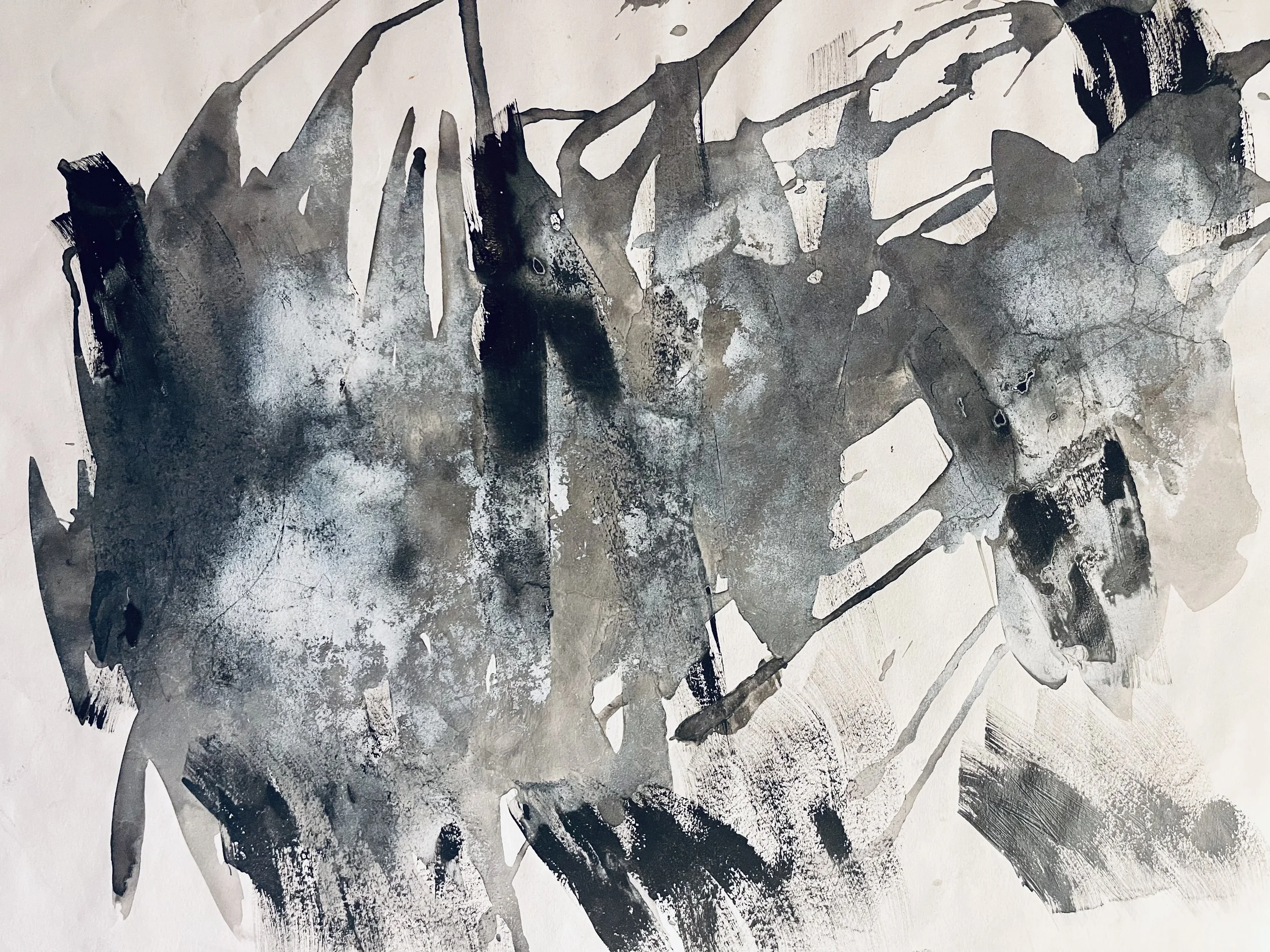
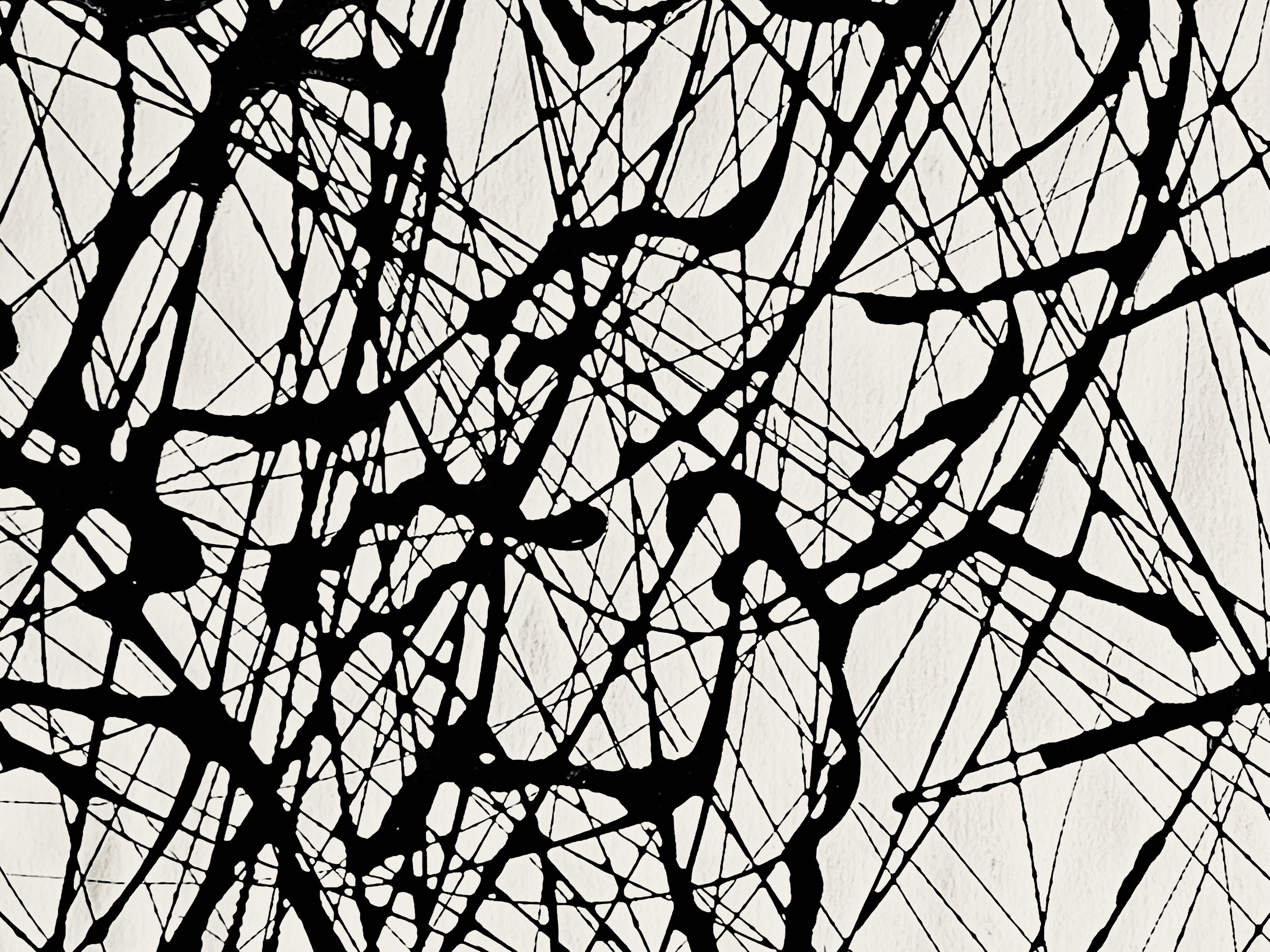
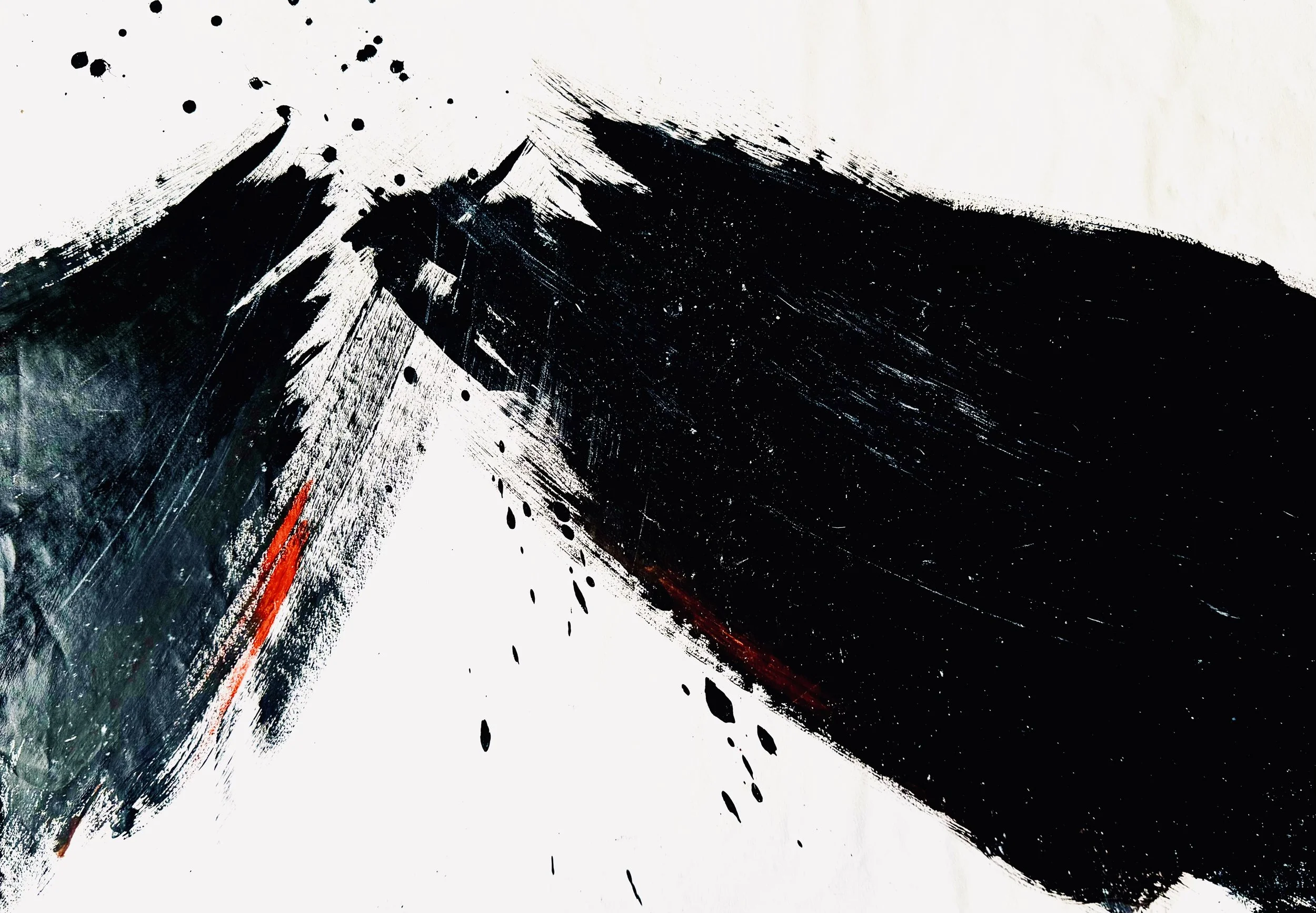
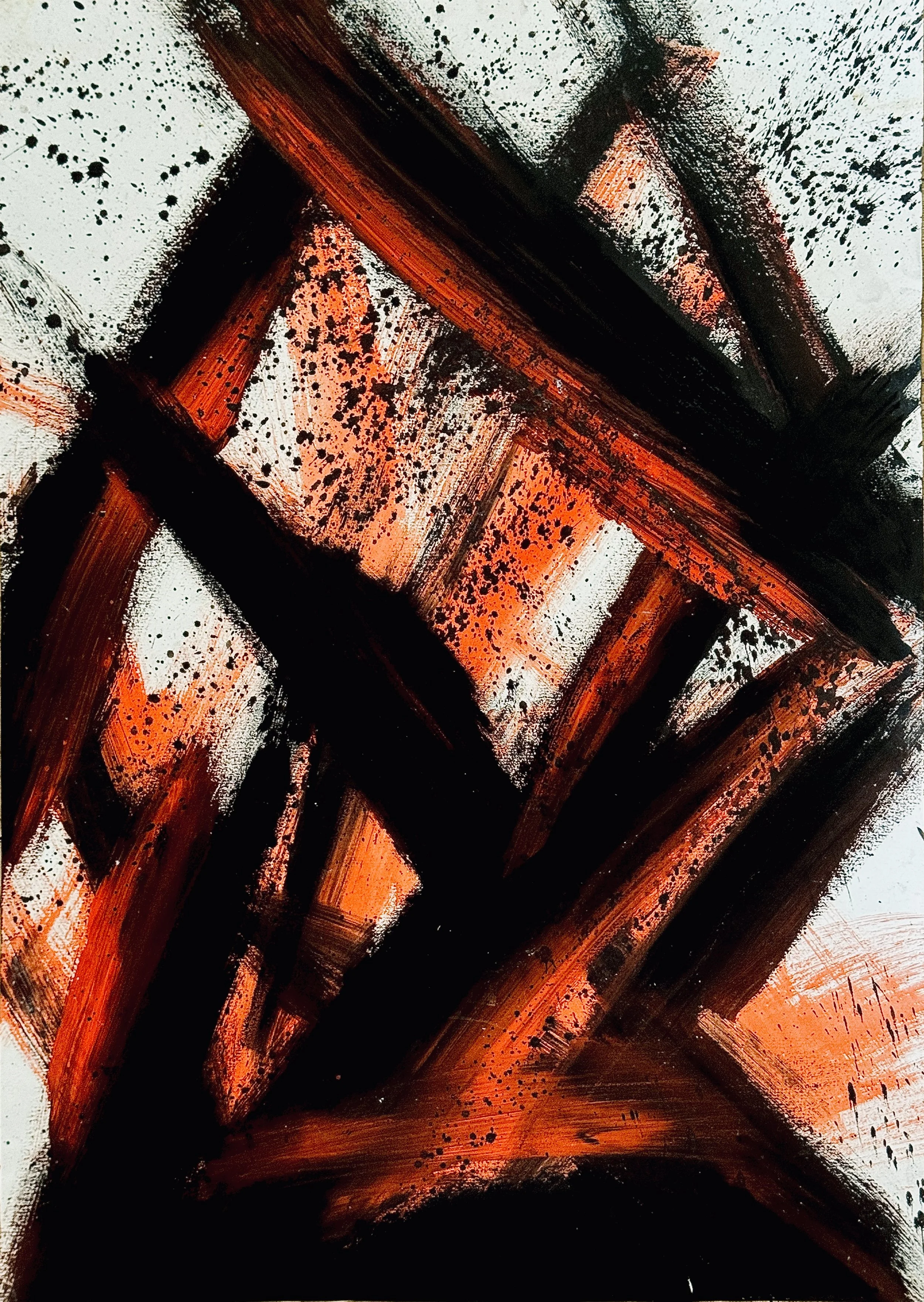
This piece began as a large Indian ink painting on paper in 2012, one of many open experiments in movement, rhythm and gesture influenced by Action Painting and graffiti. Deep blues flowed into yellows, purples and reds, creating an atmosphere that initially resisted control.

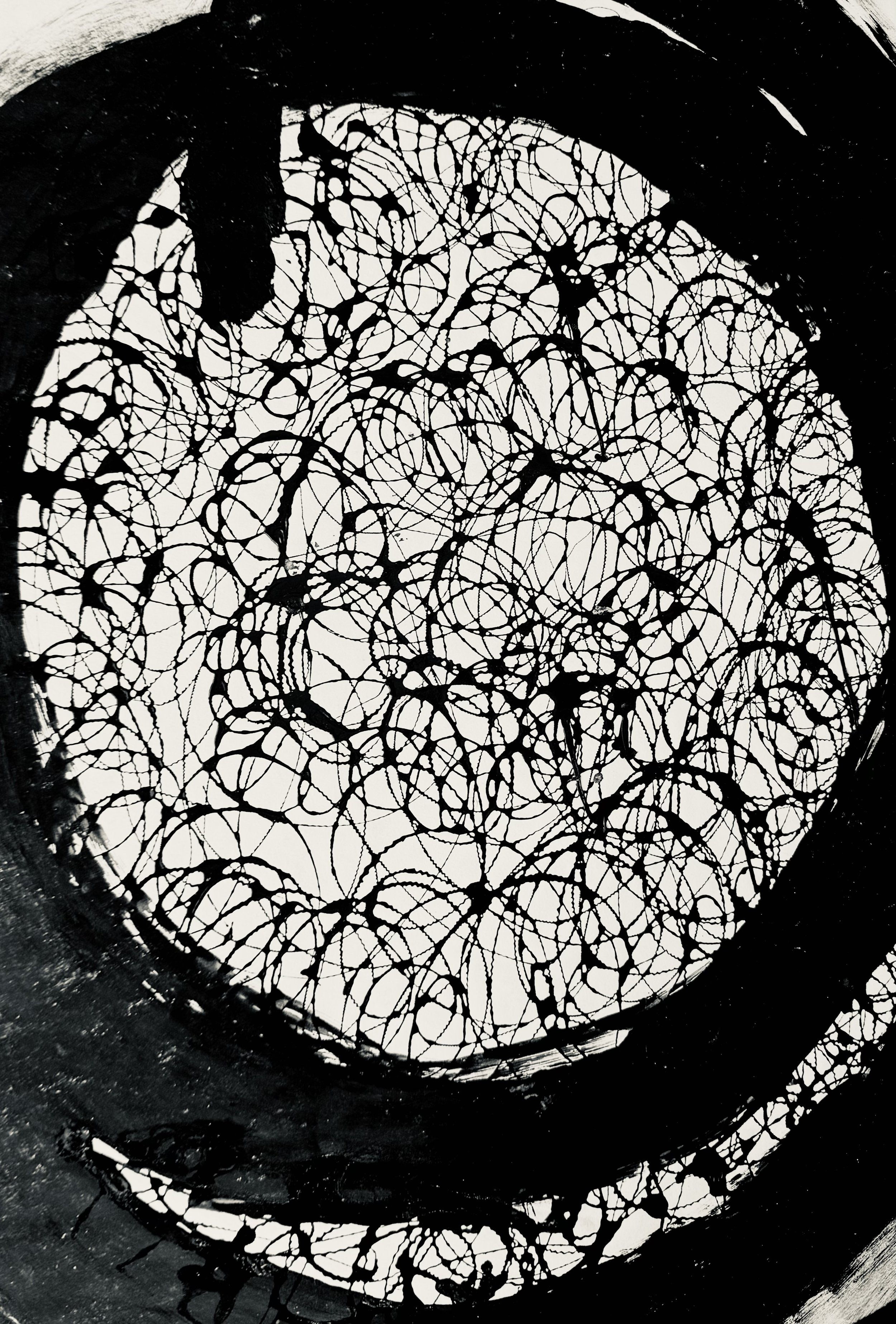
By 2026, I realised the piece had energy but had not yet found an argument, so I cut into it. Removing the white negative space by hand transformed the painting into a rectangular stencil. One section kept demanding my attention, so I cut it again into a circle. The remaining fragments were redistributed into other collages, most notably World War Moi.

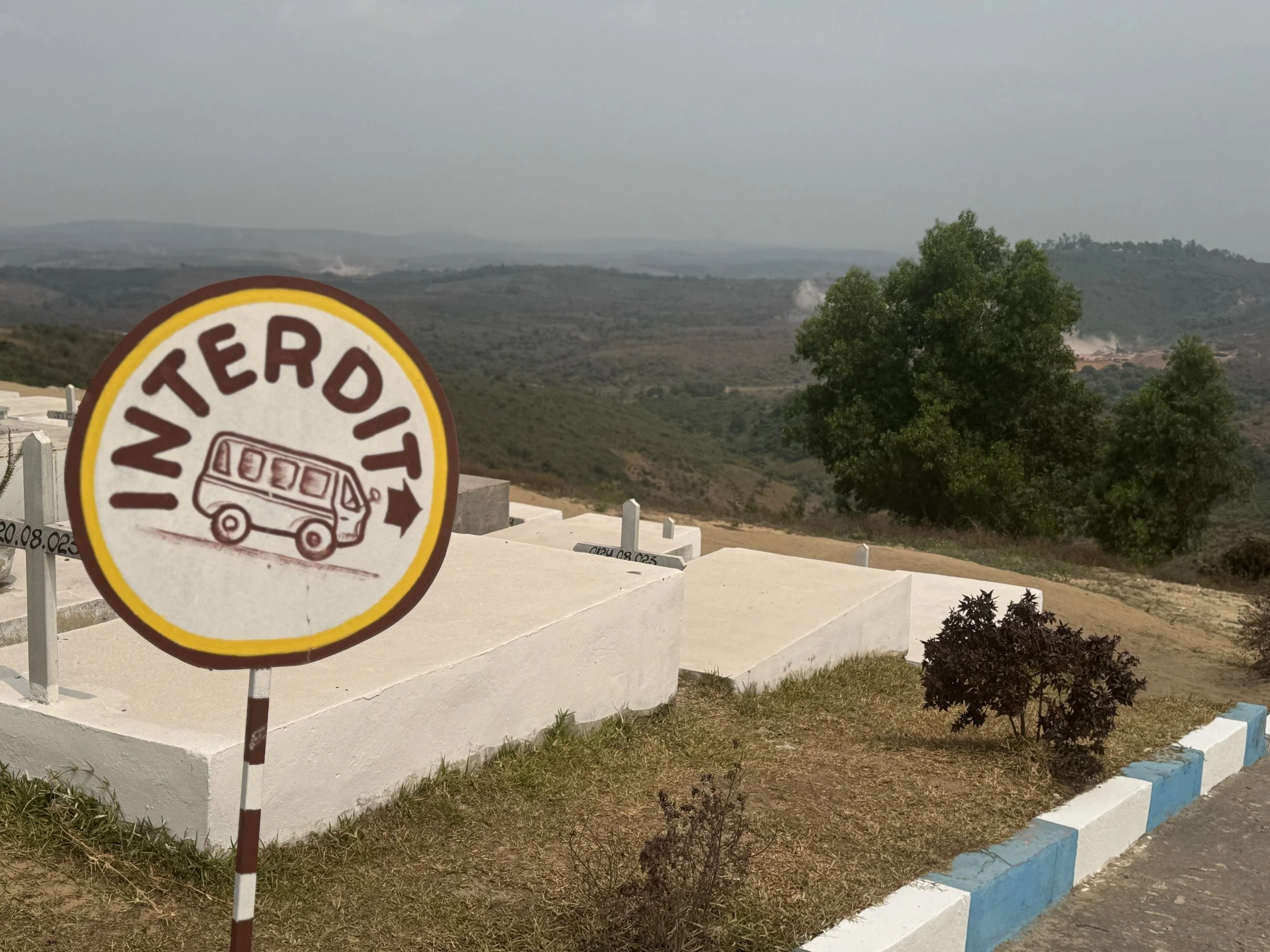
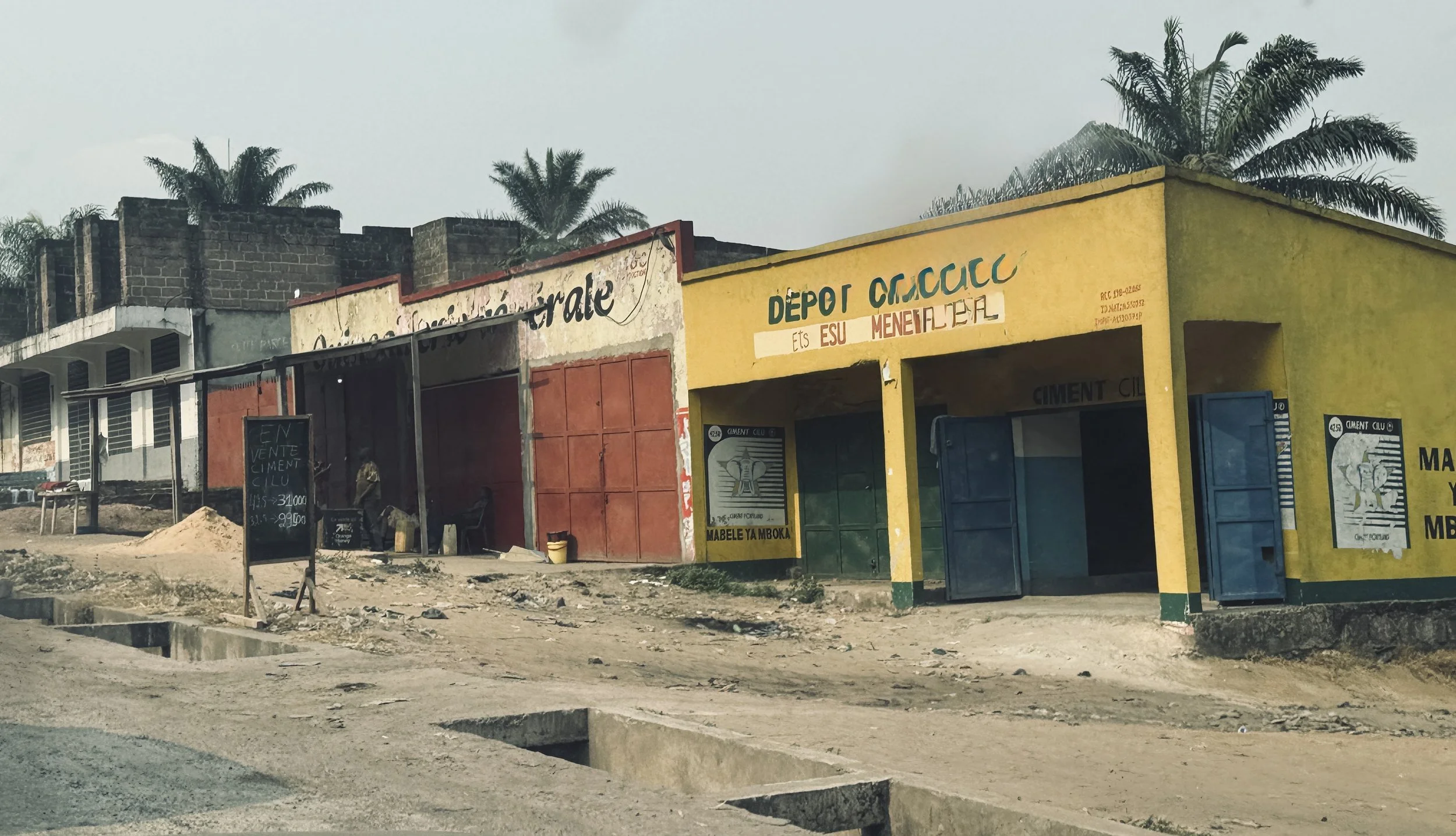
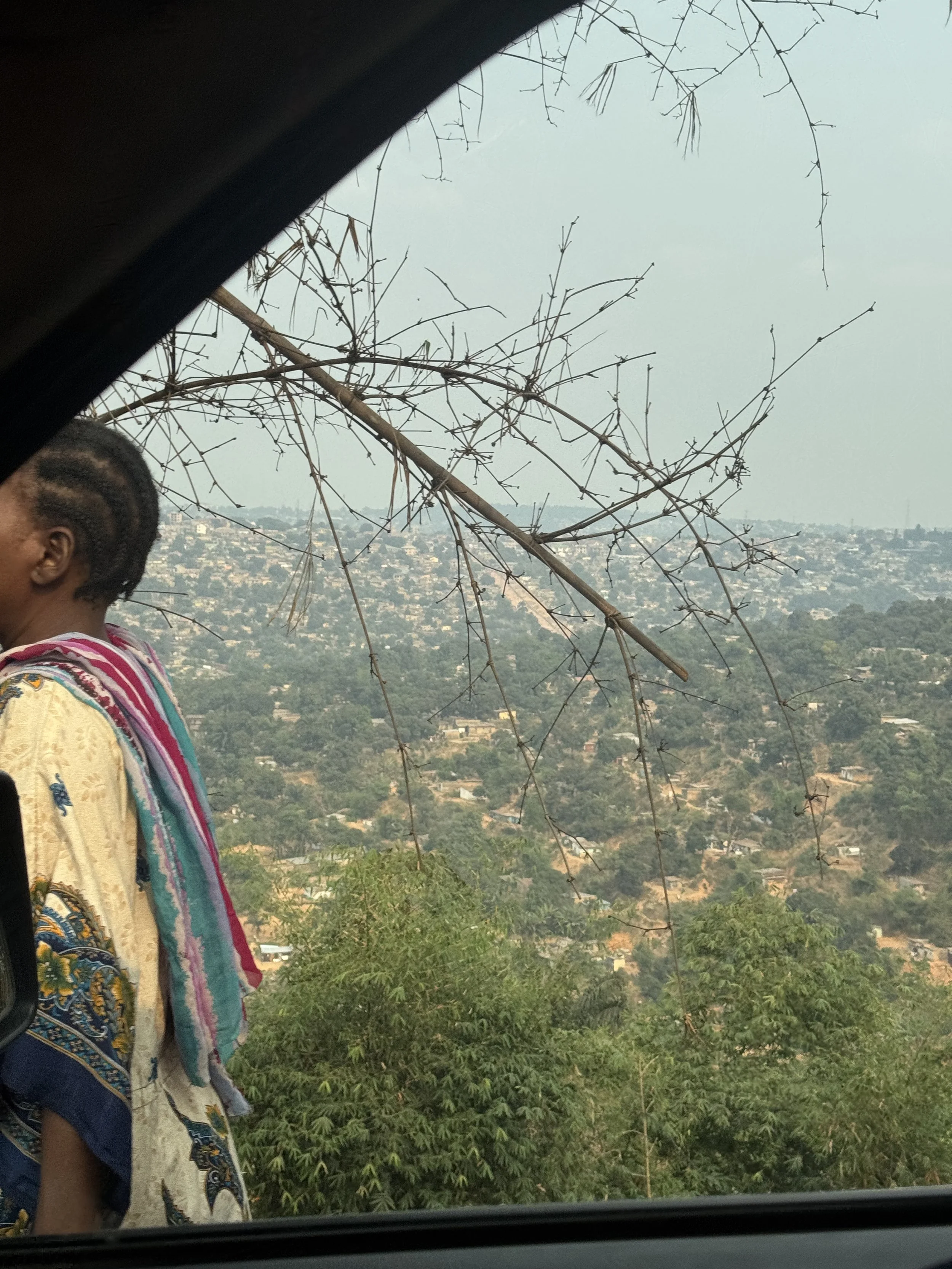
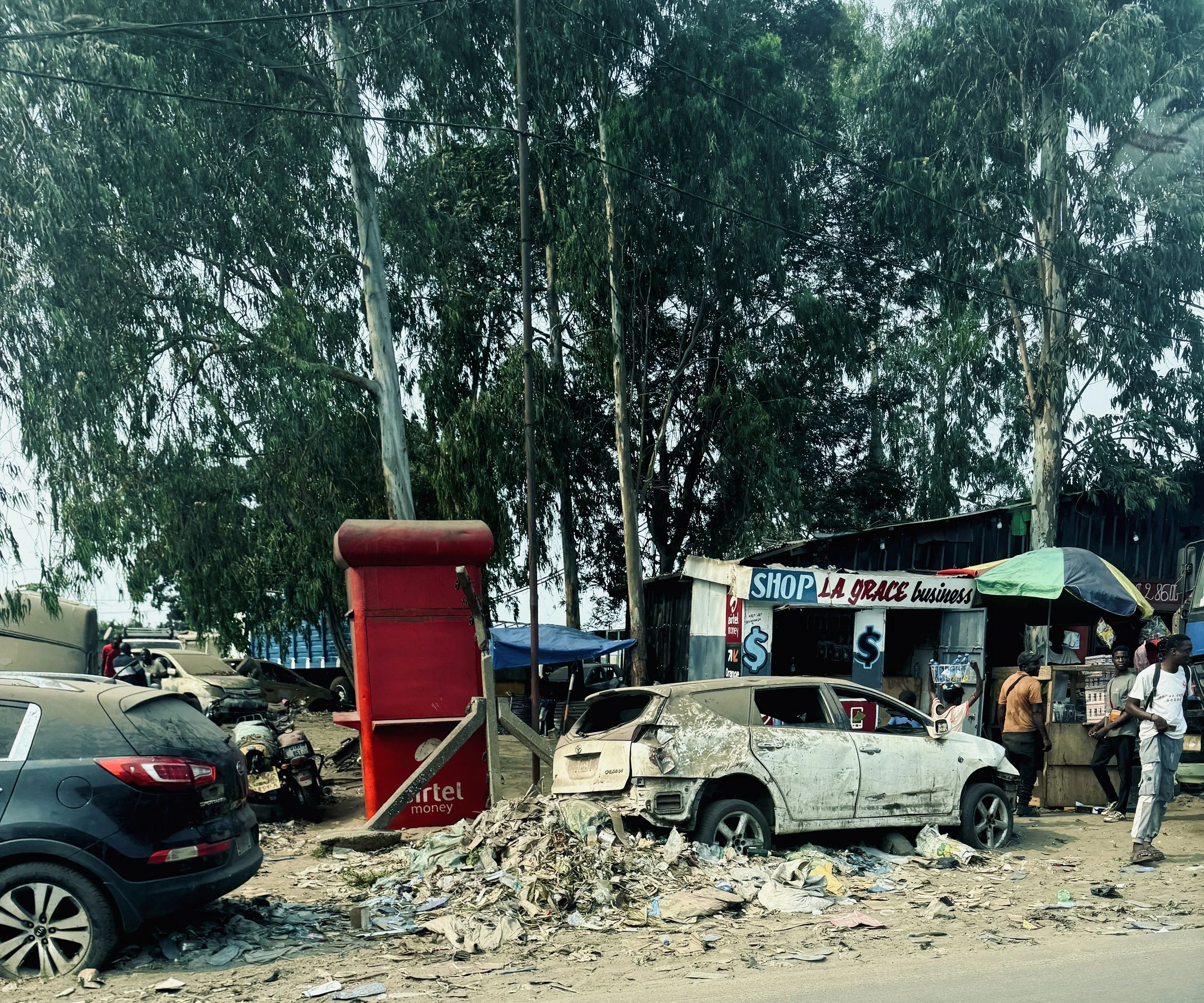
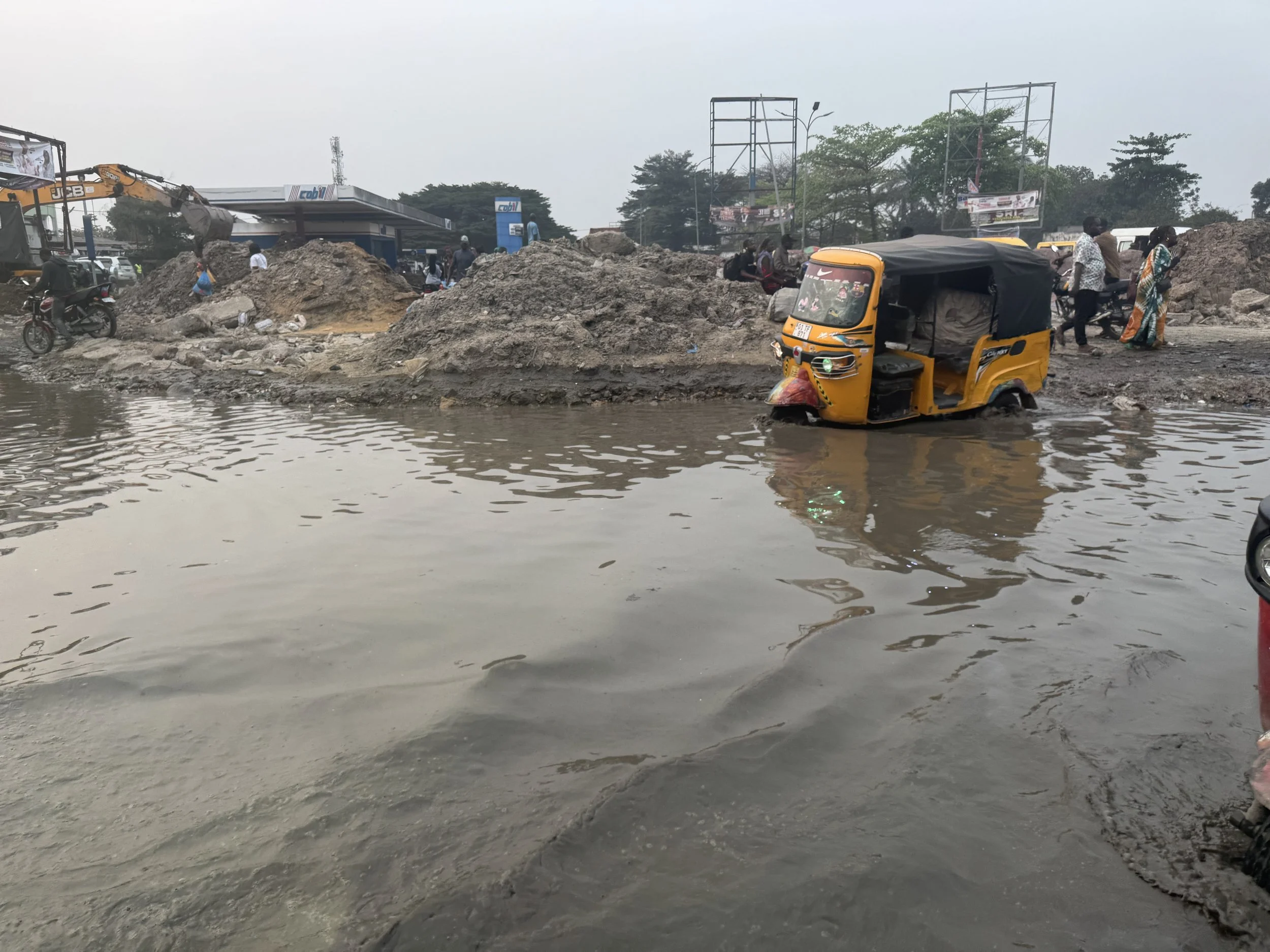
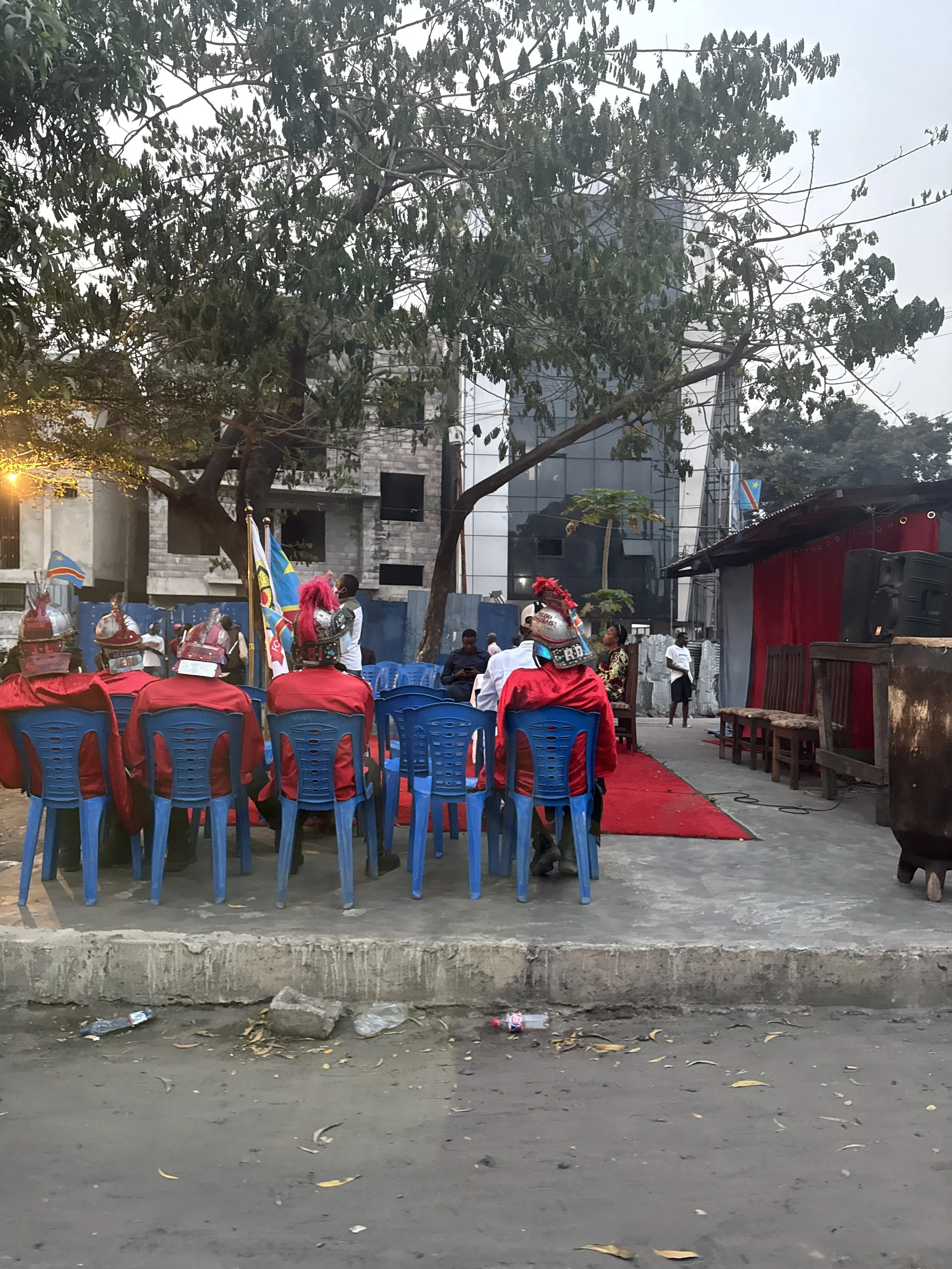
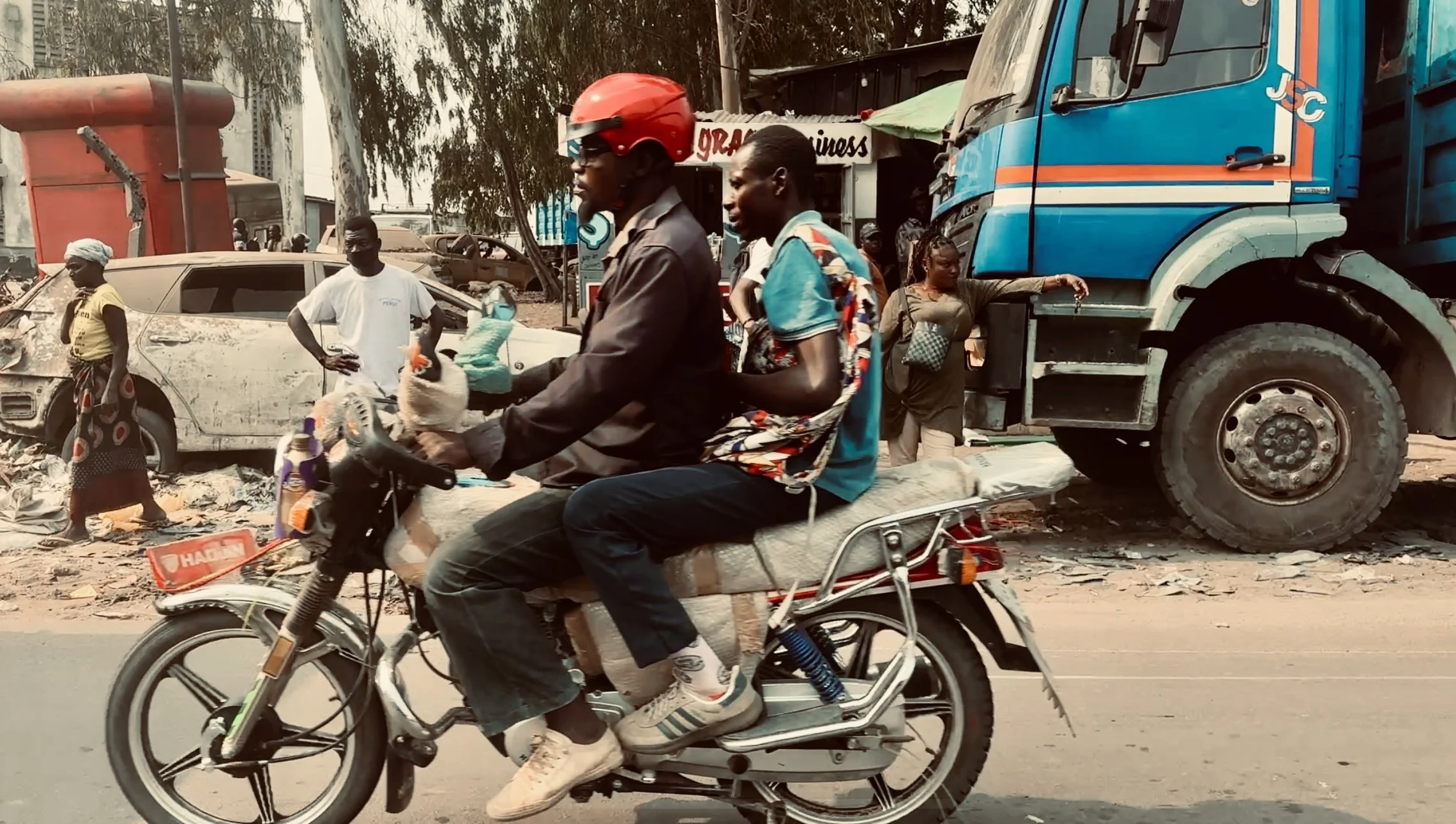
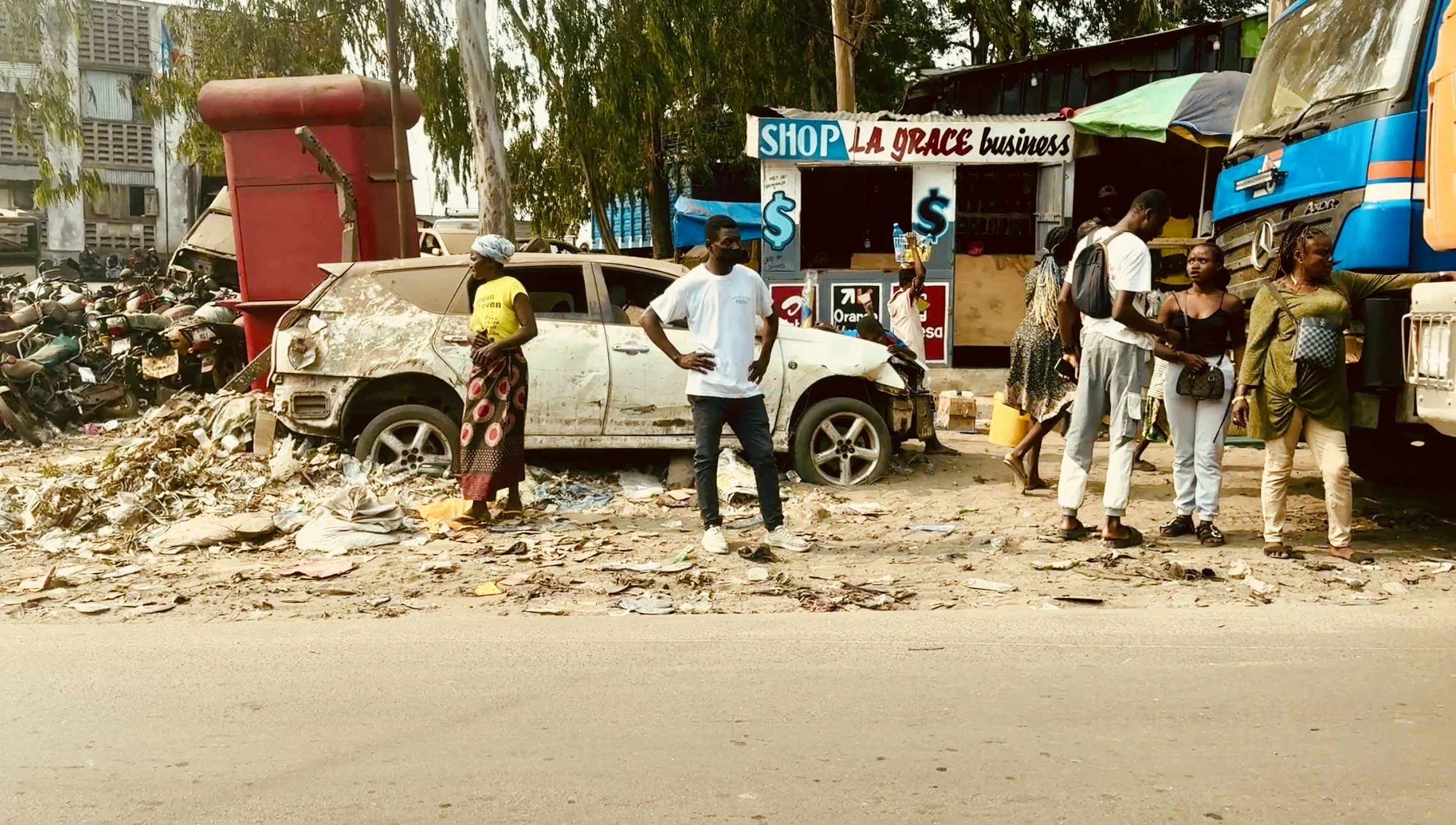
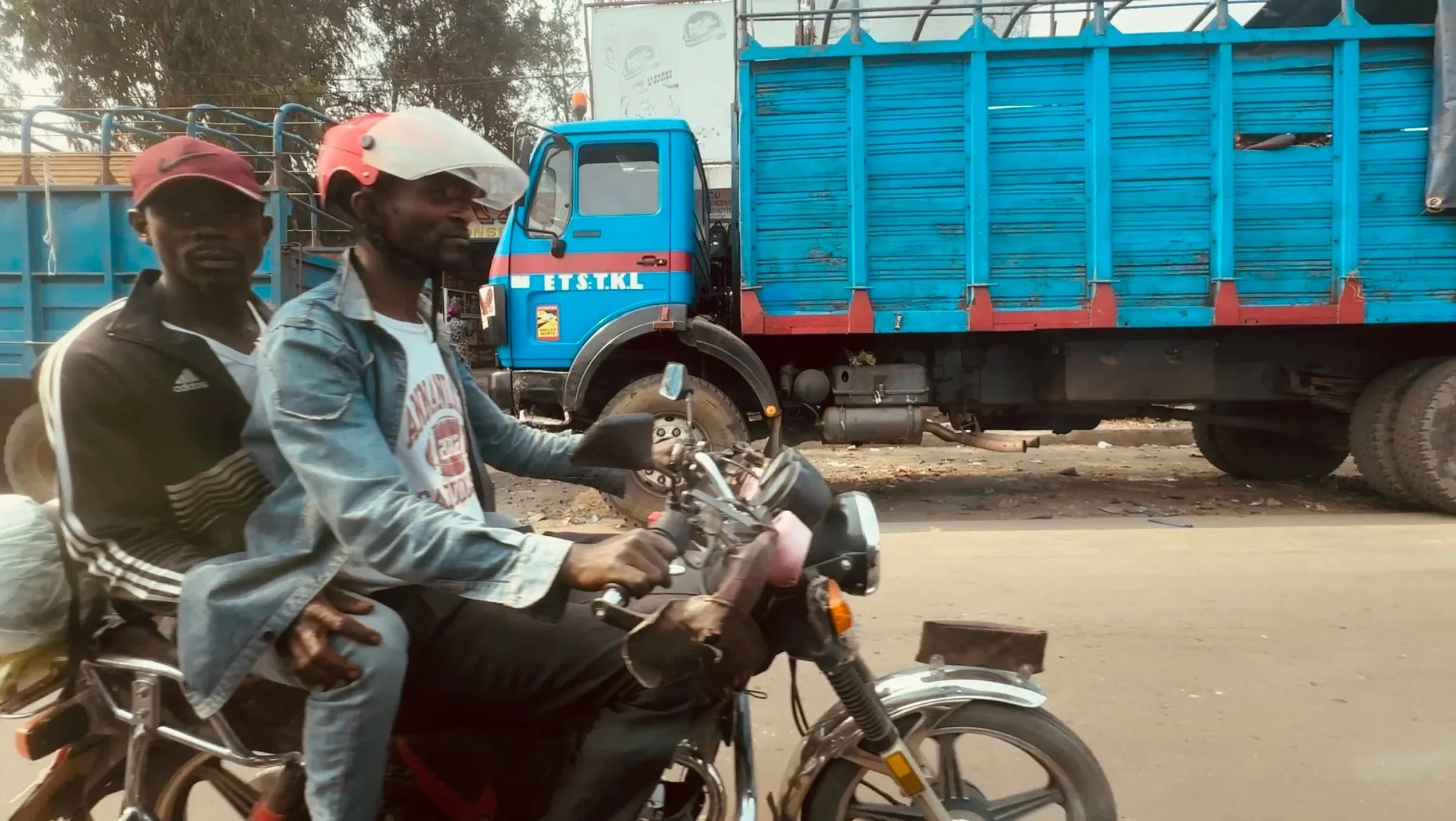
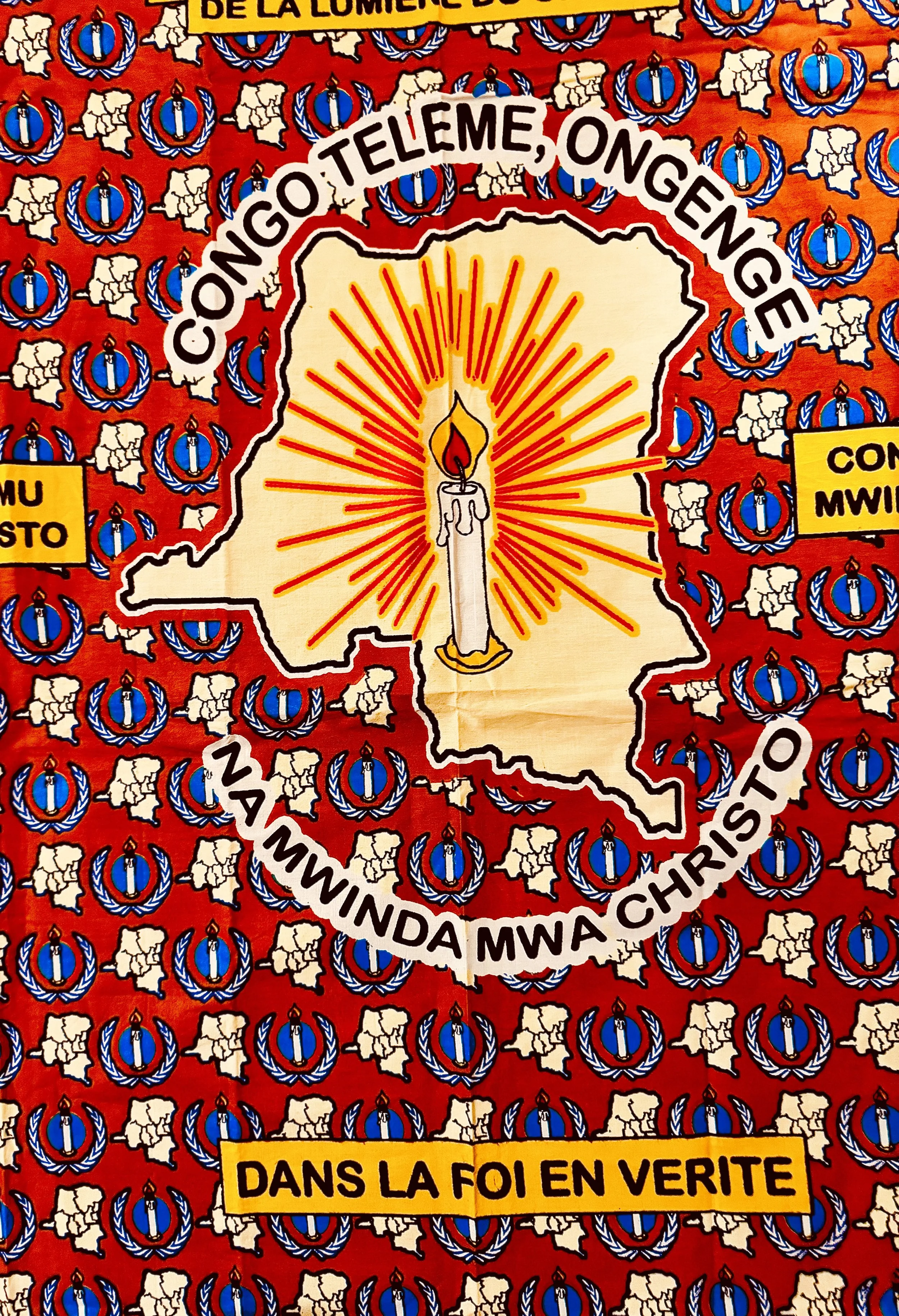
The colours and textures reminded me of my own archive from the Democratic Republic of Congo. The piece became a portrait of the contradictory emotions I associate with being there: love, frustration, familiarity and distance existing at the same time. It reflects the experience of moving through a place that feels both home and not home, where beauty, dysfunction and everyday resilience coexist.

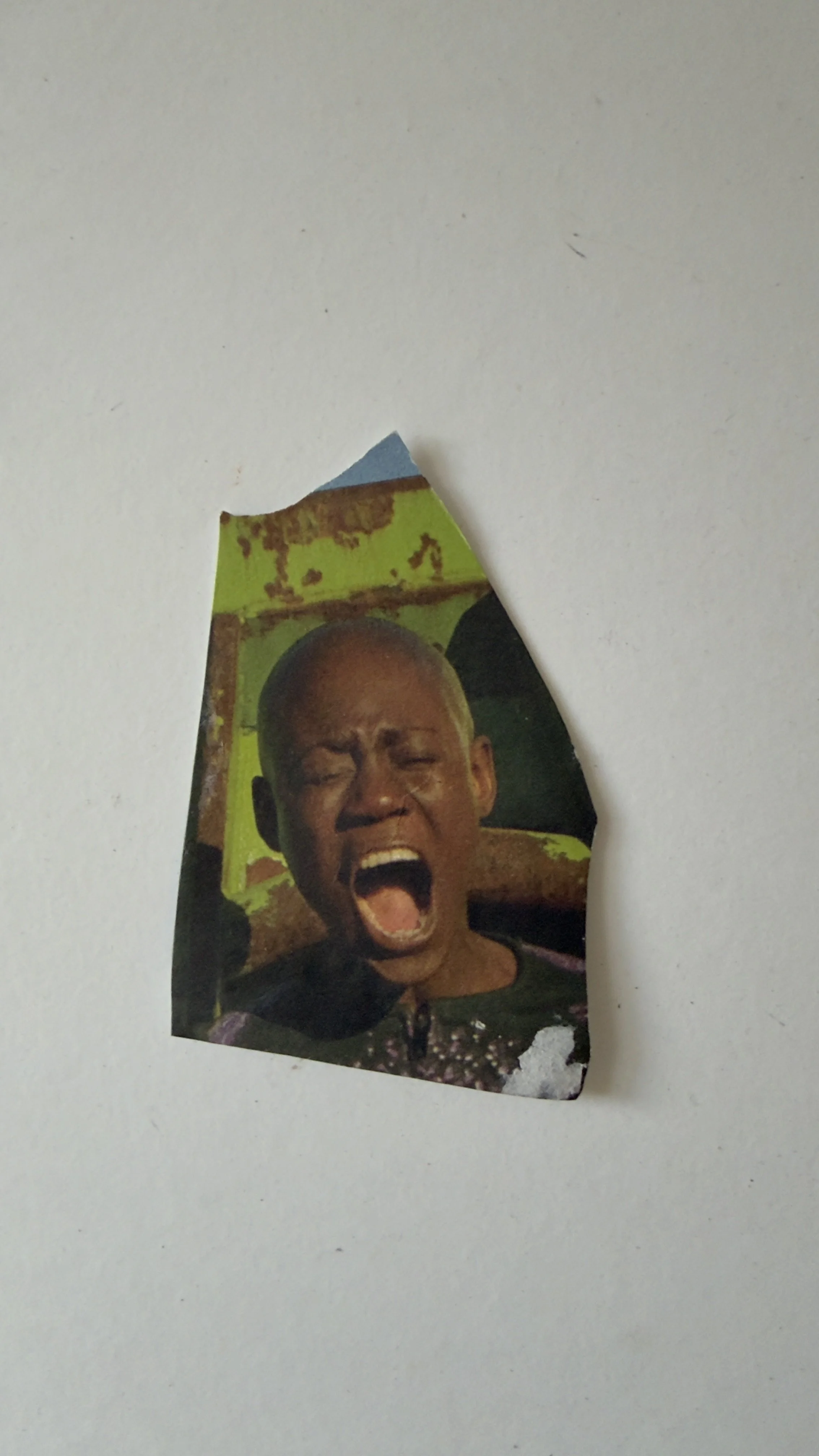
It is titled Scream, but at this scale it is only a shout. The central figure sits within the circle, held inside vine-like trails of Indian ink that absorb rather than release the scream. The composition contains the emotion instead of allowing it to overwhelm the page. Green skull screen prints quietly occupy the spaces left by the cutting, connecting the work to other experiments made during this period of research and development.

Scream

Mixed-media collage on paper

50 × 70 cm

2026

World War Moi

Mixed-media collage on paper

50 × 70 cm

2026

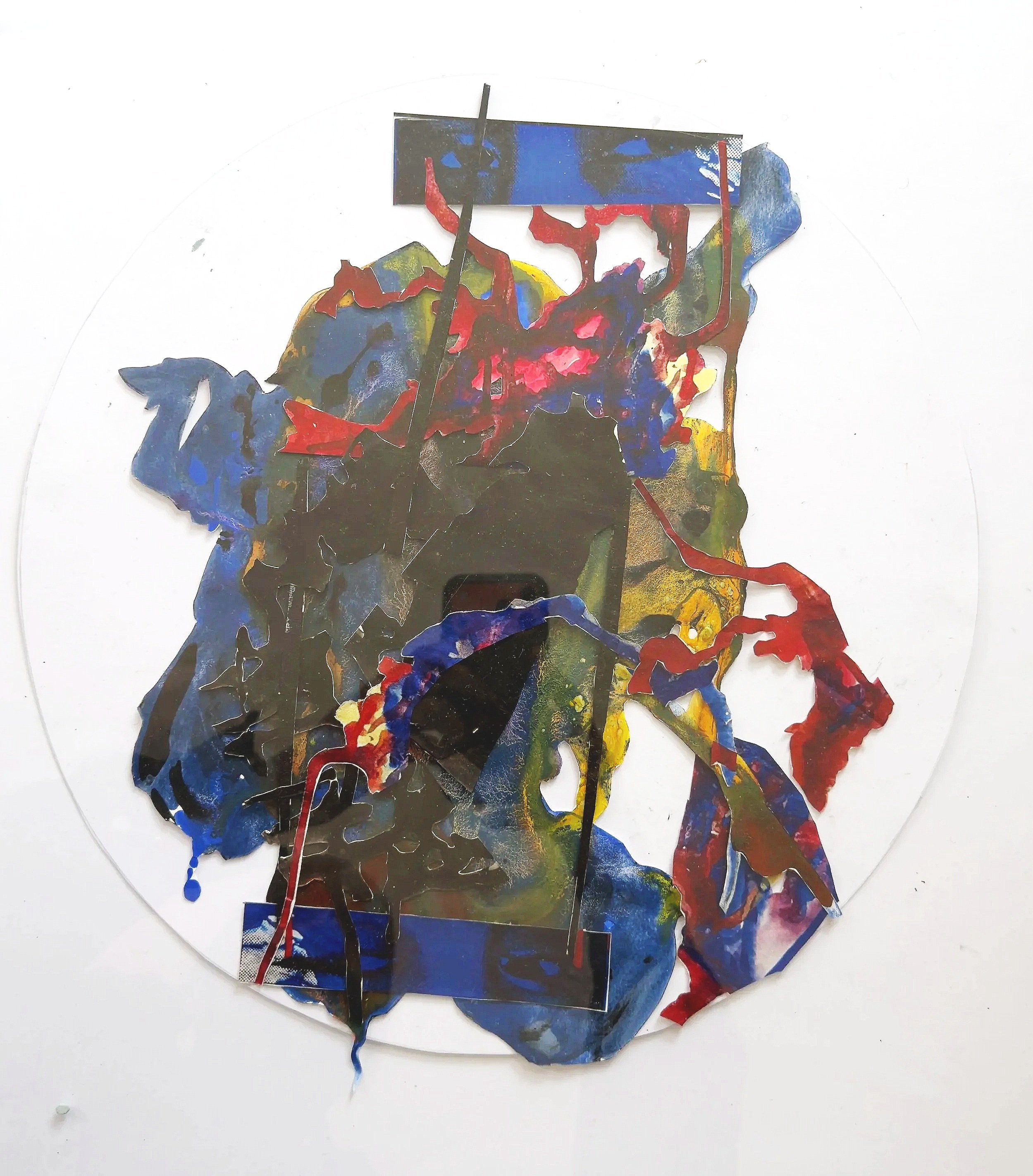
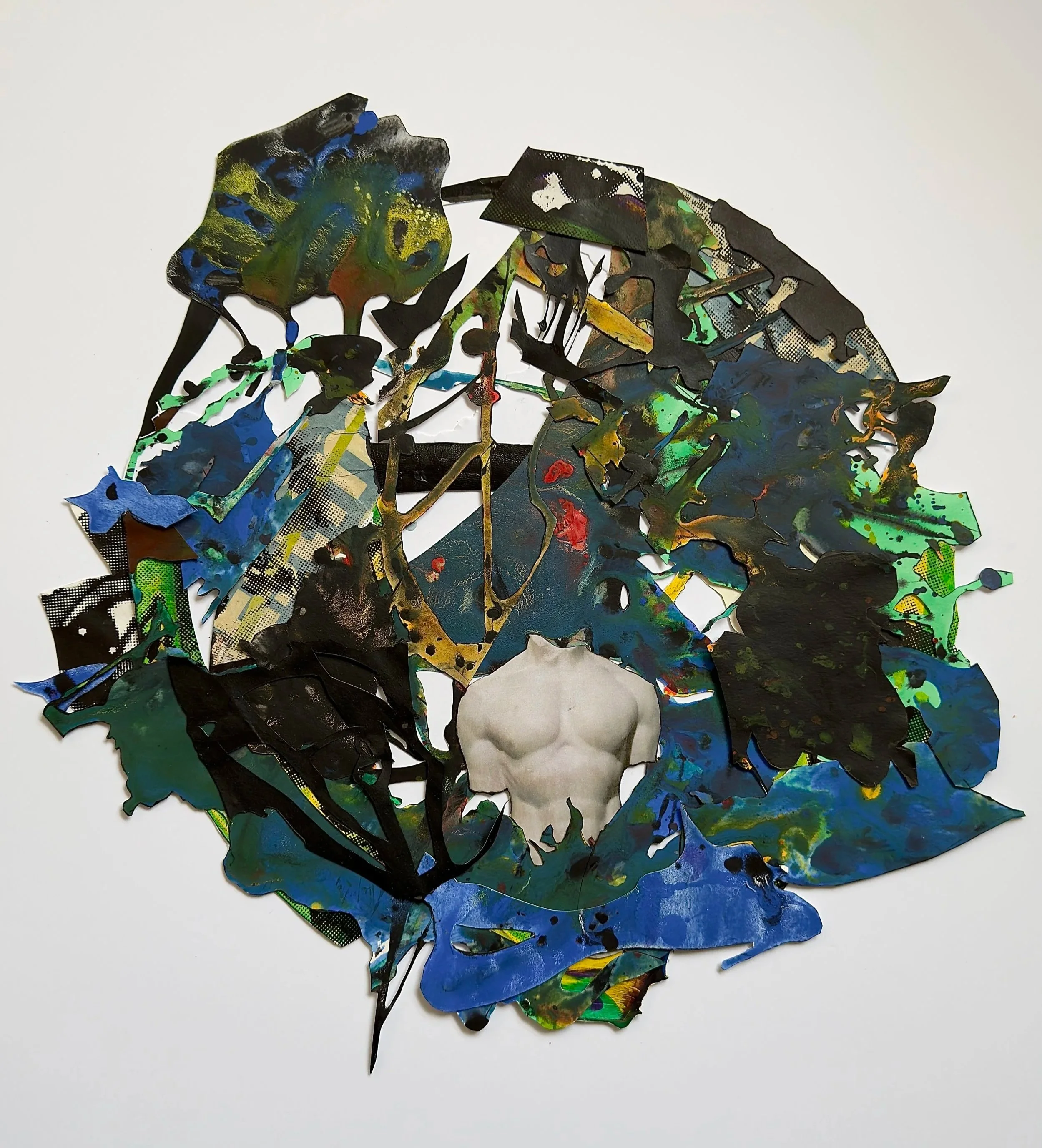
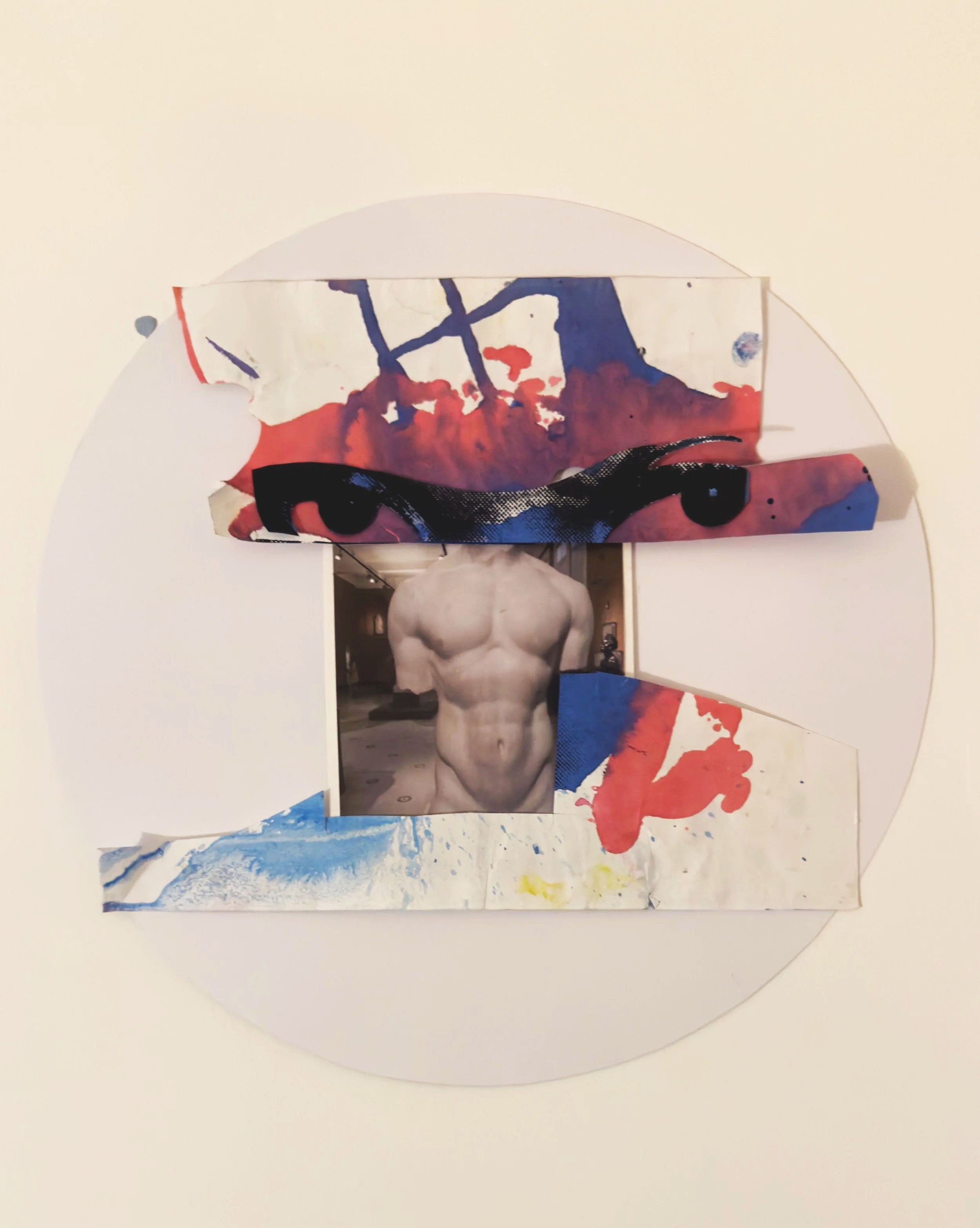
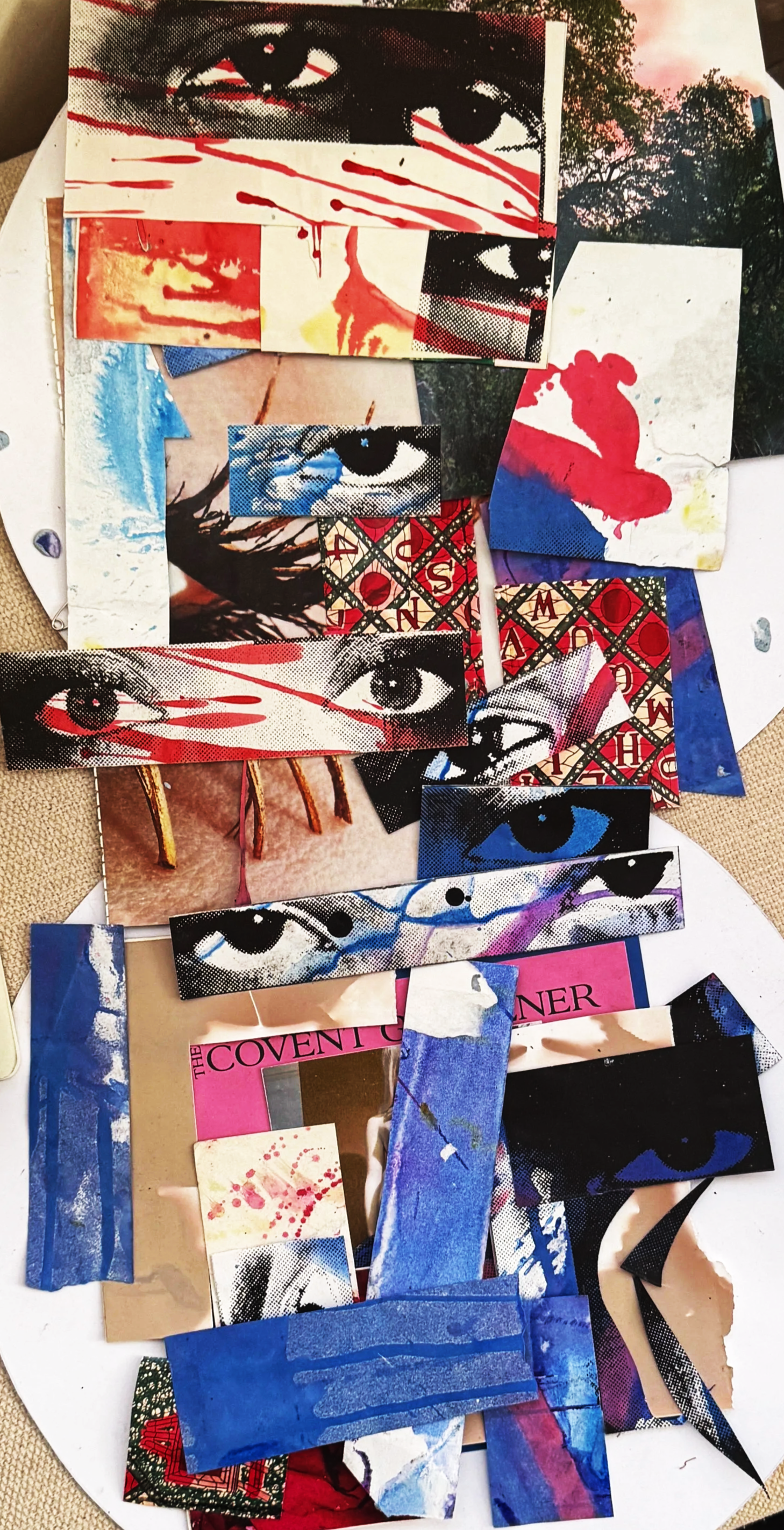
World War Moi was built over three weeks for the Paxton Centre exhibition through the continual exchange of material between collages. Fragments migrated from one composition to another as the work gradually emerged through repeated cycles of cutting, layering, removing and rebuilding. The title began as World War Me before becoming World War Moi. The shift into French reflected my Congolese heritage and acknowledged a conflict that has shaped the Democratic Republic of Congo for decades. It also widened the work beyond autobiography, placing personal concerns alongside longer histories of war and political instability.

The torso was one of the final elements to enter the work. Taken from a photograph I made of a classical bust at the British Museum, it introduced a centre of gravity to what had been an almost entirely abstract composition. I was interested in the irony of using an object held within an institution that remains central to debates around ownership, repatriation and cultural stewardship, while also drawing on its associations with discipline, permanence and idealised masculinity.

The title came from a much smaller conflict. While wars, political crises and economic instability dominated the news, I found myself thinking about dieting, masculinity and self-improvement. The piece became a reflection on how private concerns continue alongside public crises. Around the figure, storm systems, eyes, architectural fragments and painted forms compete for attention, creating a world that feels simultaneously unstable and familiar.

A small bow appears within the composition. For me it acknowledges both vulnerability and limitation. Much of what shapes our lives lies beyond individual control, yet we continue searching for moments of agency within larger social, political and economic systems.

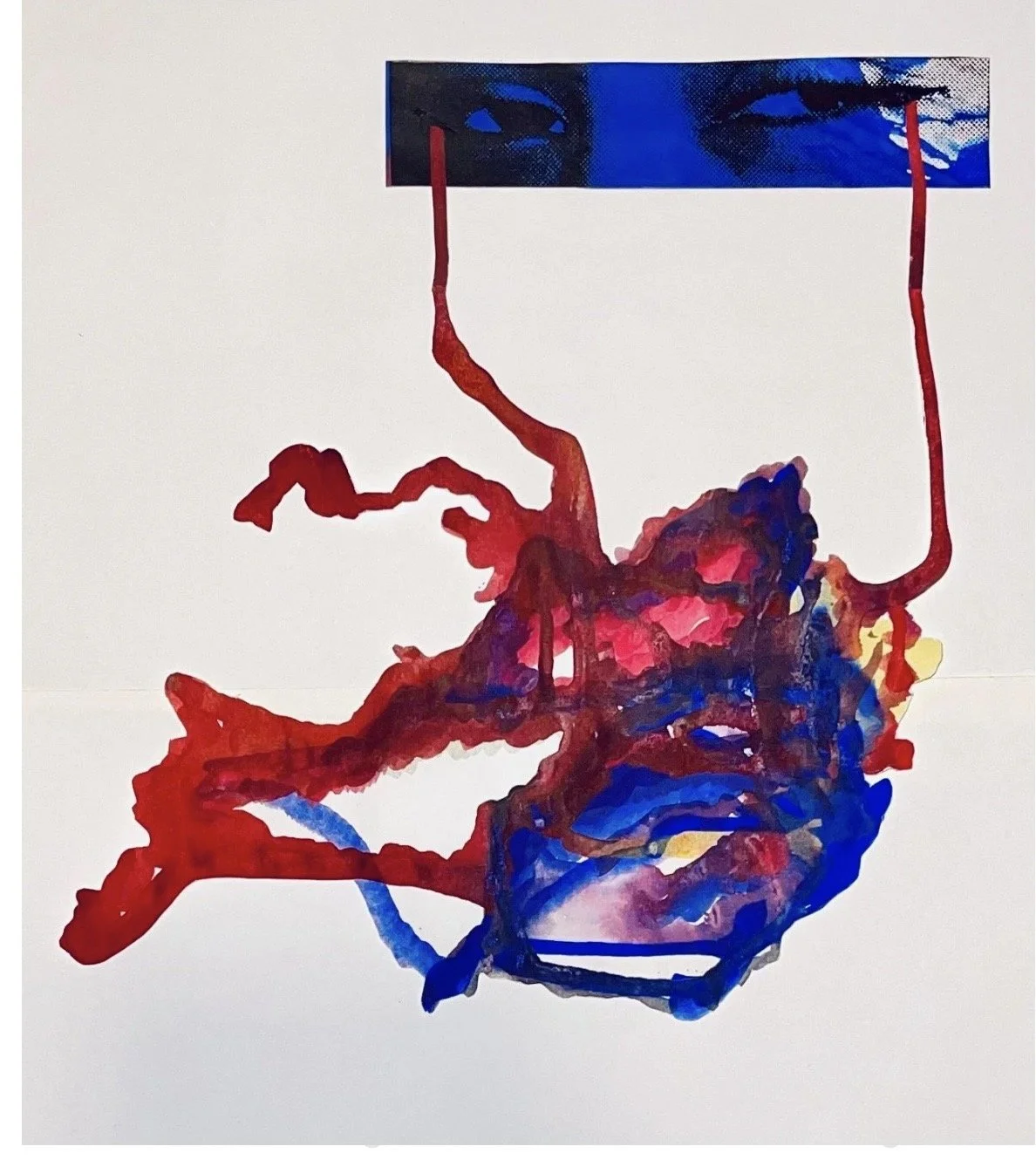
Clockin' You, Crossin' Me (Aisha)

Mixed-media collage, giclée print on photographic paper

61 × 91 cm

2022

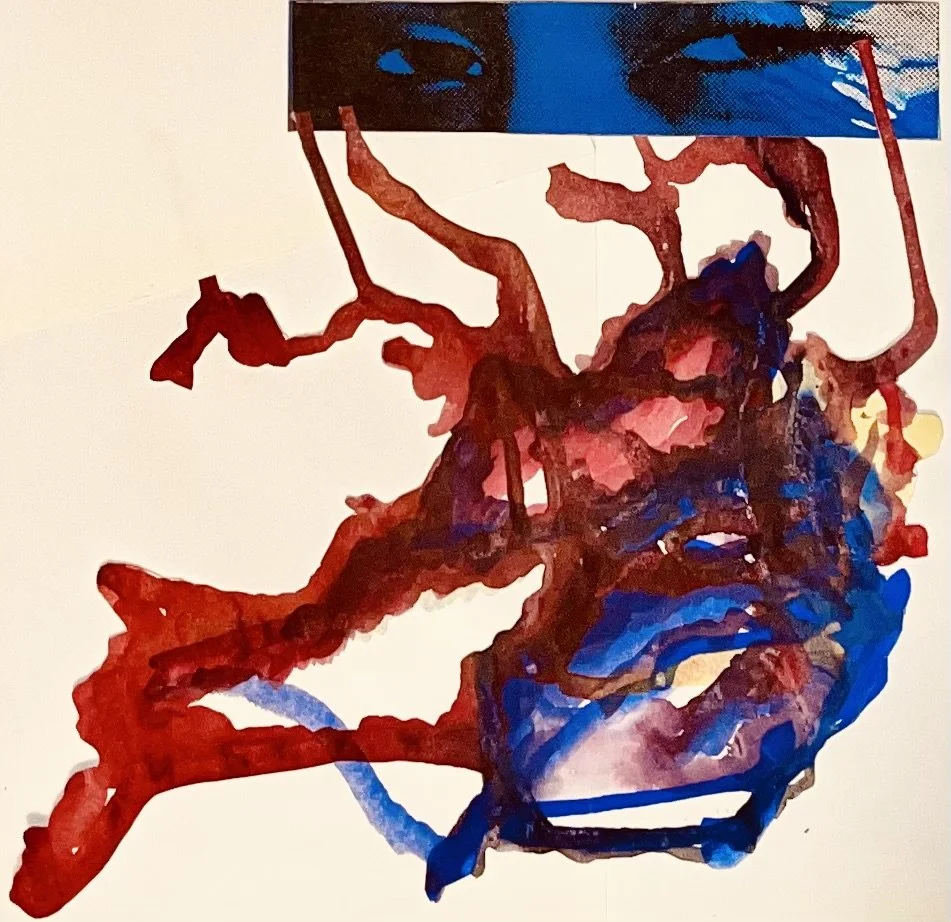
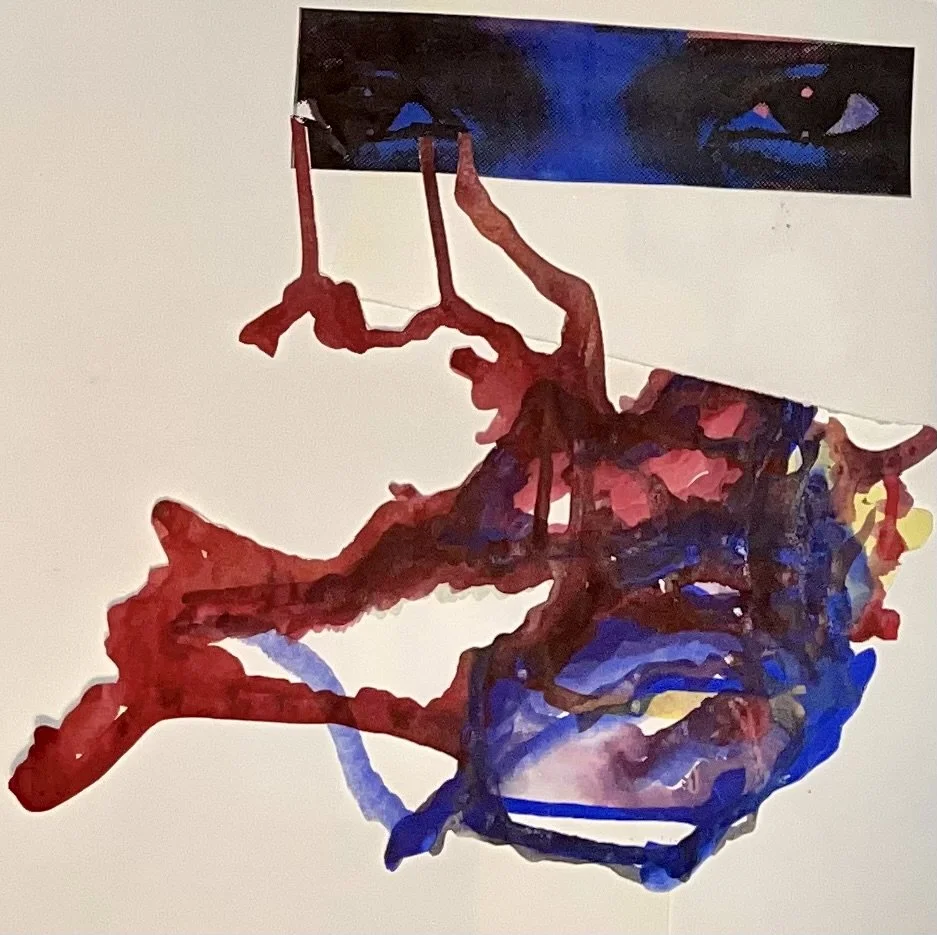
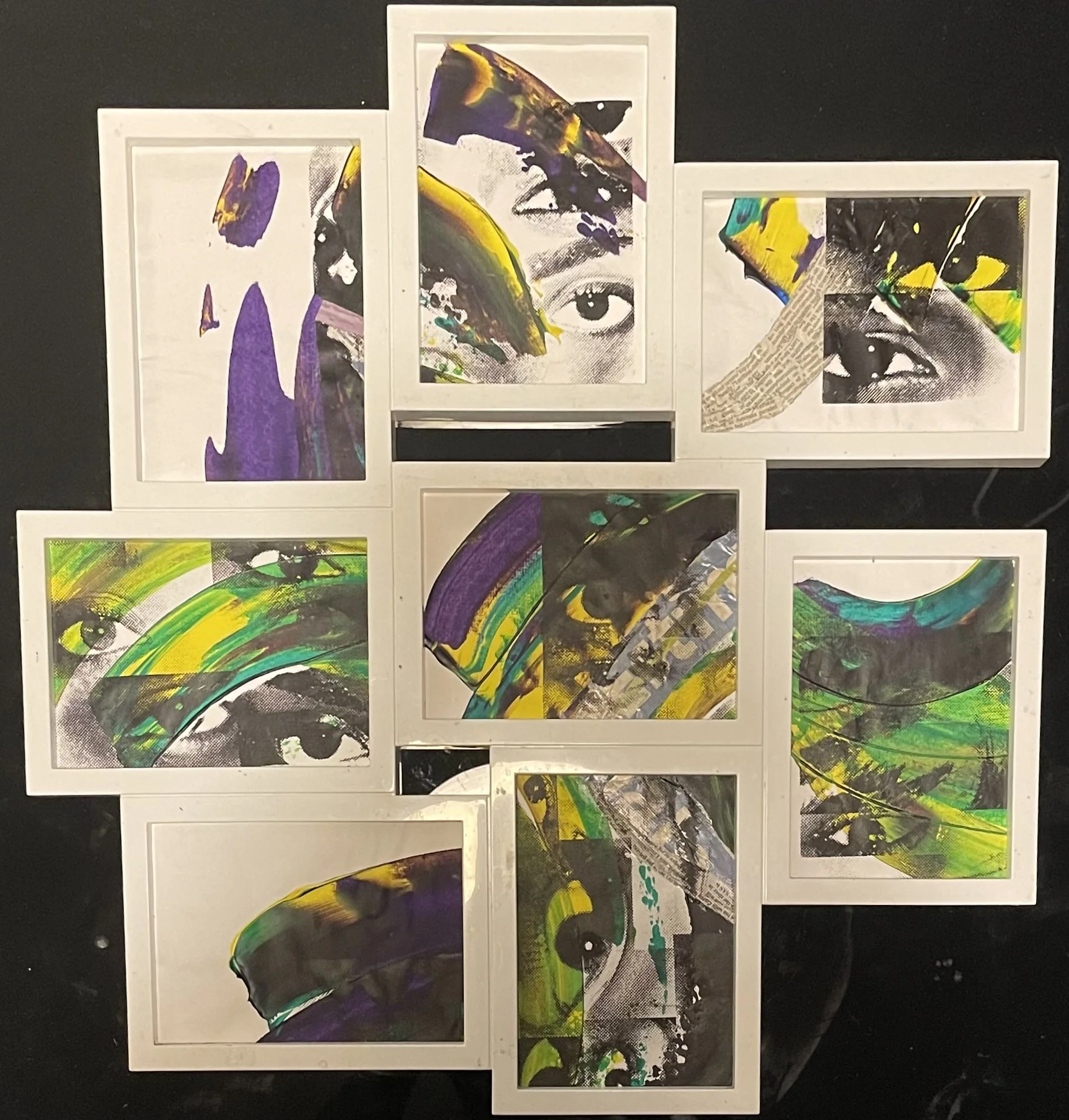
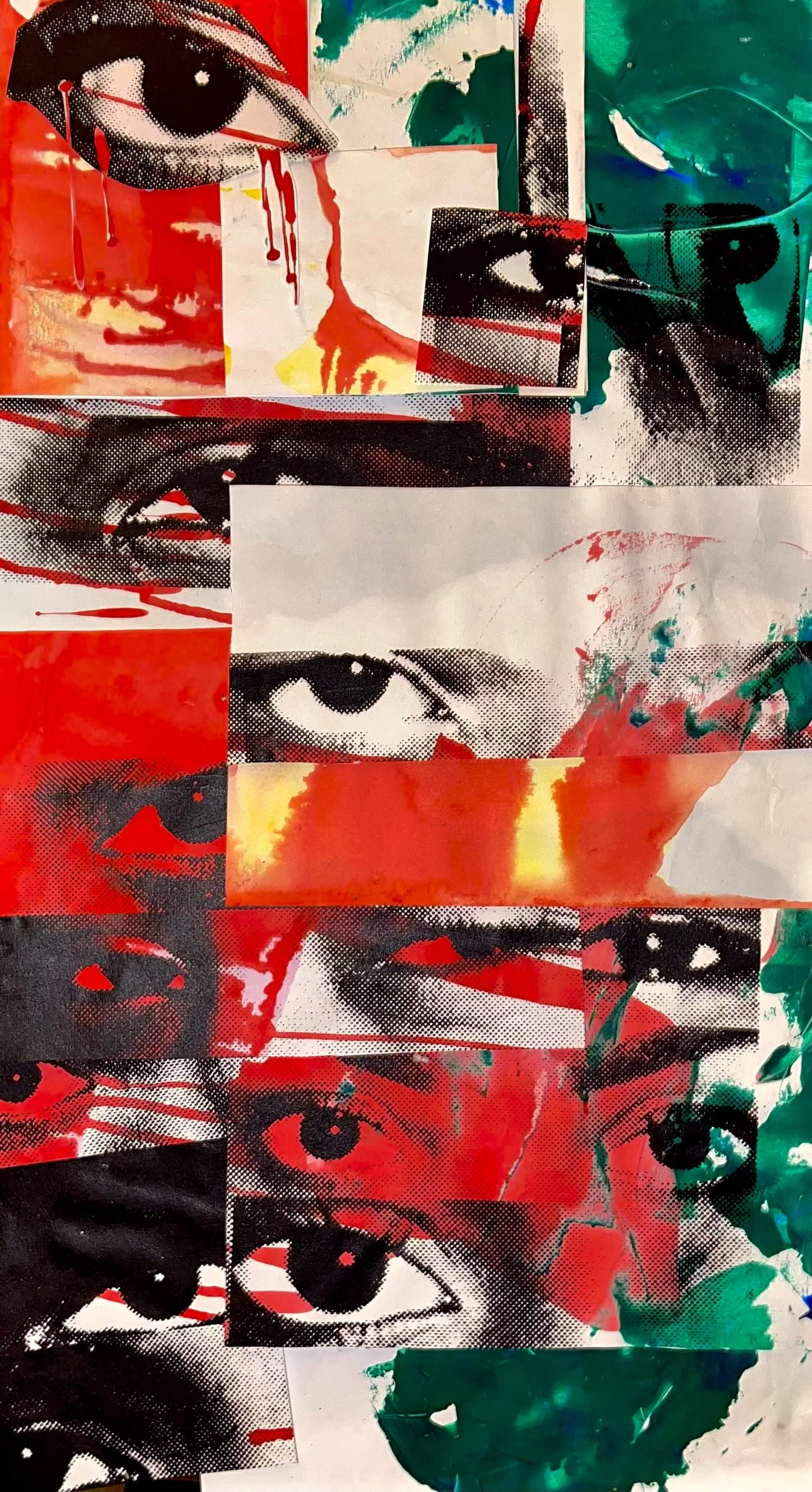
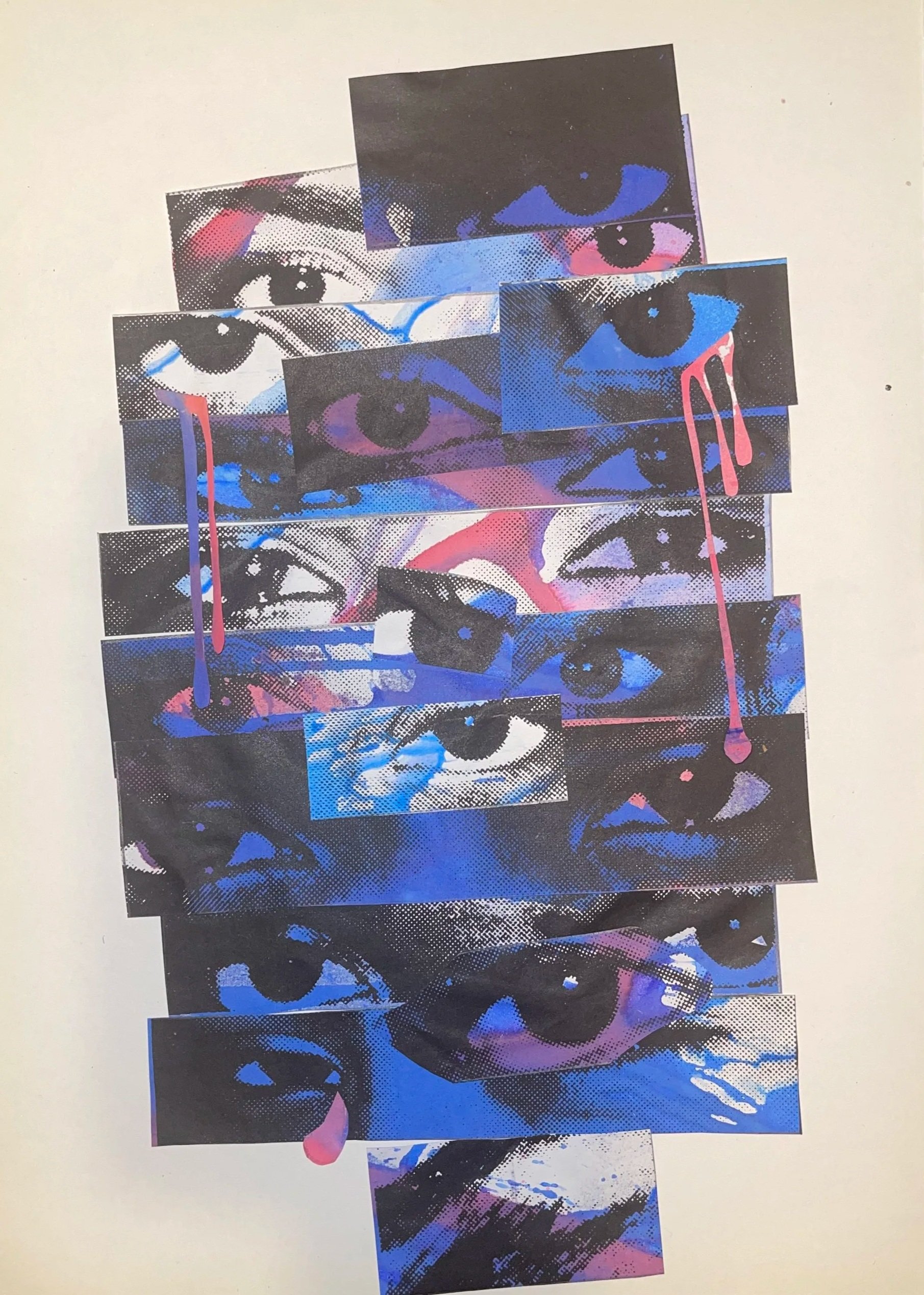
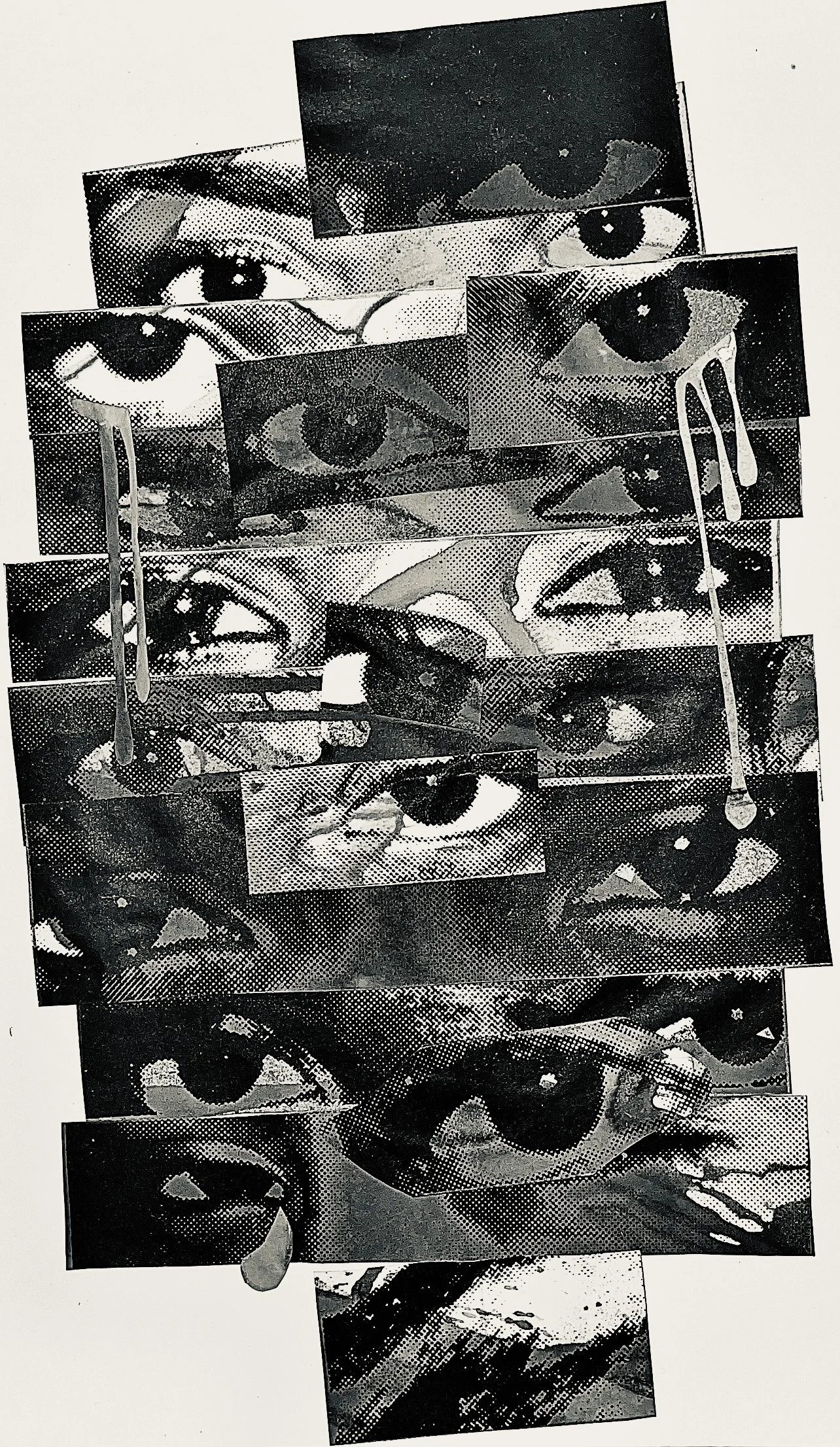
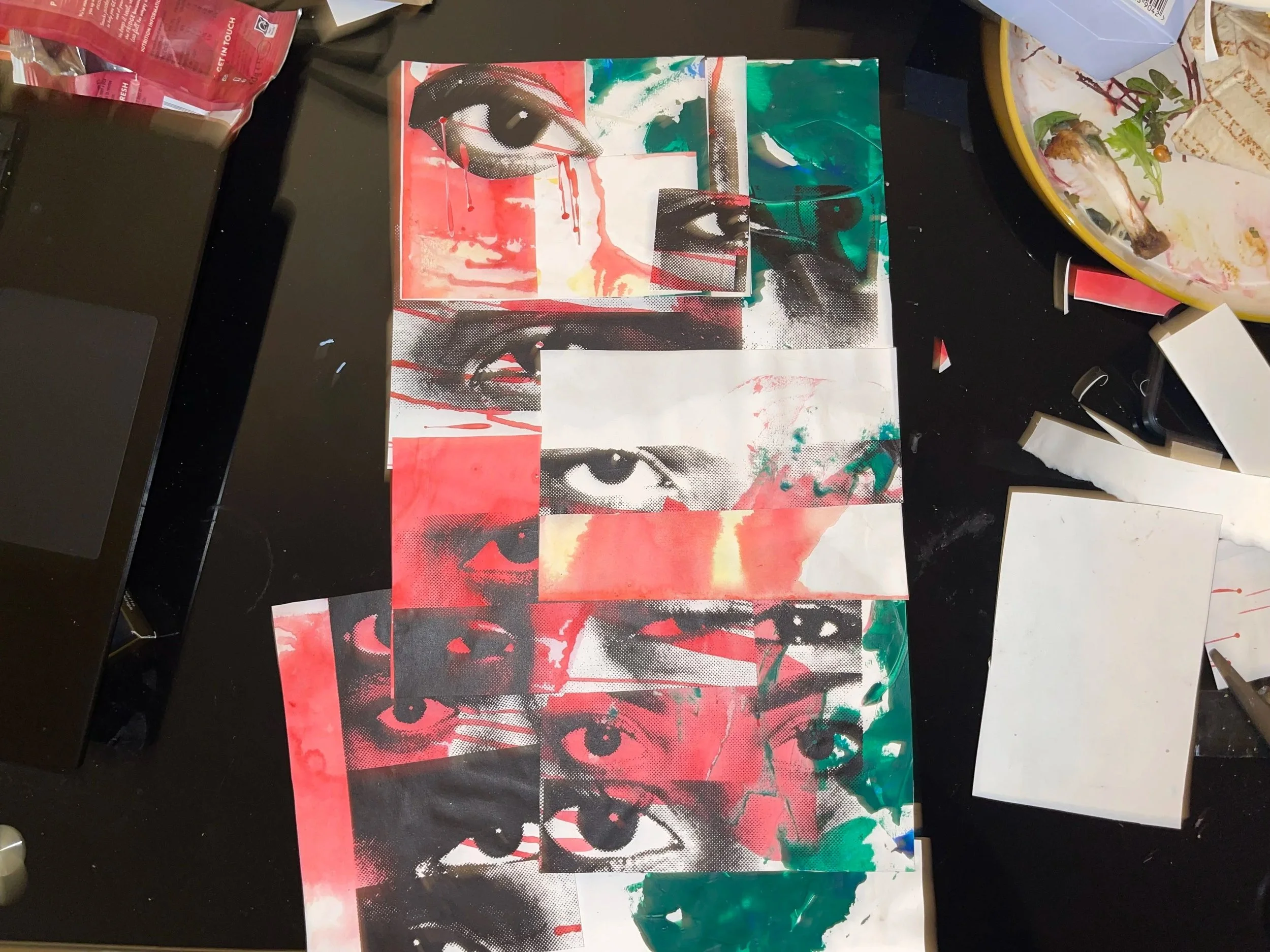
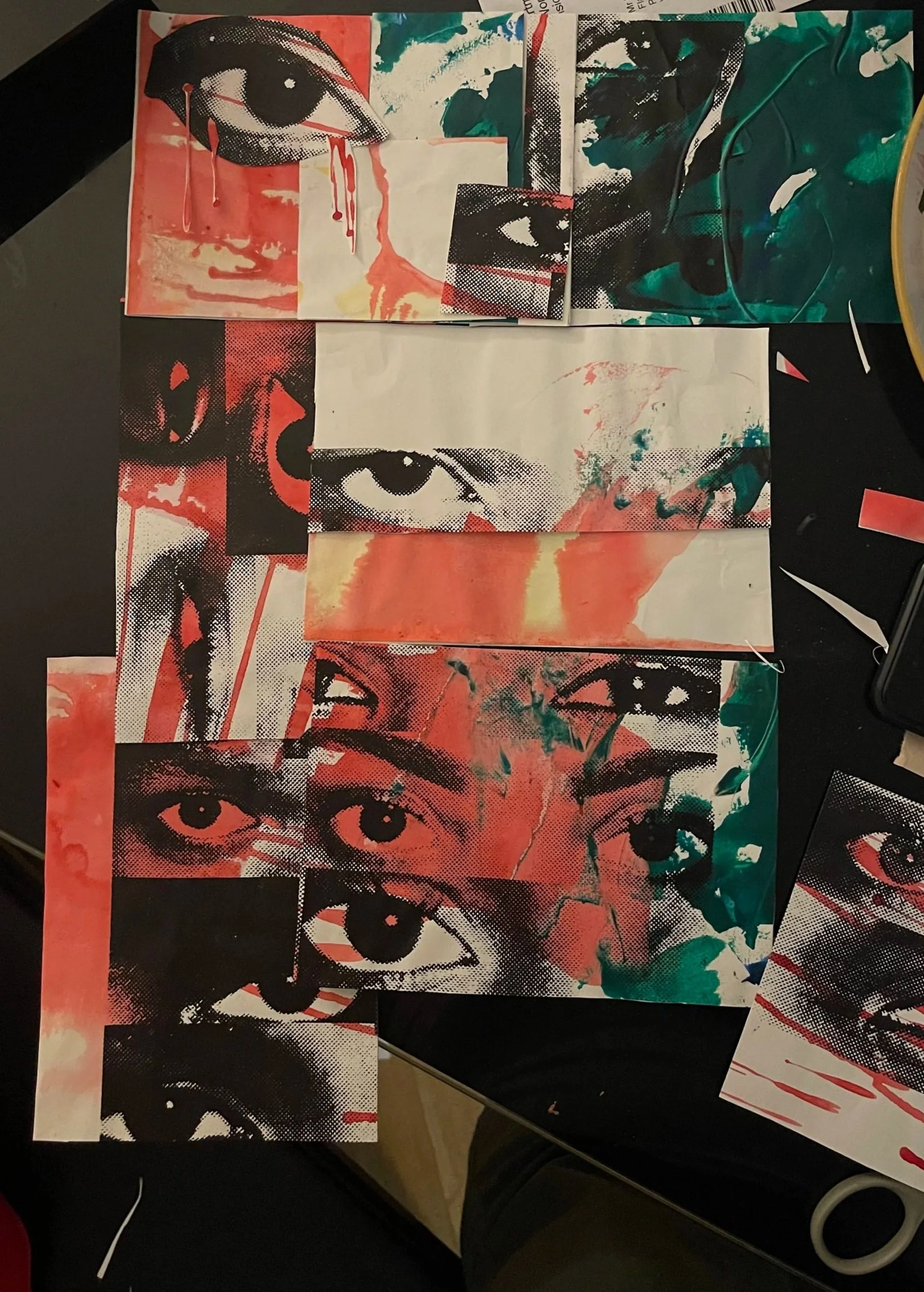
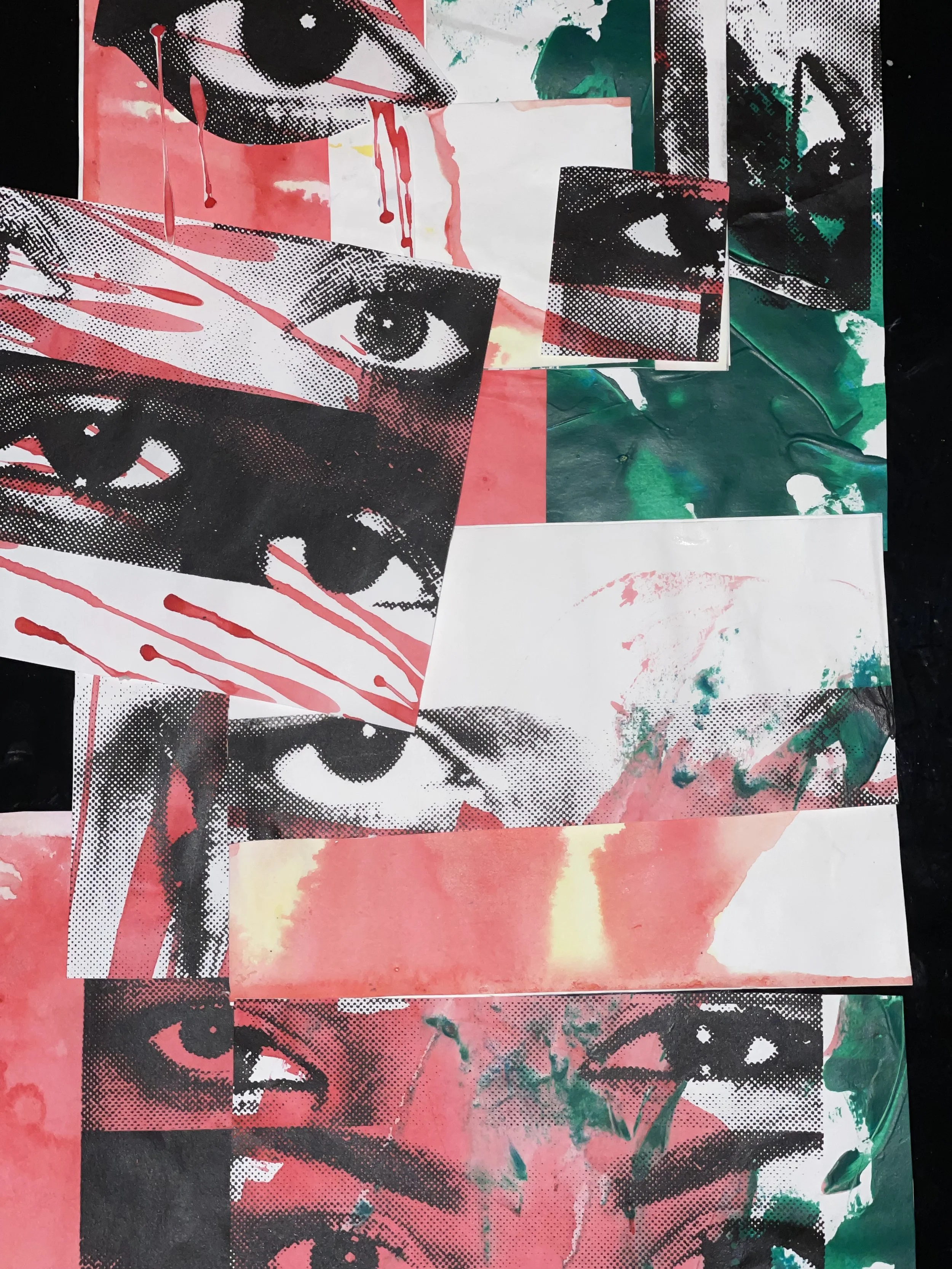
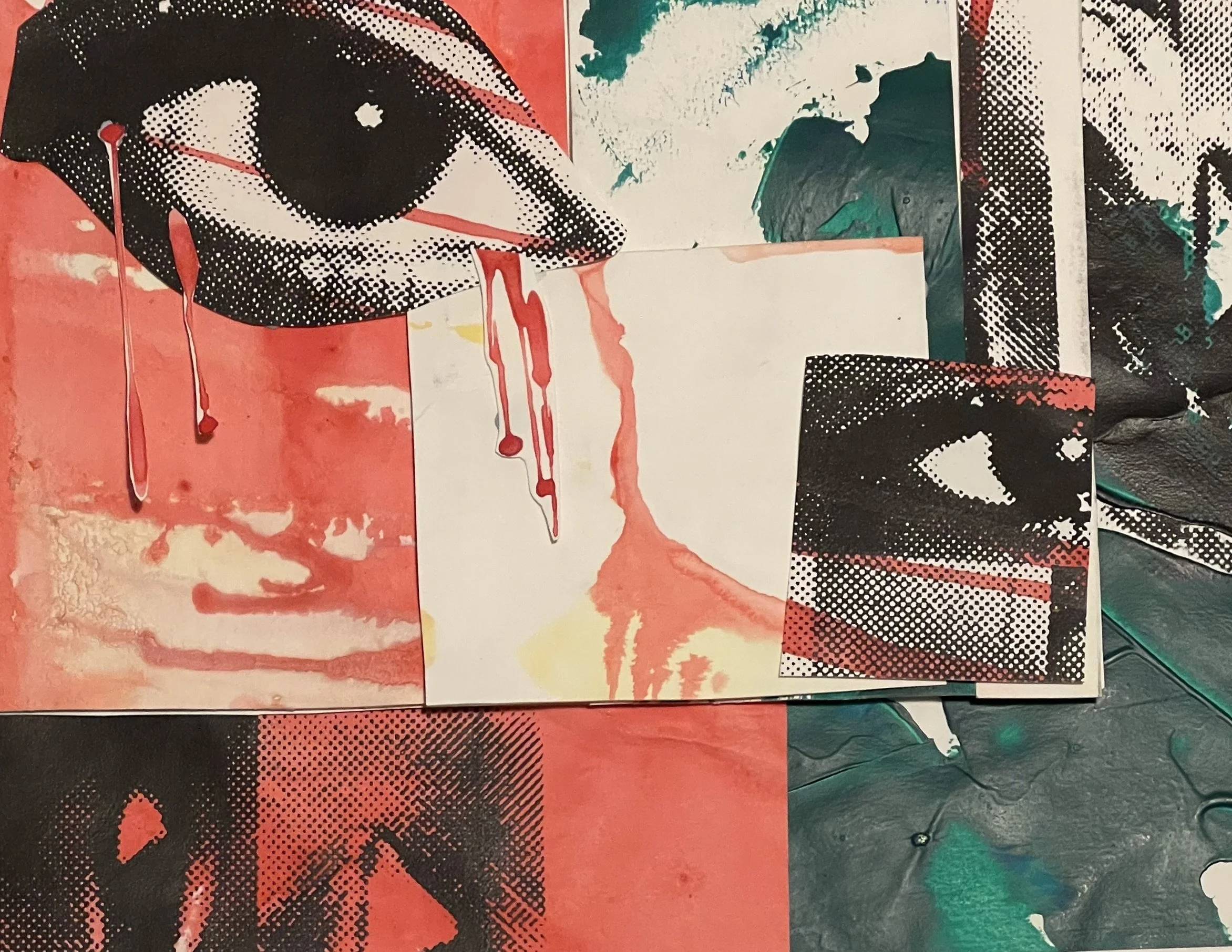
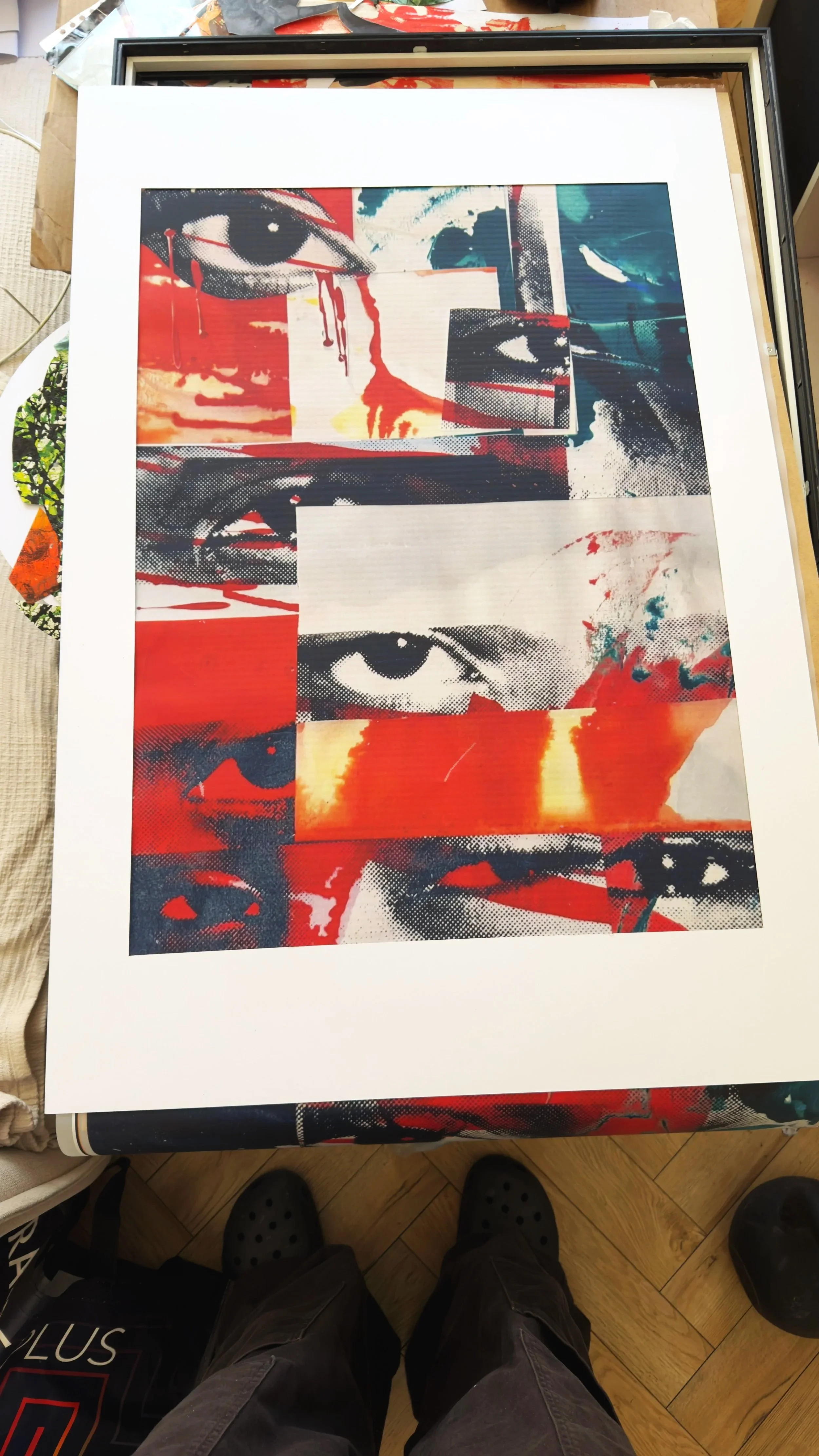
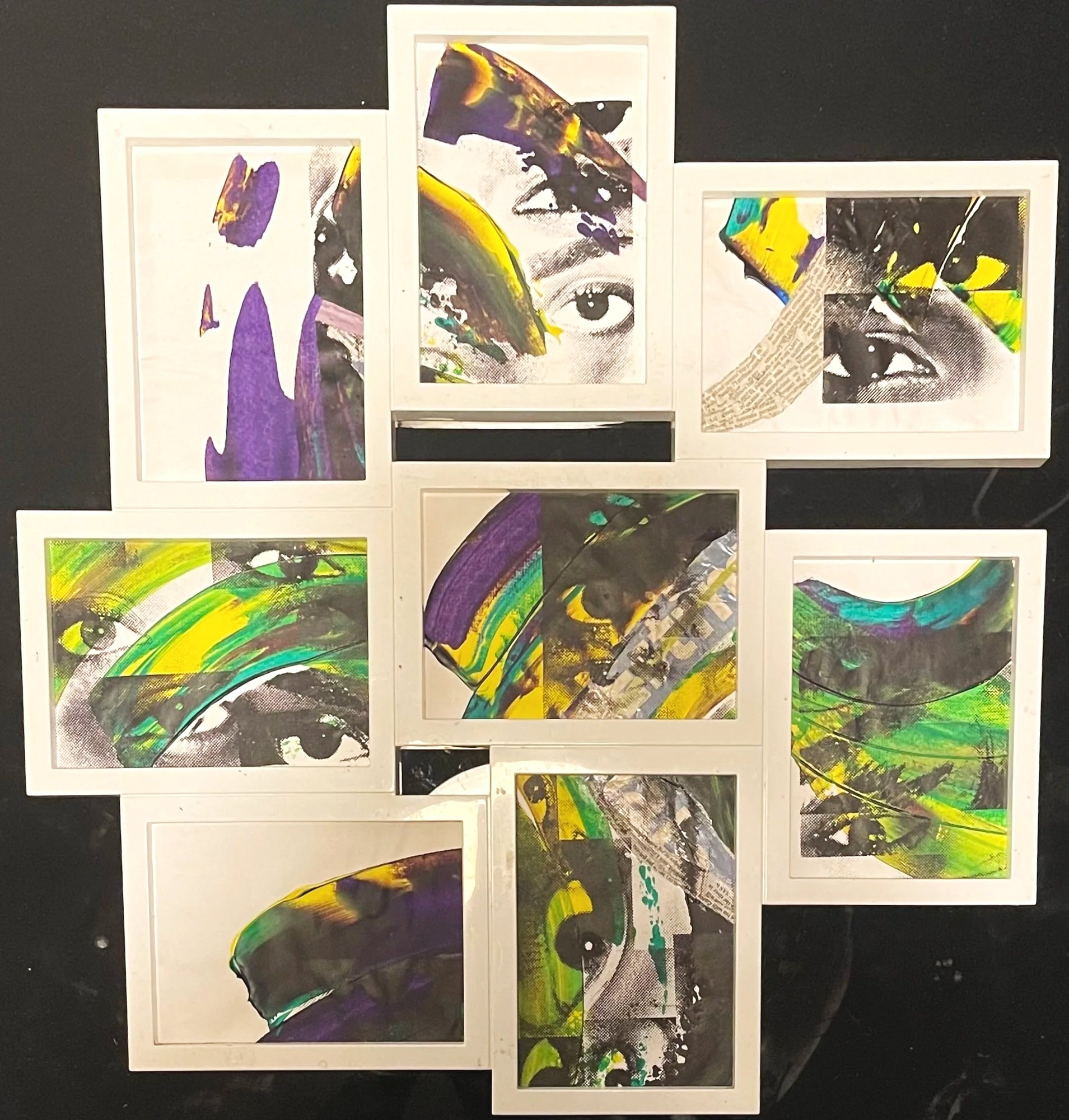
When Aisha was moving house in 2020 and clearing out her studio, she handed me a stack of experimental screen prints, mostly repeated grids of eyes, that she was about to throw away and suggested I do something with them instead. I did. At first, I thought I would use them as teaching material when I returned to working as an Art Teaching Assistant with 11 to 18-year-olds. Instead, they became the first collages I had made in several years.

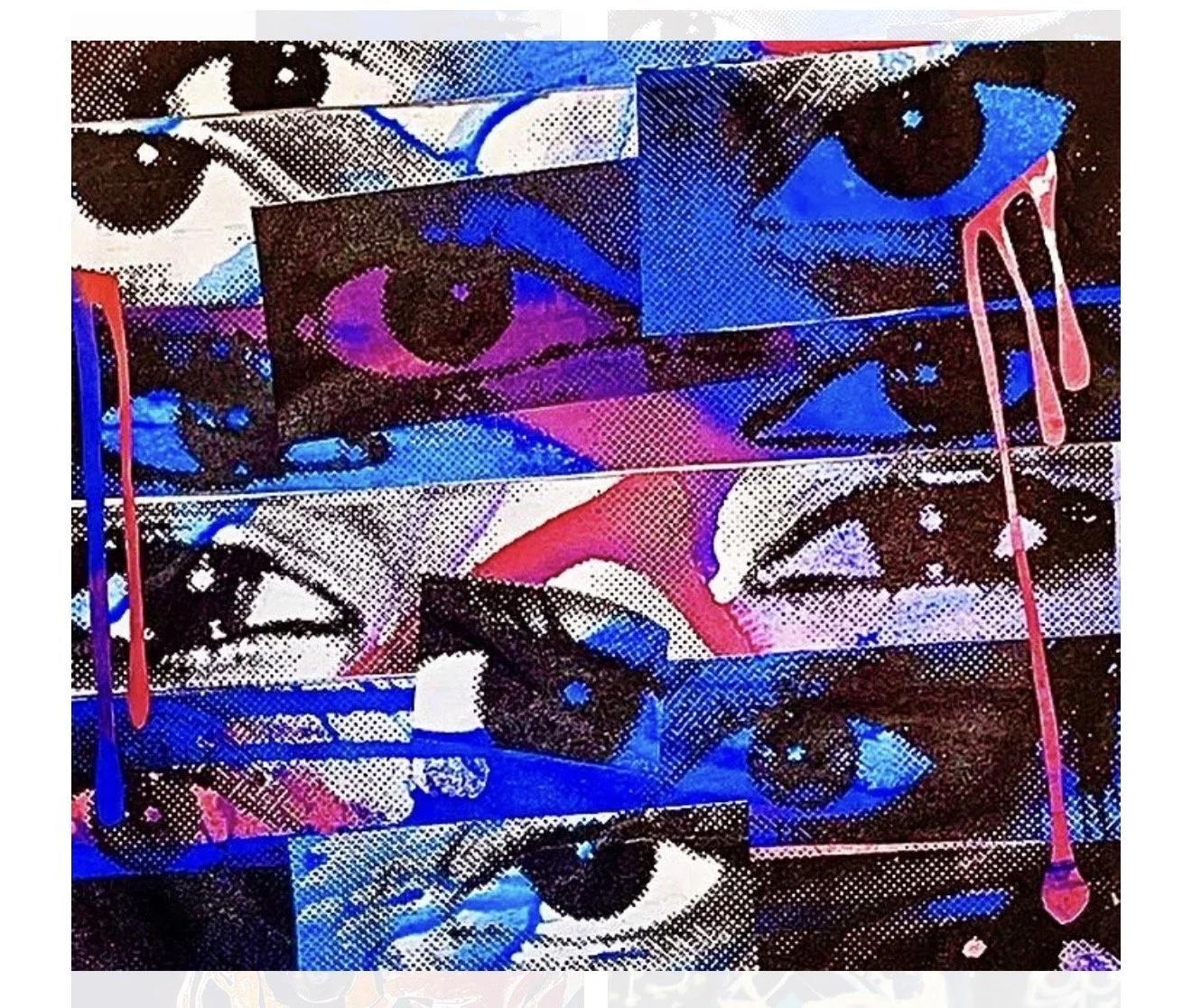
The work began as a small 20 × 20 cm experiment. I cut out individual eyes, added ink panels, stacked and layered elements until the repetition became oppressive, then kept extending the composition through tearing, obscuring, rearranging and rebuilding. I pushed the reds, sharpened the contrast and allowed the work to absorb the atmosphere of the COVID period: fragmented, crowded and inescapable. You are being watched before you decide to look.

Greentea Peng's Clockin was on repeat throughout the making of the piece. The title comes from the song, whose atmosphere of observation, intimacy and mutual scrutiny reinforced what was already emerging in the composition.

This piece marks an important origin point within my practice. Aisha's discarded screen prints became the catalyst for a way of working that would later become central to Dolly's Chop Shop: cutting into existing work and reassembling it into something else. Looking back, this was the first time another person's work became inseparable from my own—an instance of genuine co-creation. My role shifted from making individual pictures to becoming an image architect. The creative act was not producing the eyes; it was organising them. Meaning emerged through relationships between images—through cutting, scale, repetition, rhythm, density and absence—rather than from any single component.

What began as a 20 × 20 cm collage has since been scaled up successfully several times. For me, the work remains unfinished. The next stage is my first architectural-scale test: a 4 × 6 metre version that will allow me to explore what is lost, gained and transformed when the viewer moves through the composition rather than simply looking at it.

London in Action

Mixed-media collage on paper

50 × 70 cm

2012

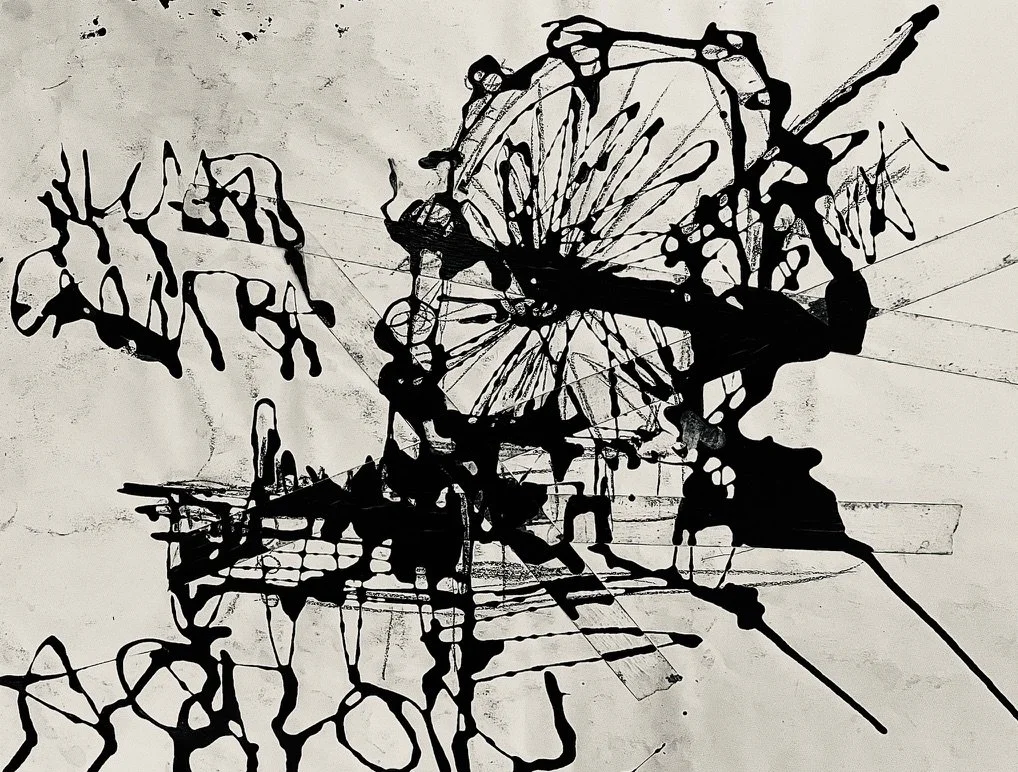
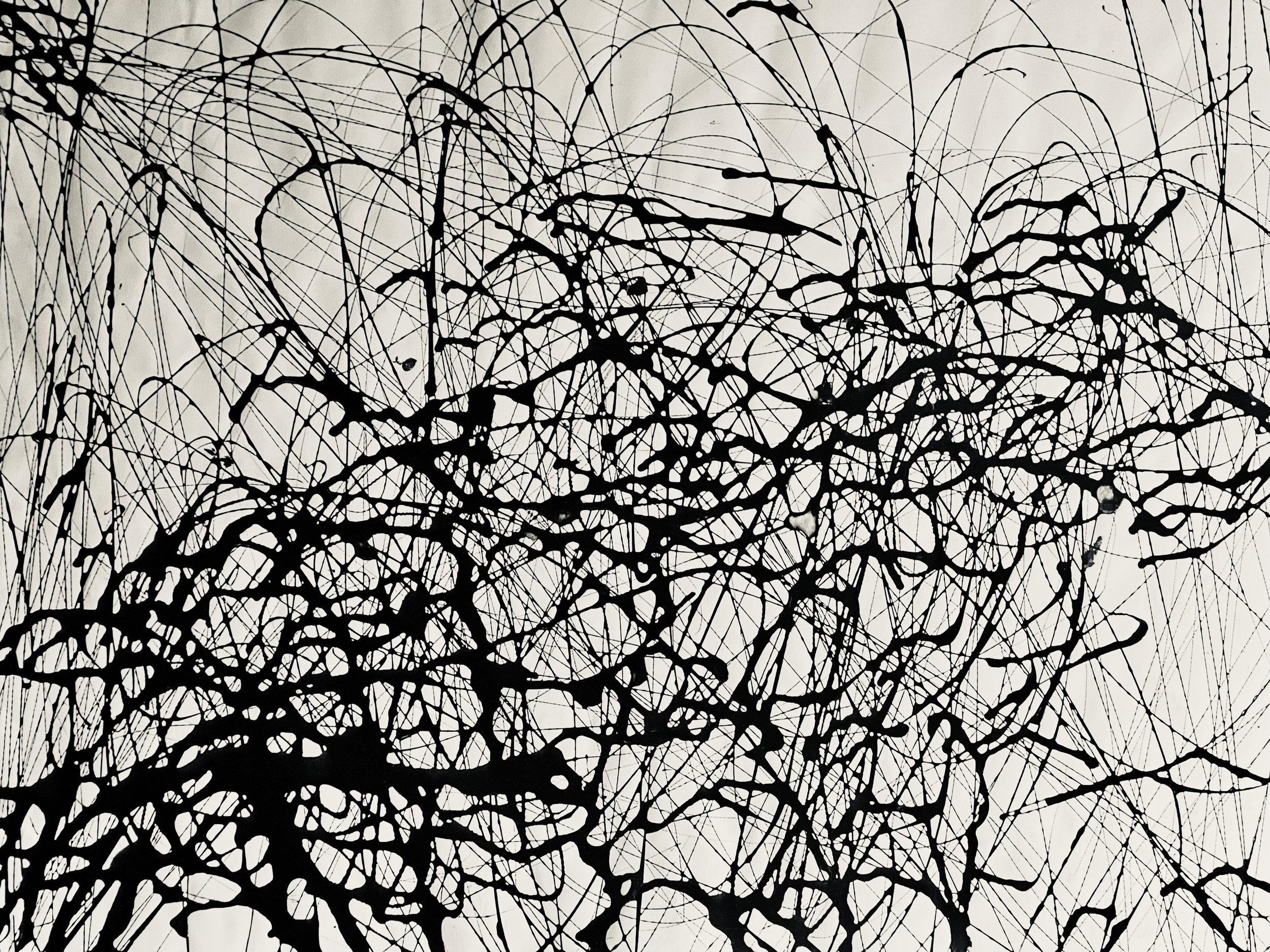
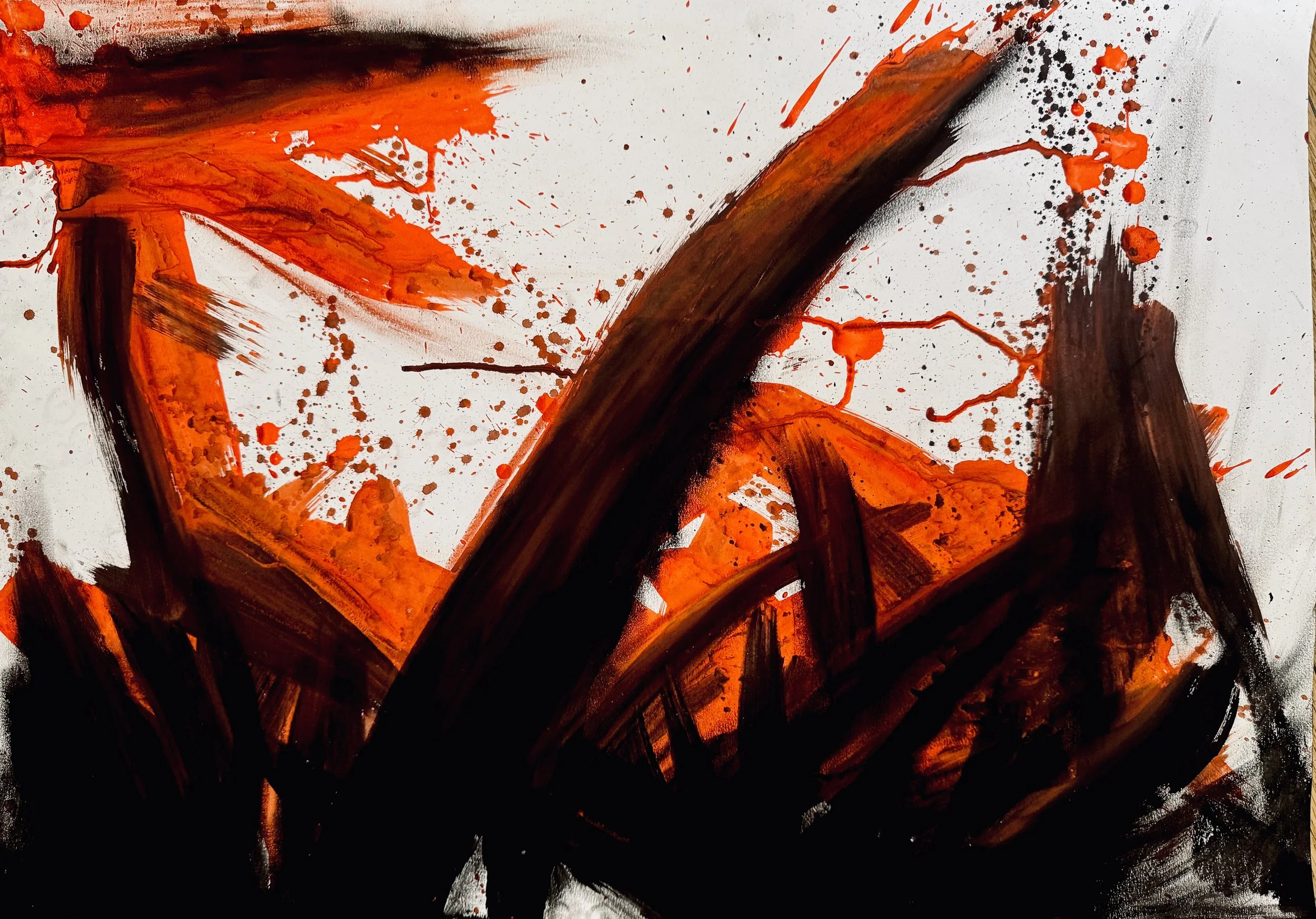
London in Action emerged from a sustained period of experimentation with action drawing, gesture and composition. Rather than illustrating the city, I wanted to construct it through movement, layering and rhythm.

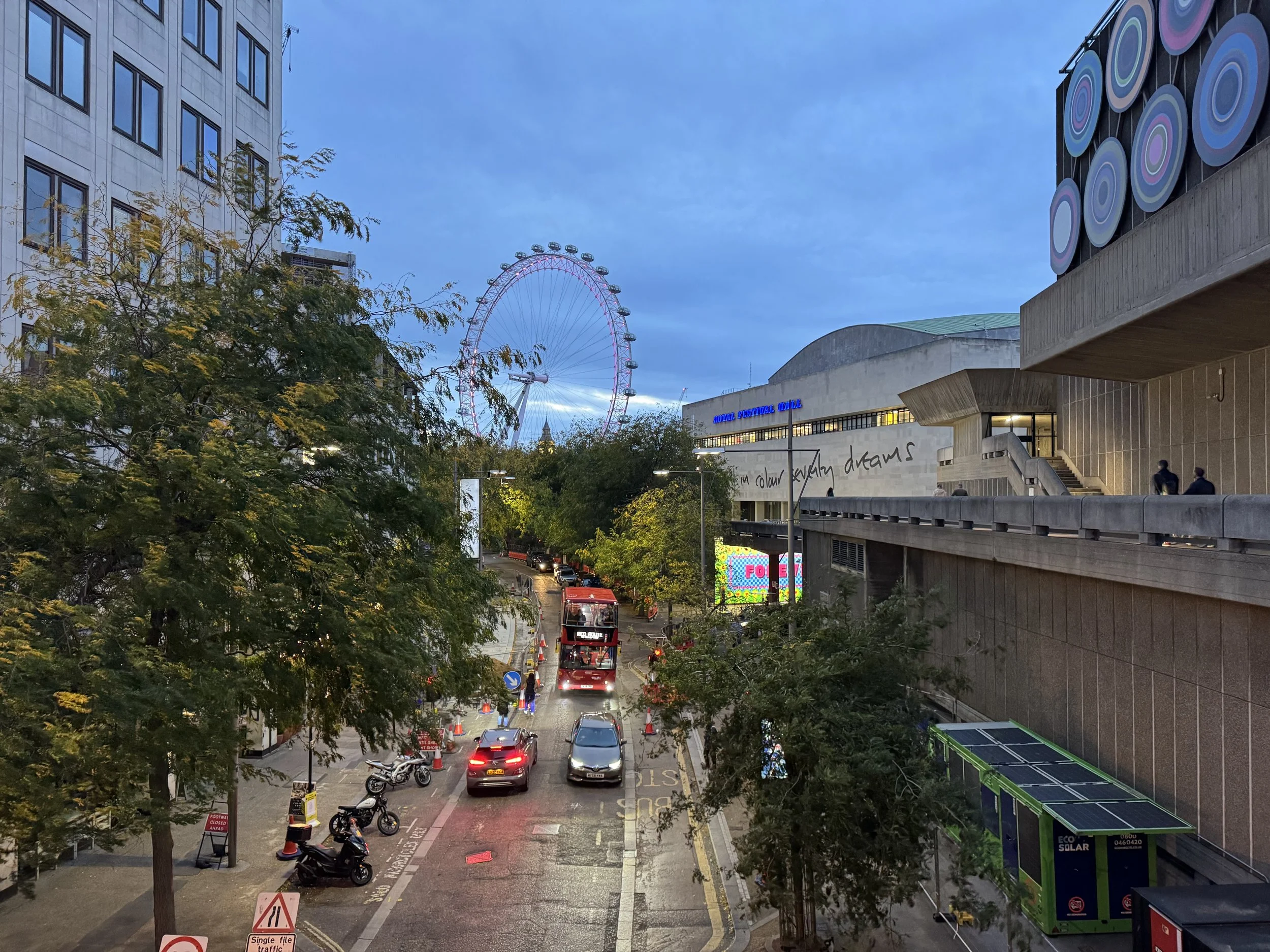
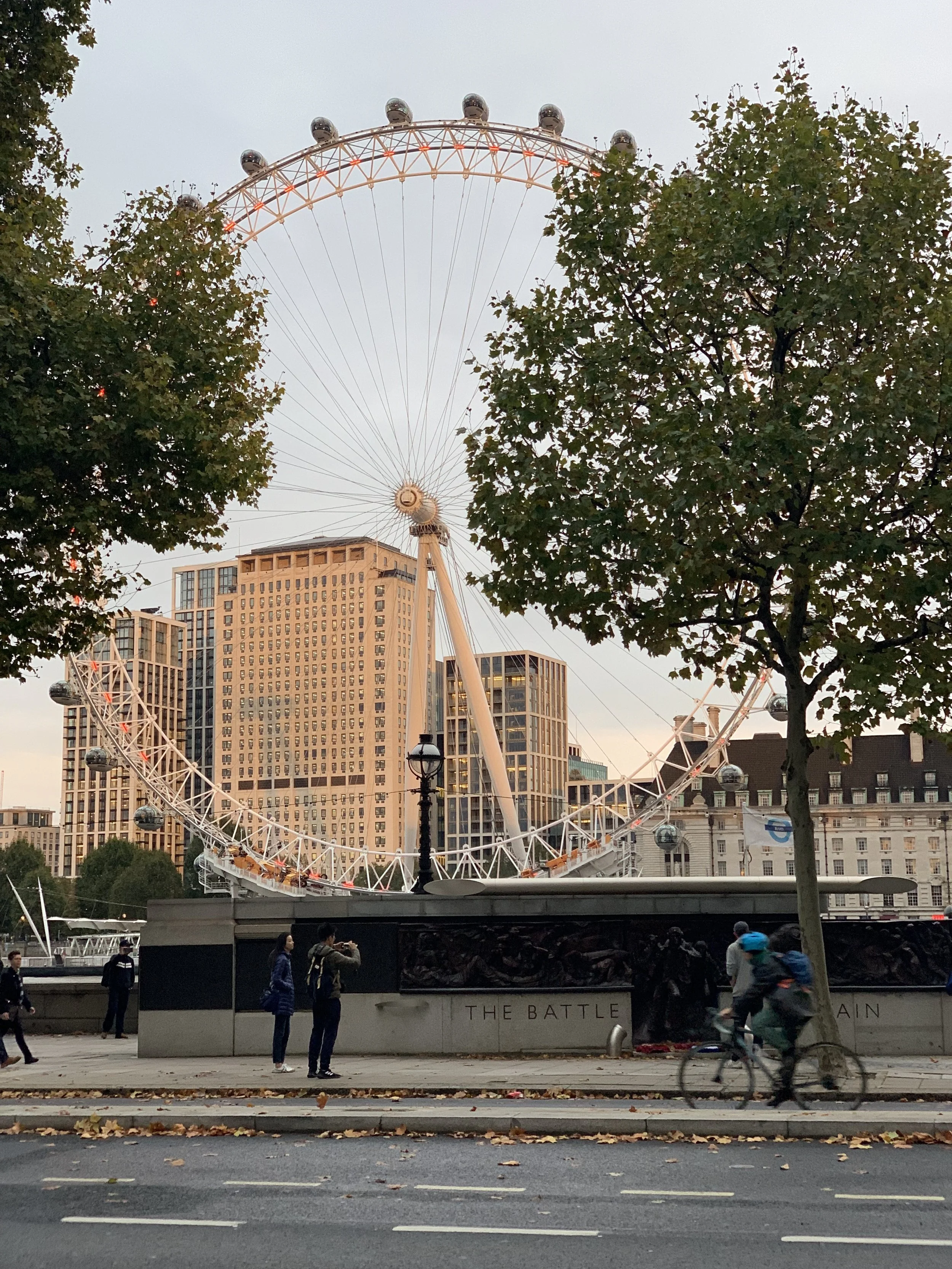
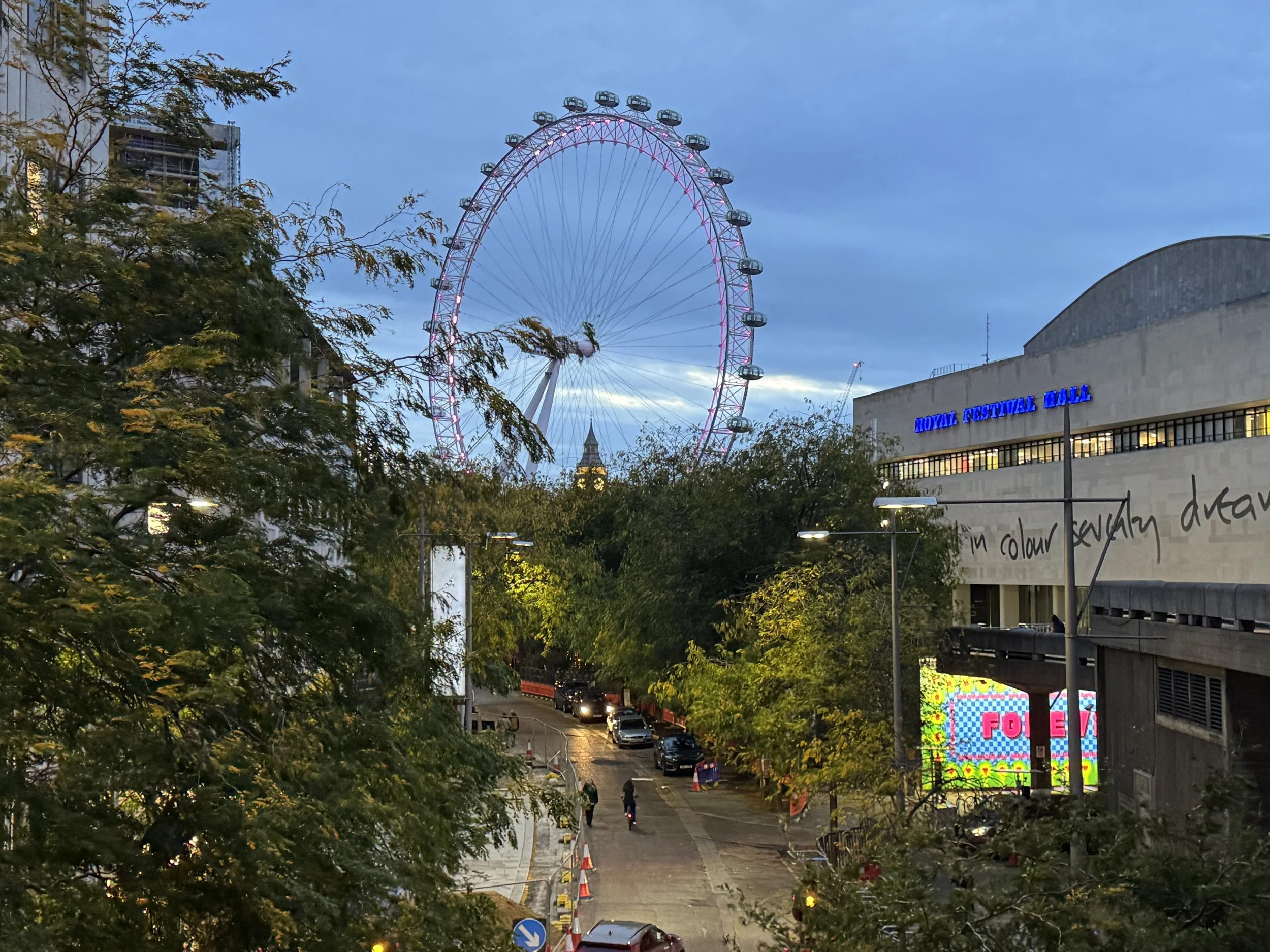
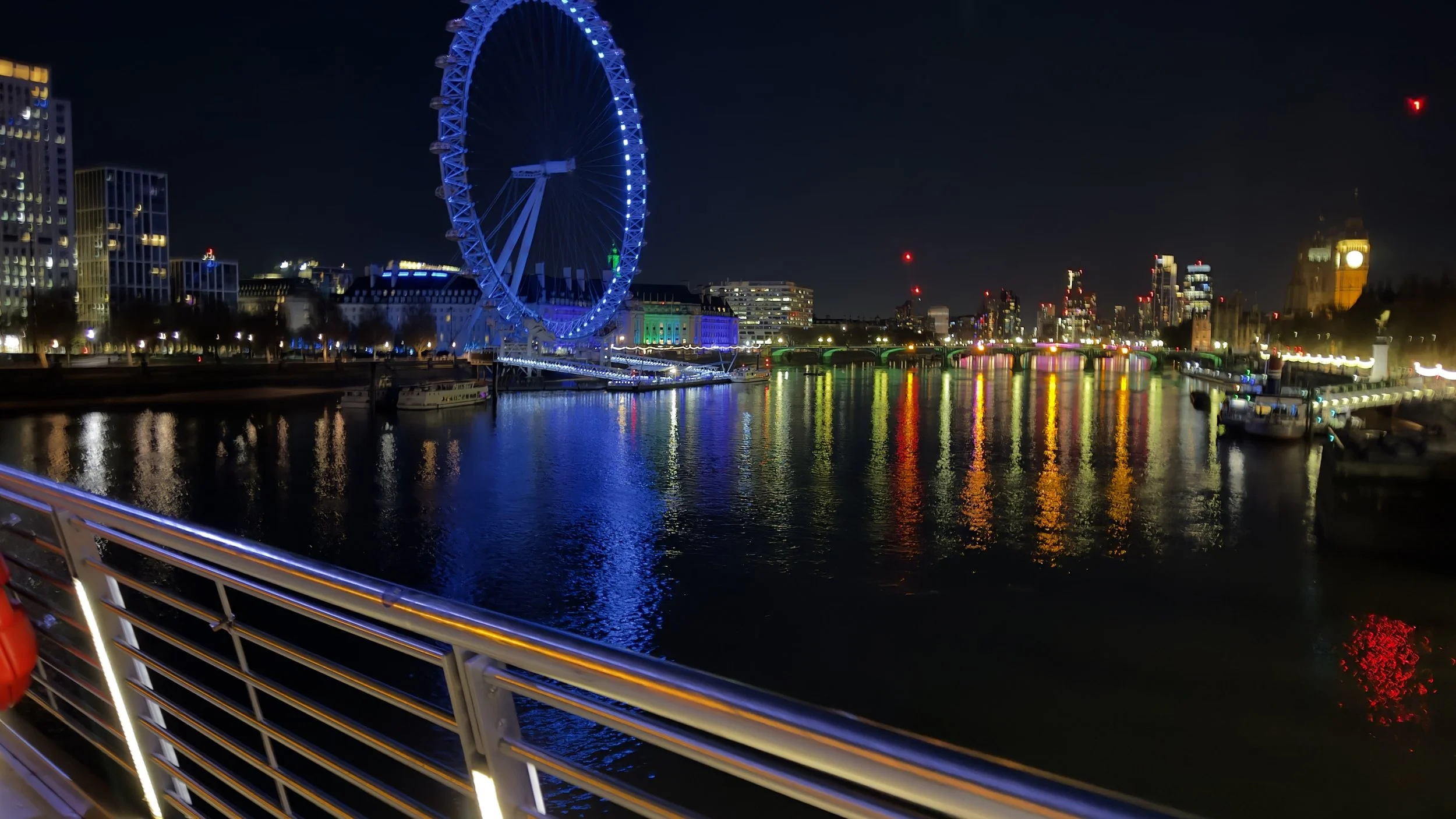
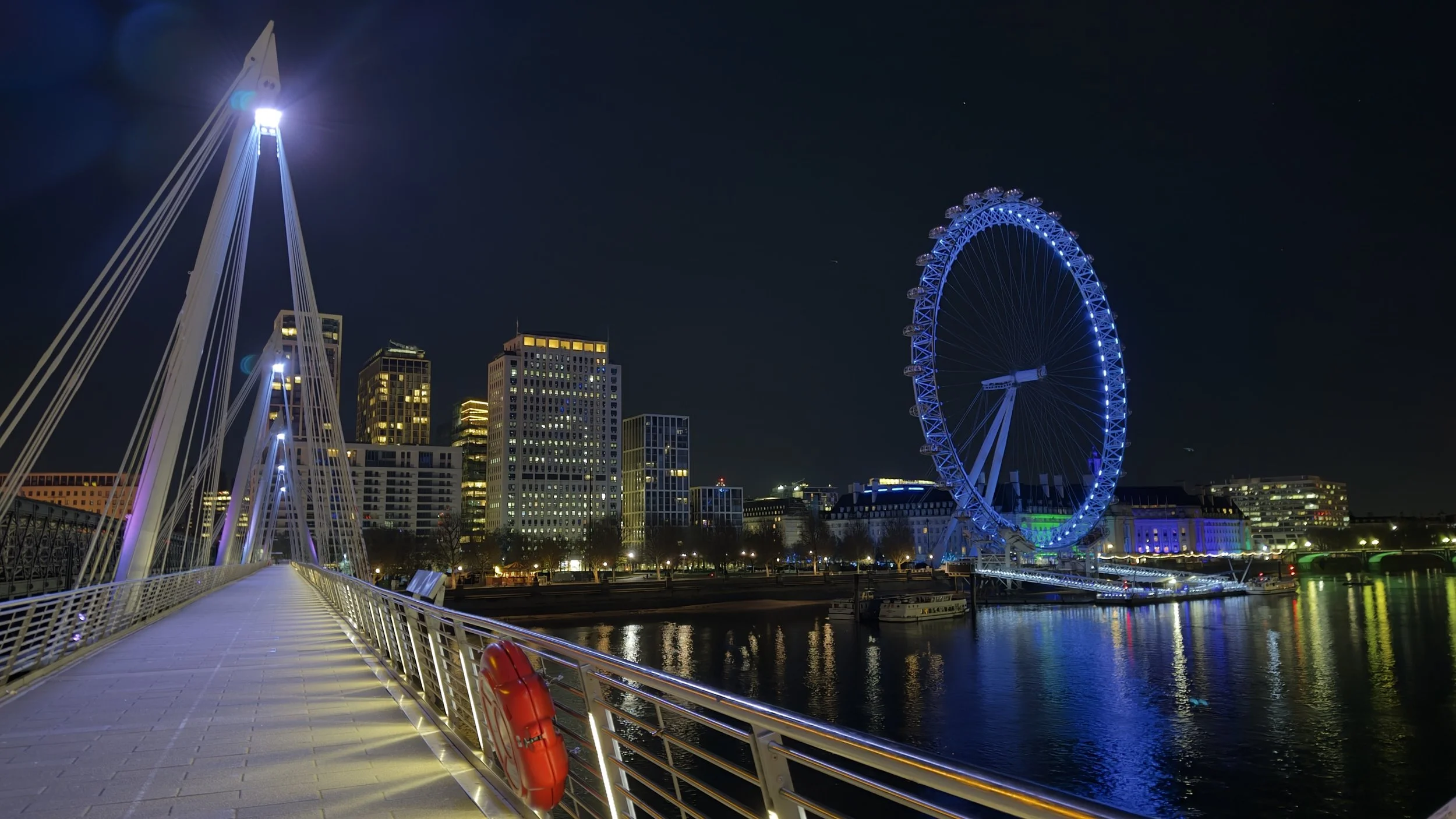
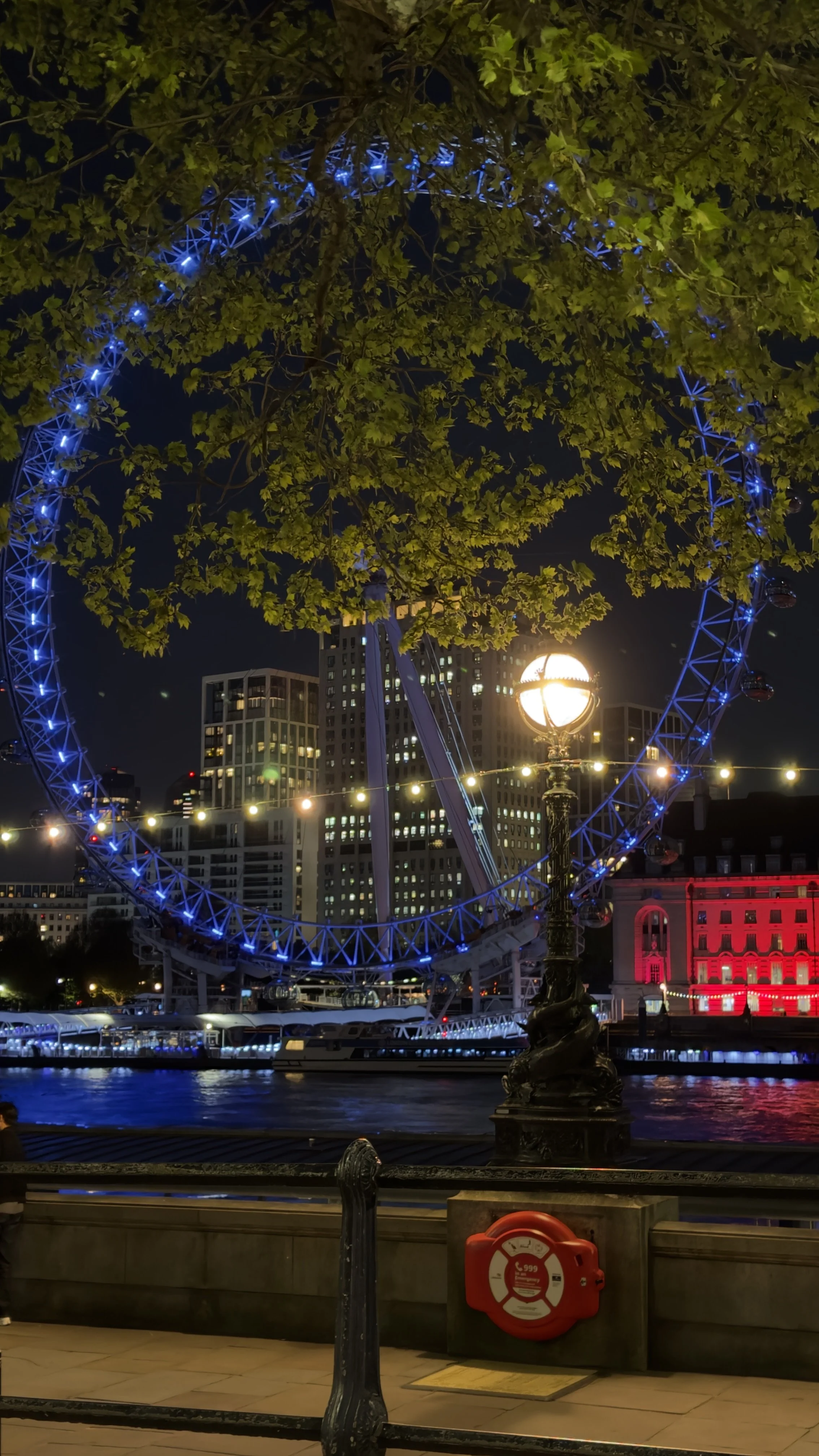
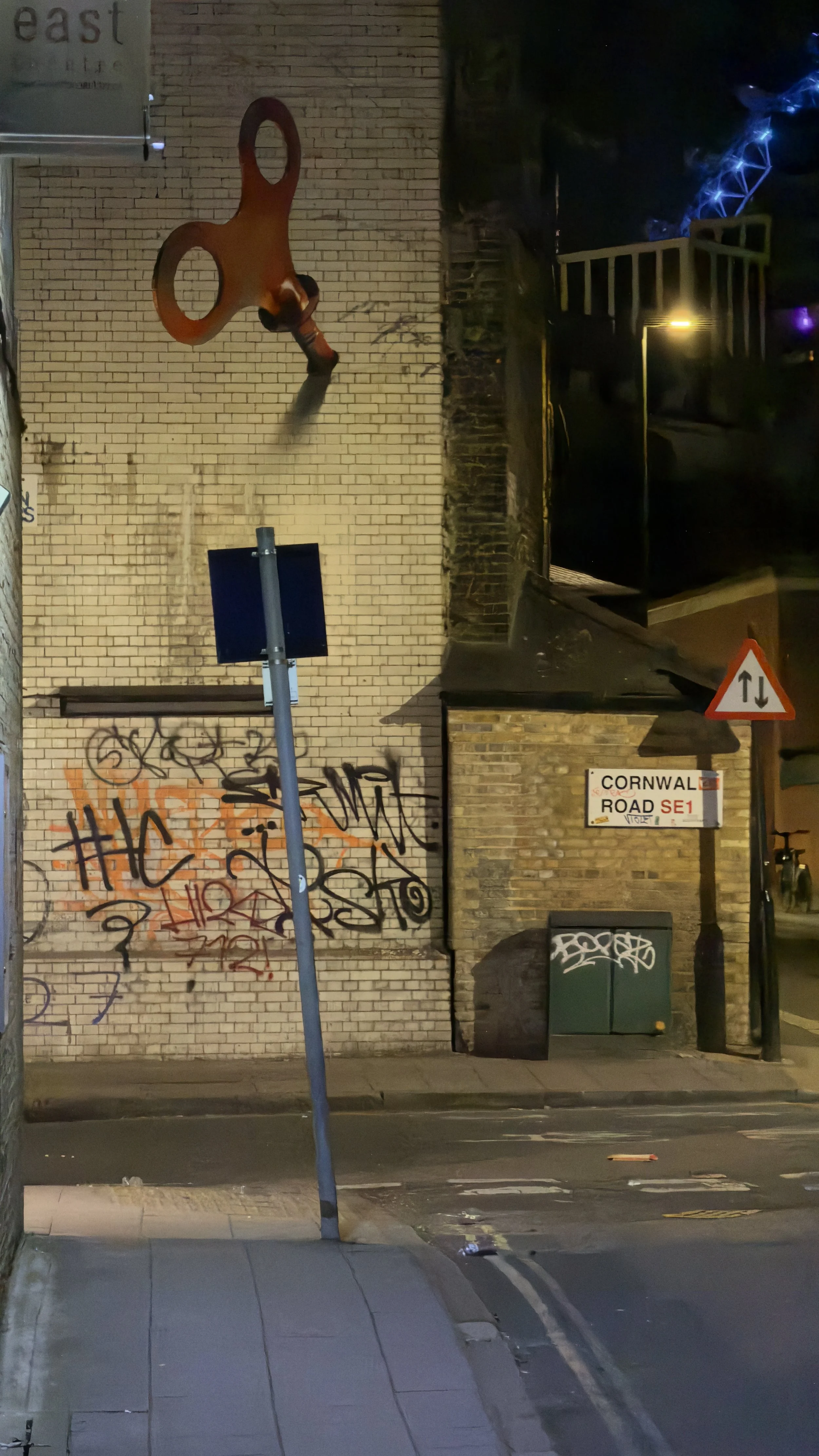
The London Eye was planned from the outset. I mapped its position using masking tape and construction lines before building the composition around it. Originally those marks were intended to disappear, but I realised they added movement, making the Eye feel less like a monument and more like something in motion. The scaffolding became part of the final work.

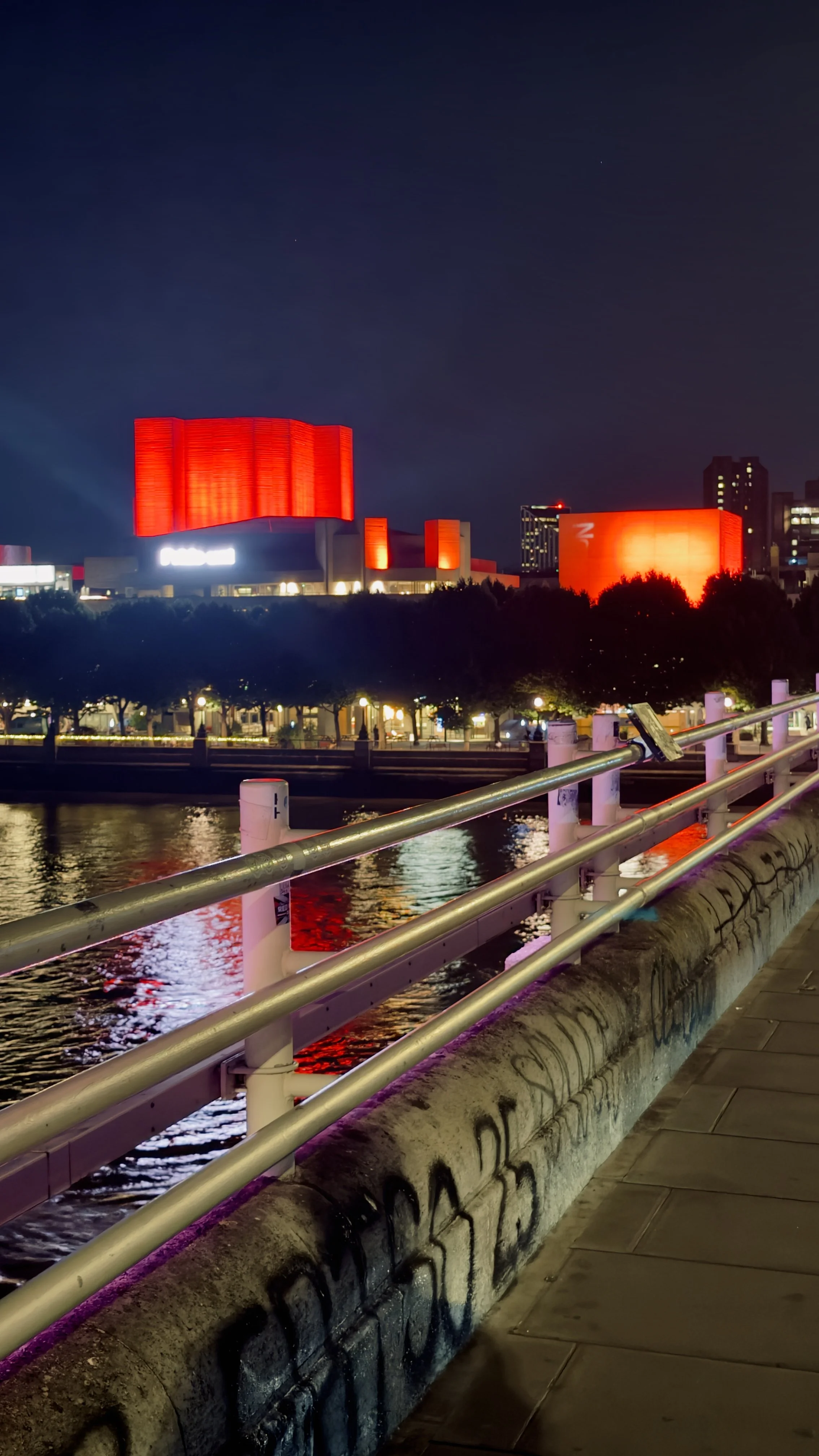
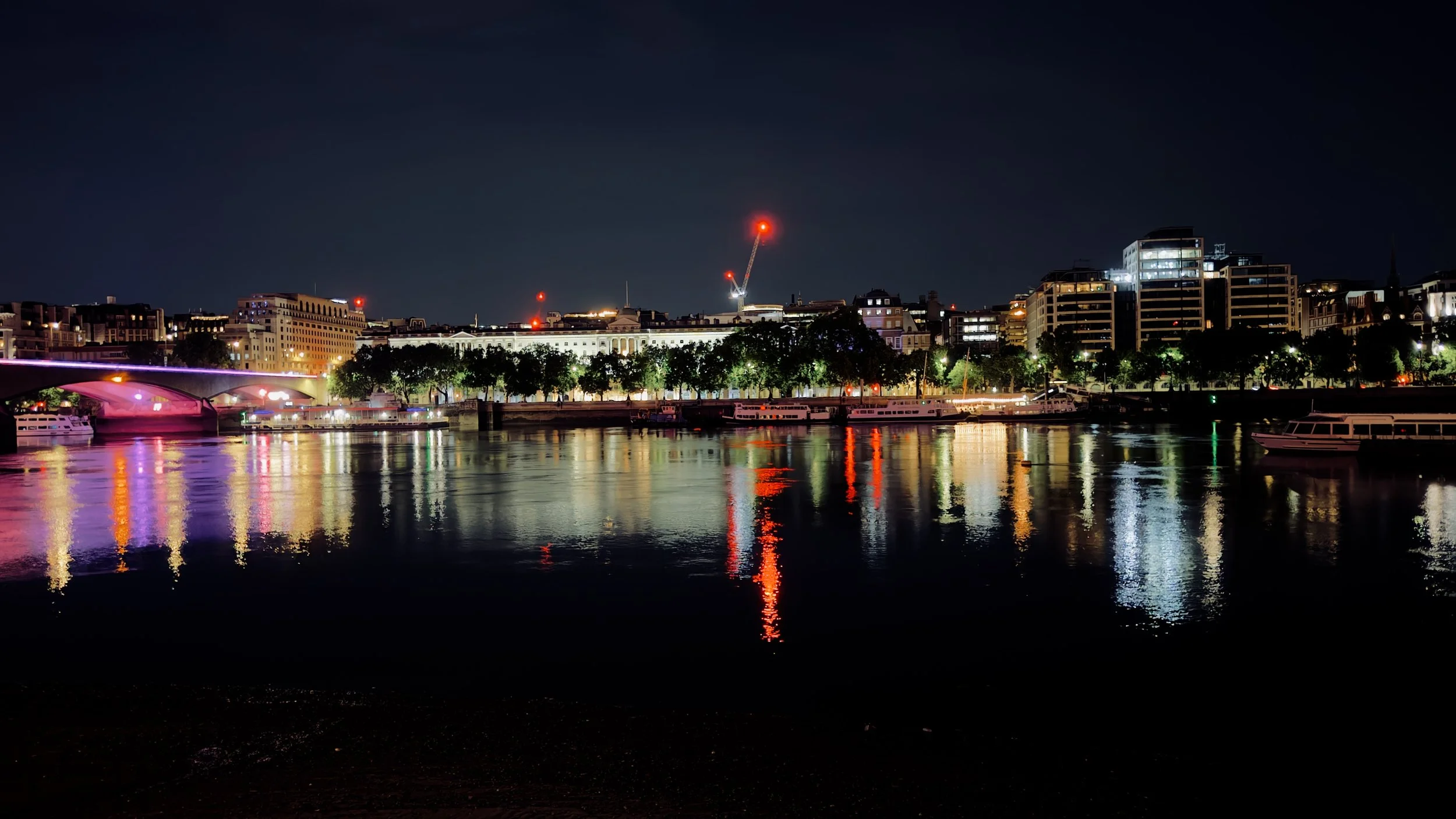
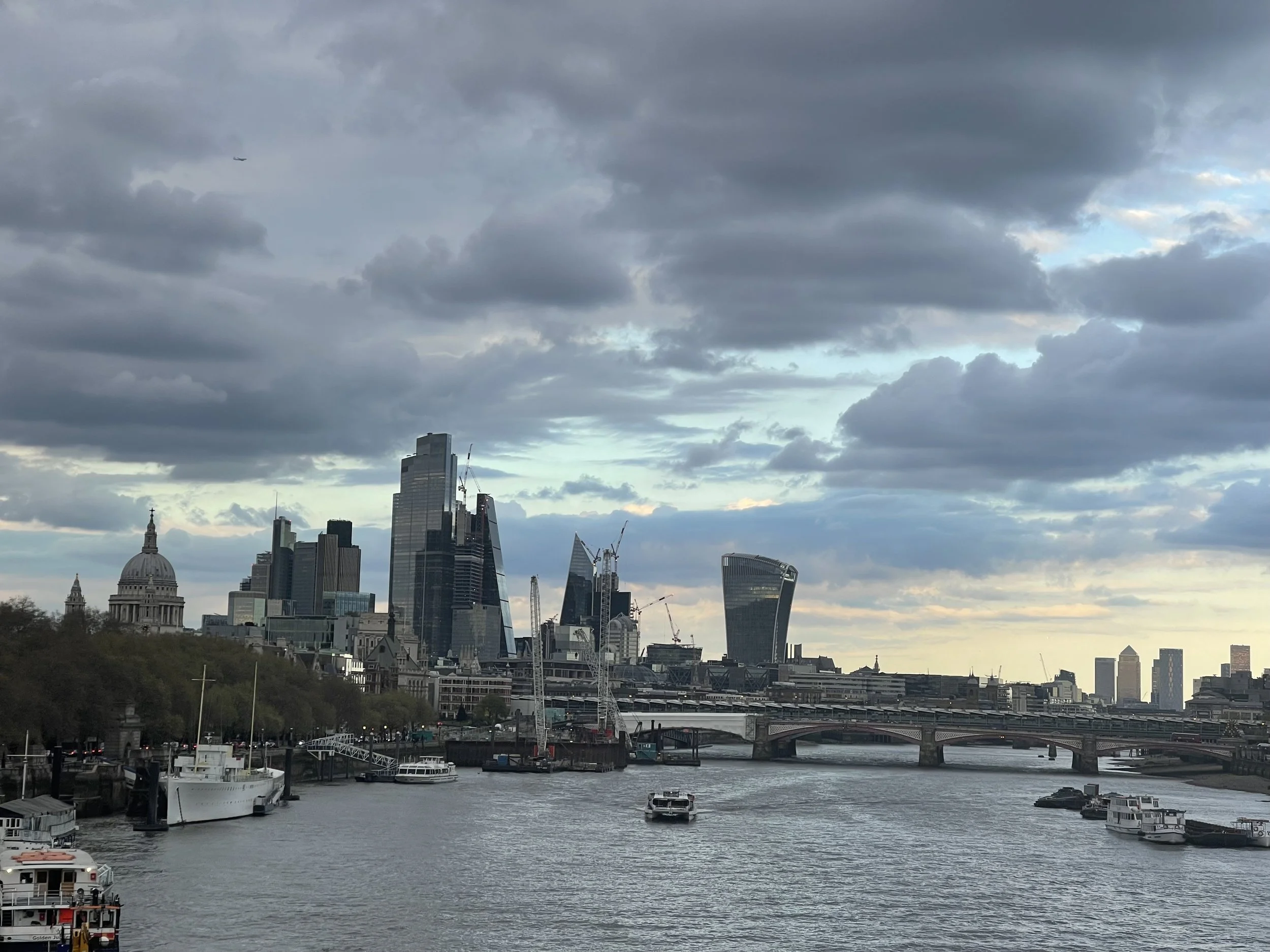
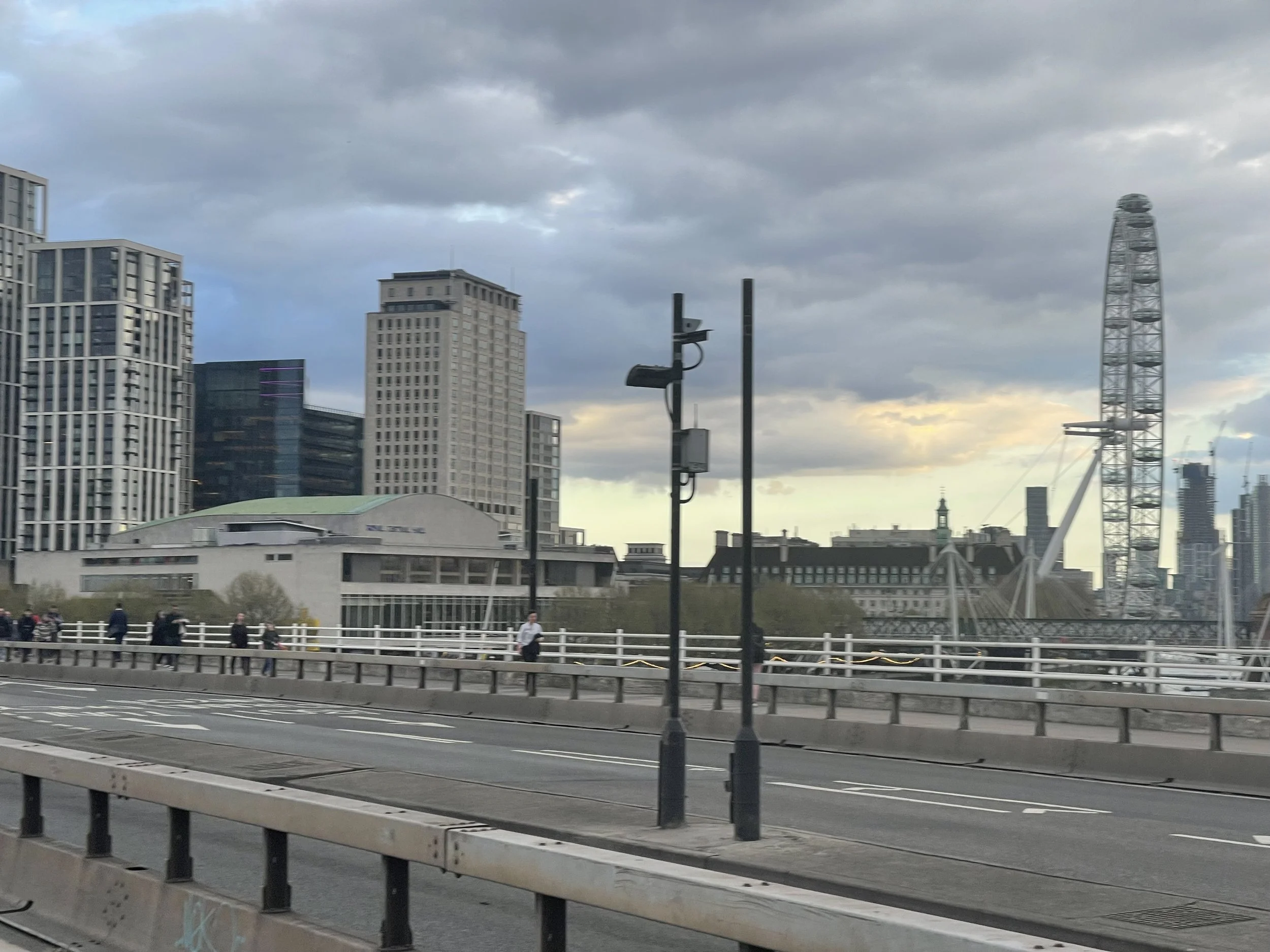
The piece draws on countless walks across Waterloo Bridge and through the South Bank. The same view constantly changed with the weather, the light and the people moving through it. I wanted the work to capture that energy: architecture, graffiti, performance, traffic and tourism occupying the same space.

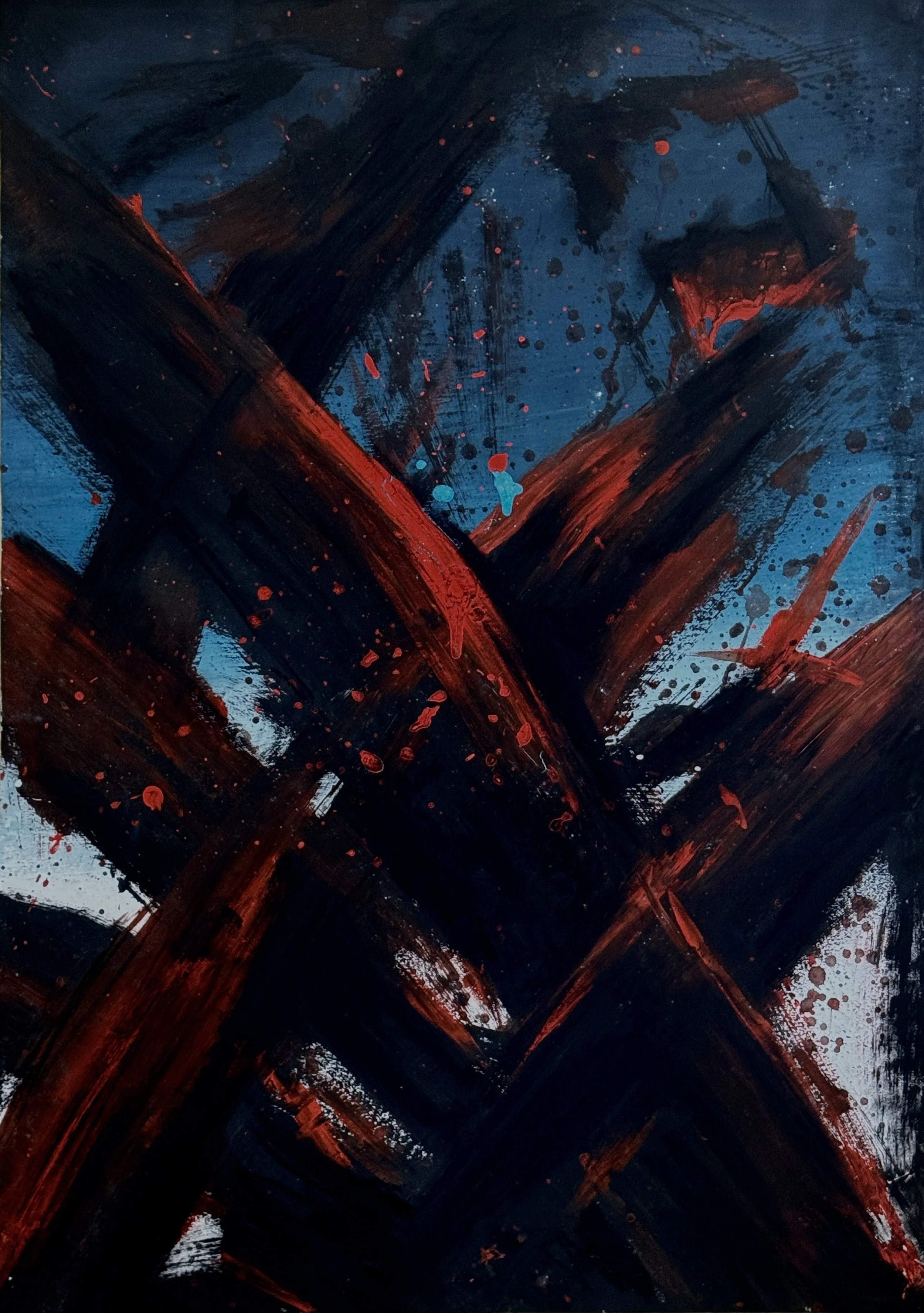
Around the same time, seeing paintings by Jackson Pollock and Barnaby Furnas in New York and John Virtue’s paintings transformed my understanding of gesture, scale and surface. Rather than imitate Action Painting, I wanted to find my own material language. Mixing PVA glue, acrylic paint and Indian ink allowed me to create marks that felt simultaneously fluid, architectural and improvised.

Looking back, this is one of the earliest works in which I recognised a visual language beginning to emerge. More than a decade later, the questions of movement, surveillance, urban space and scale that first appeared here continue to shape my practice. Unlike many later works, I have never cut this one apart. I still suspect it has somewhere further to go. Both London and my Congolese heritage are places of extraordinary visual richness, and while I continue to love the discipline of monochrome, I want to explore how colour might enter the work in a balanced way without losing the structural clarity that black and white provides.

FLOATING FORMS (MAY 2026) REFLECTIONS ON MY FIRST PUBLIC BODY OF WORK SINCE 2012

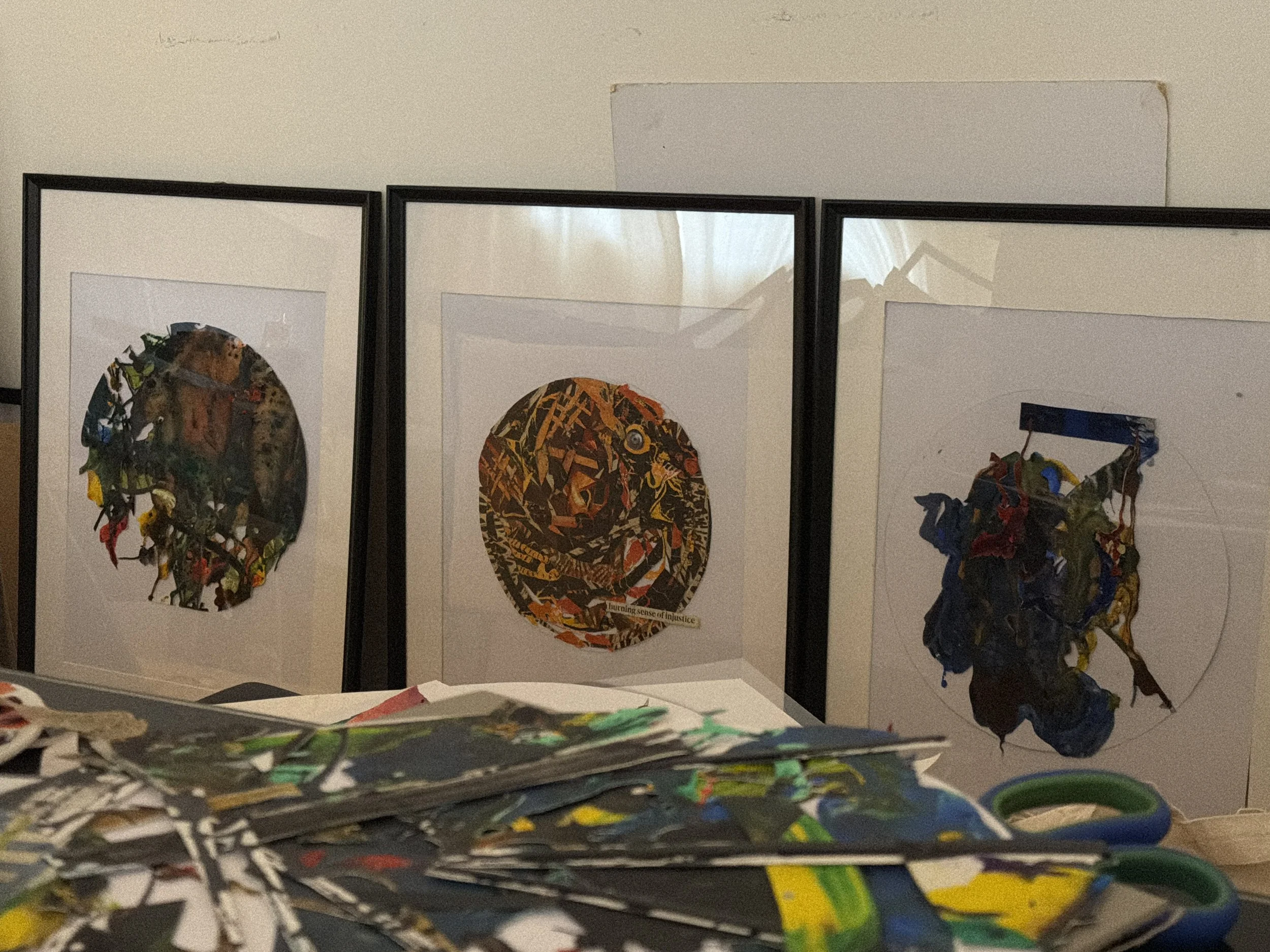
When Rosanna Head and Beth Mandler selected me for Floating Forms at the Paxton Centre, I only had two finished works. The exhibition marked my first public presentation of a body of work since 2012 and became an opportunity to test ideas rather than simply present completed pieces. Many of my works already occupy a space between structure and movement, solidity and instability, making the exhibition a natural framework through which to develop existing concerns.

Over three weeks I produced four new works while revisiting and reworking older pieces I had previously considered finished. Rather than treating the brief as a commission, I approached it as a creative problem-solving exercise. The challenge was not to illustrate the theme, but to respond to it through my own visual language.

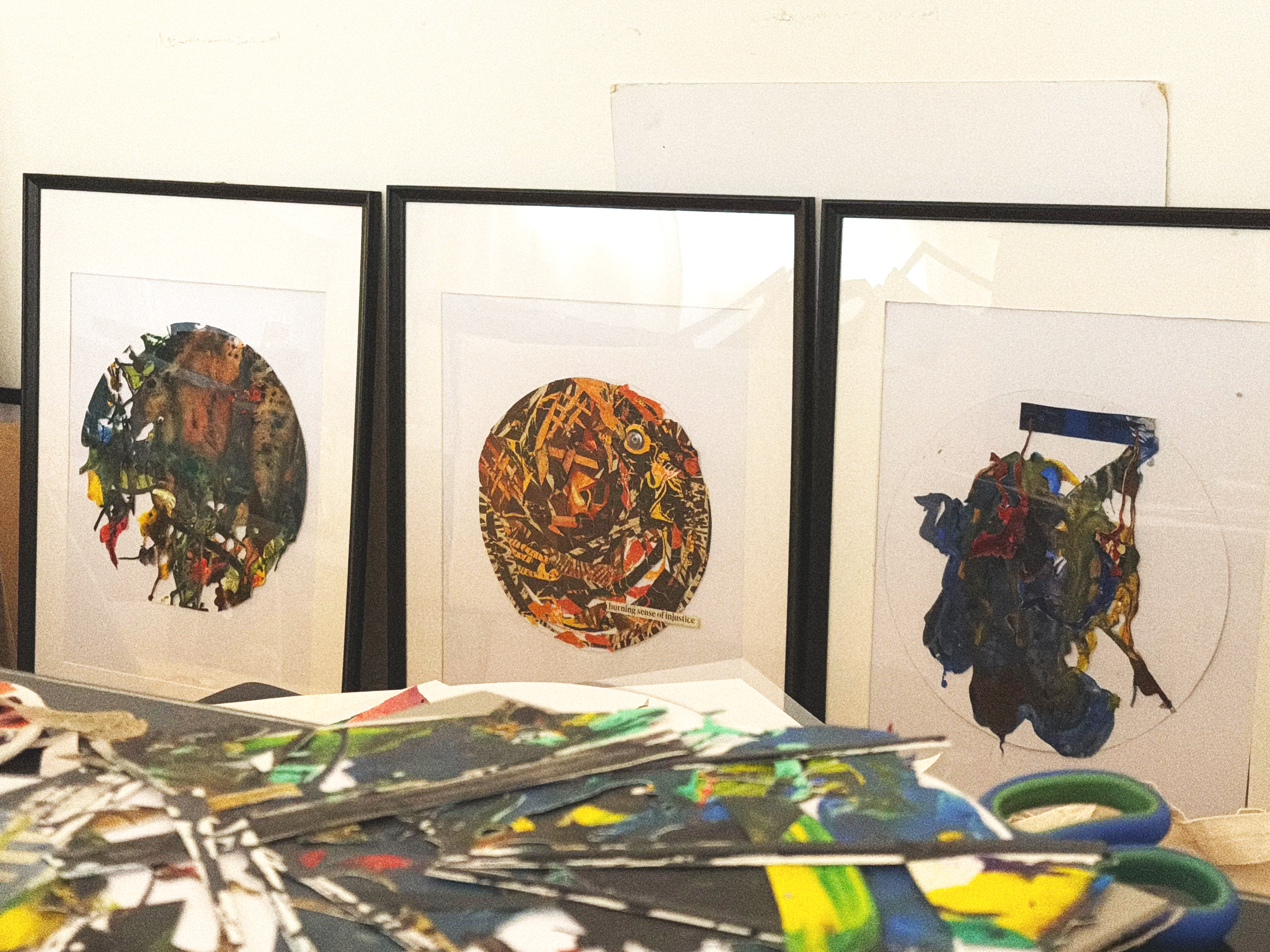
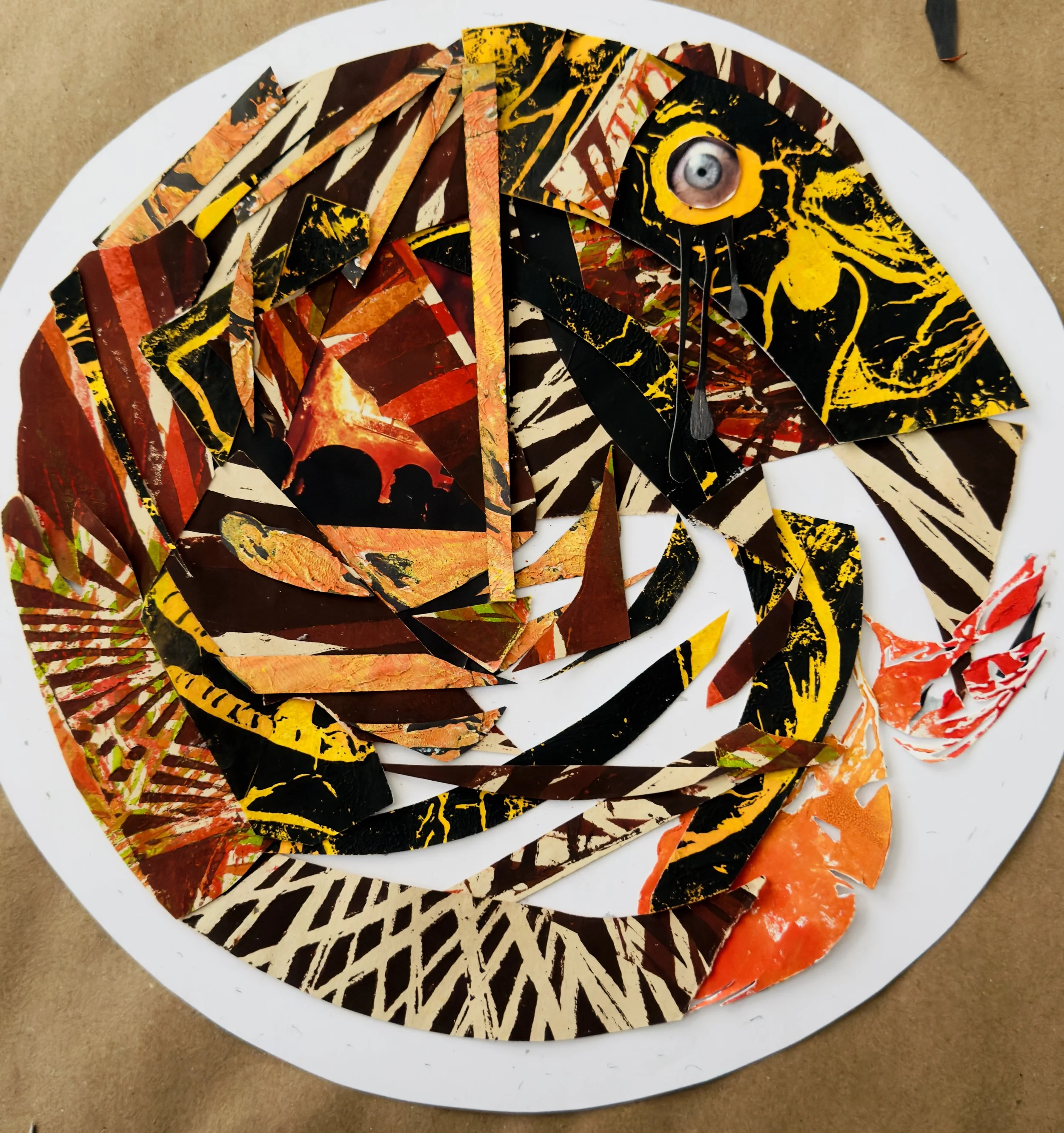
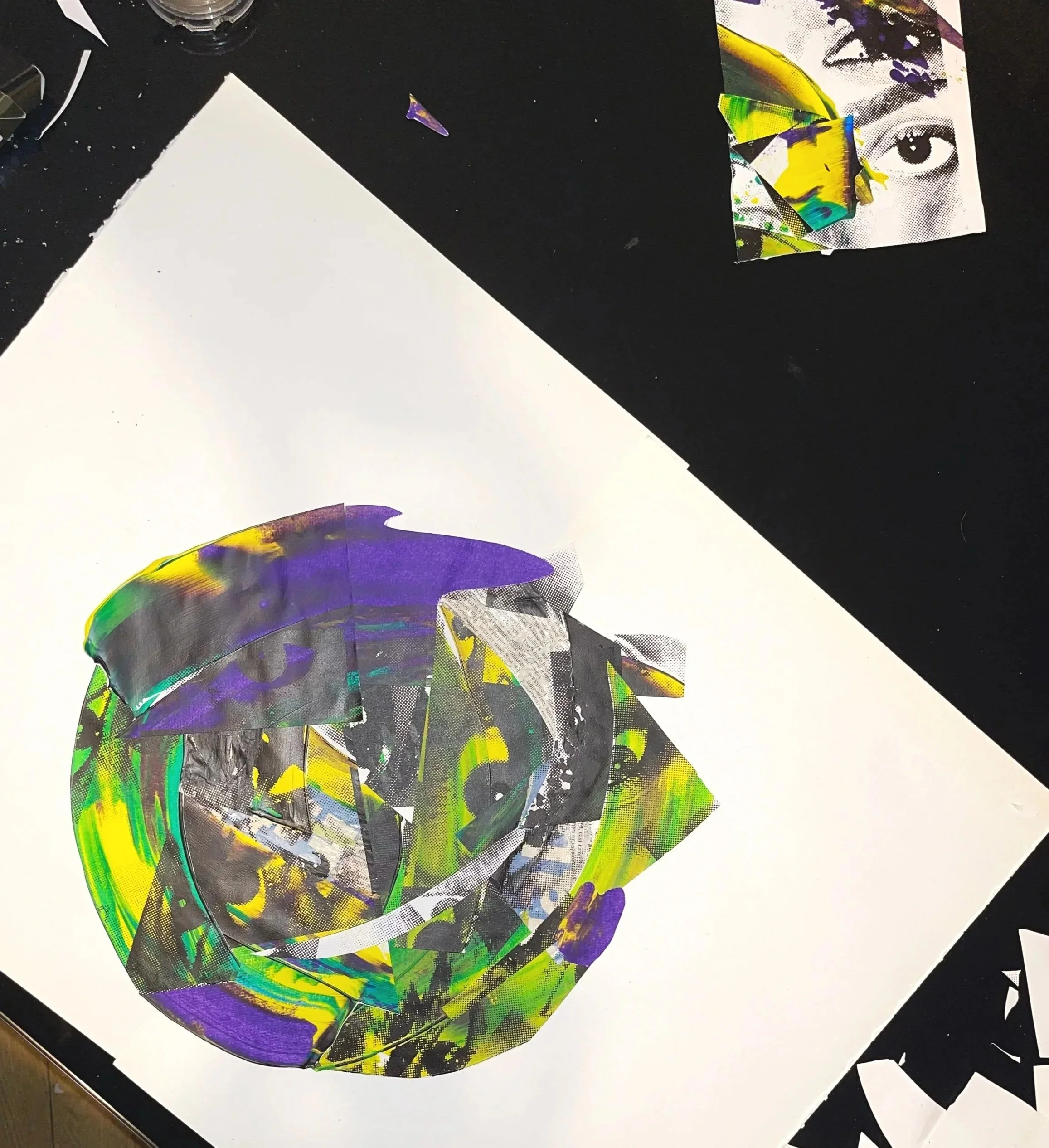
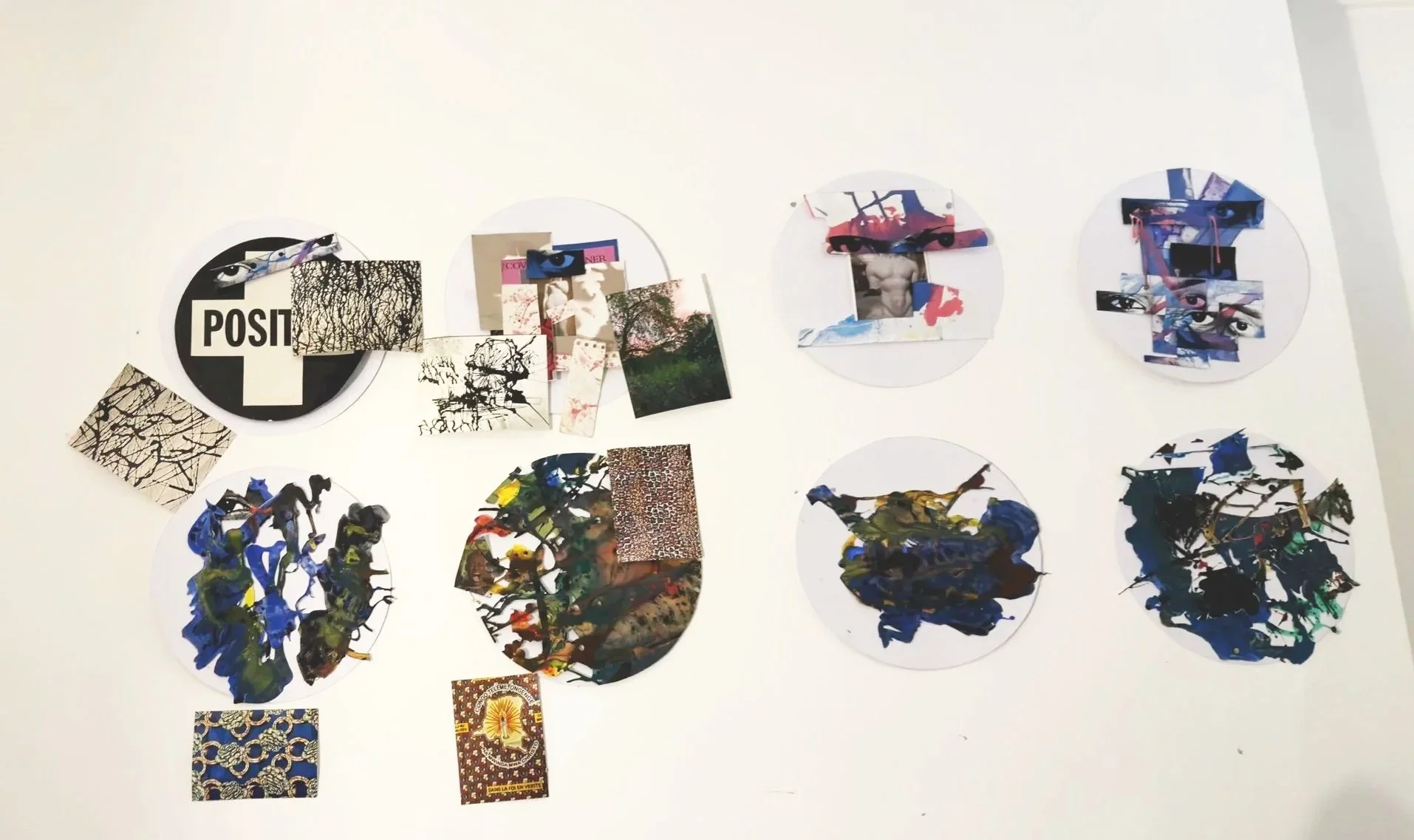
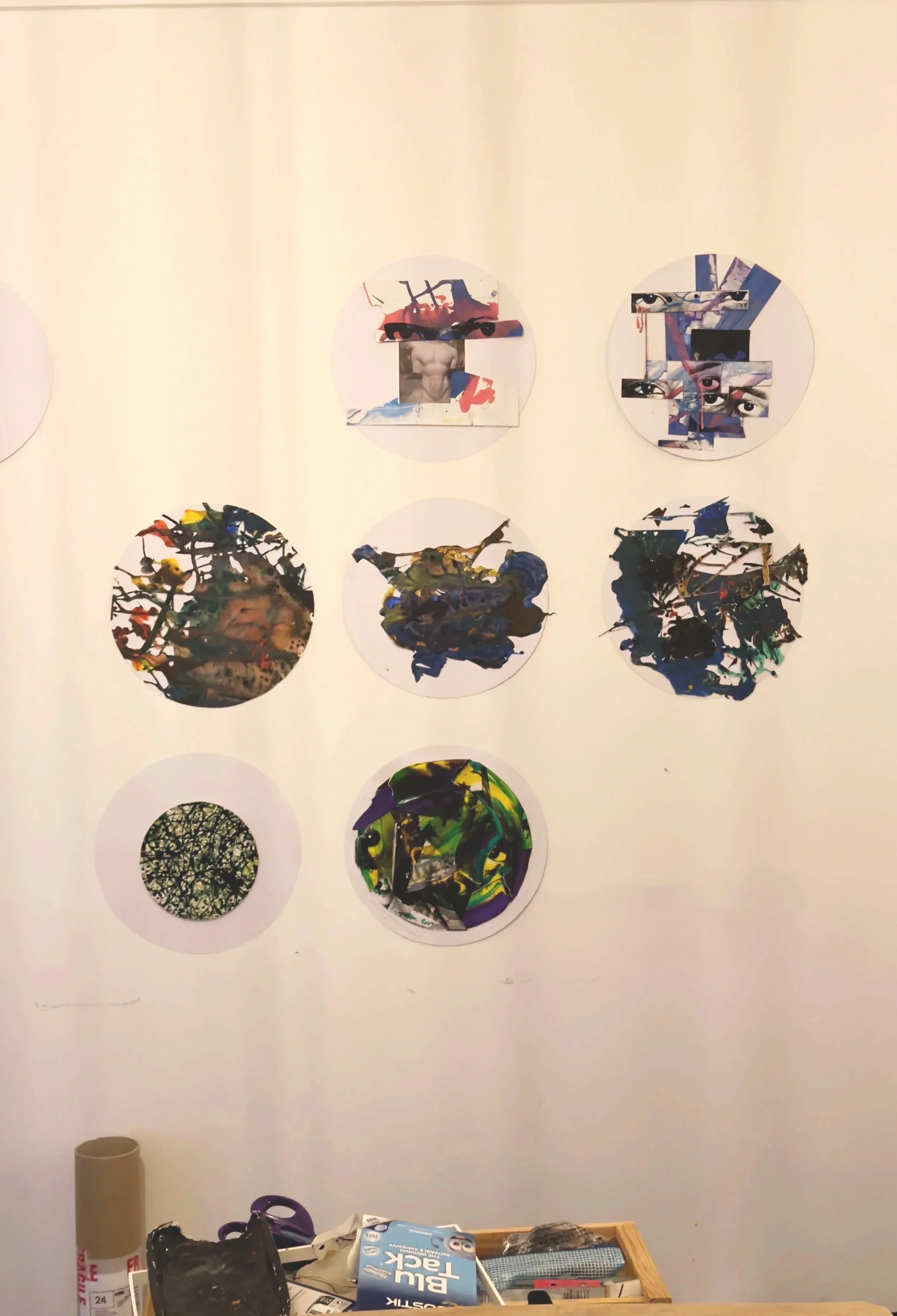
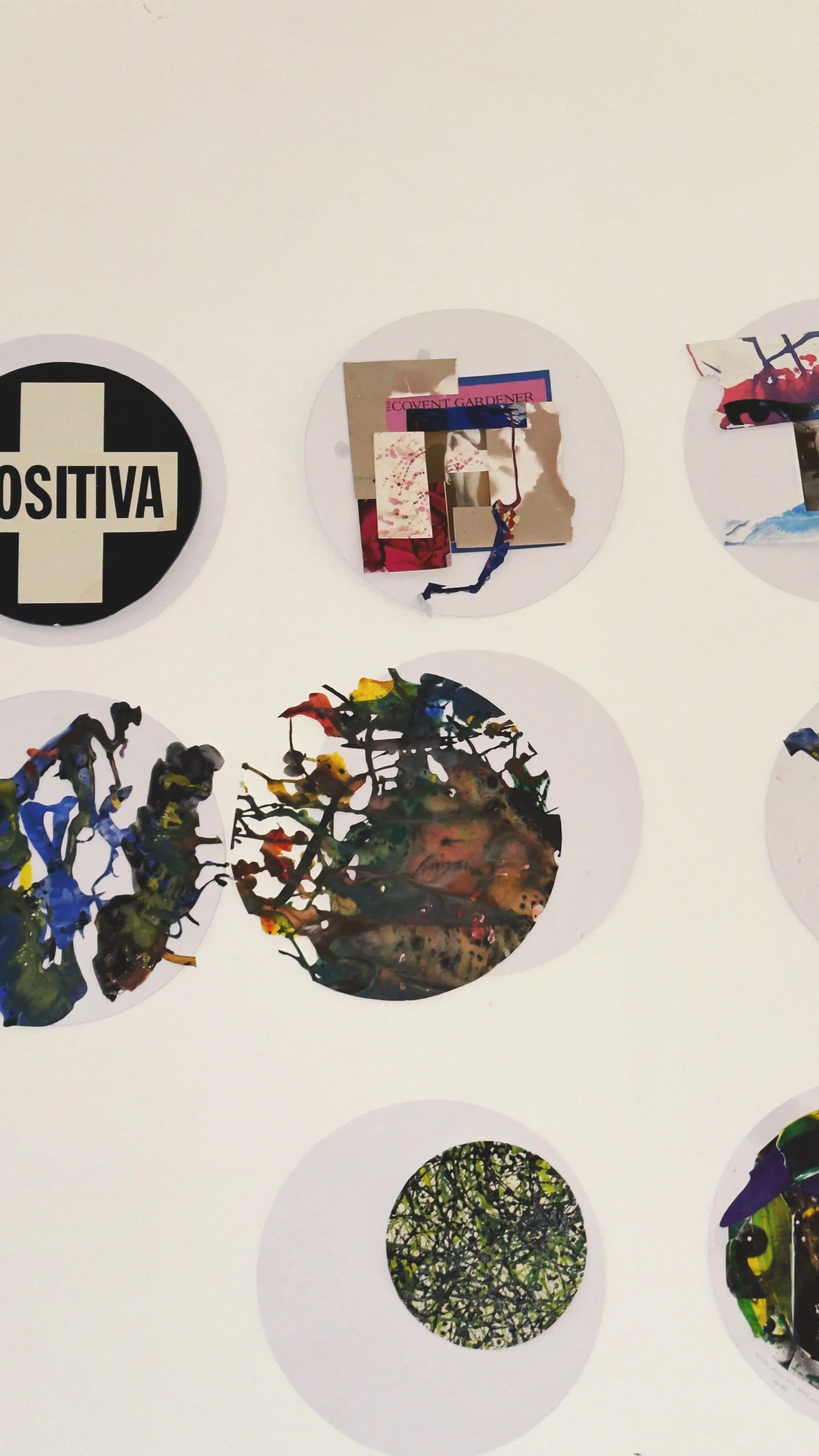
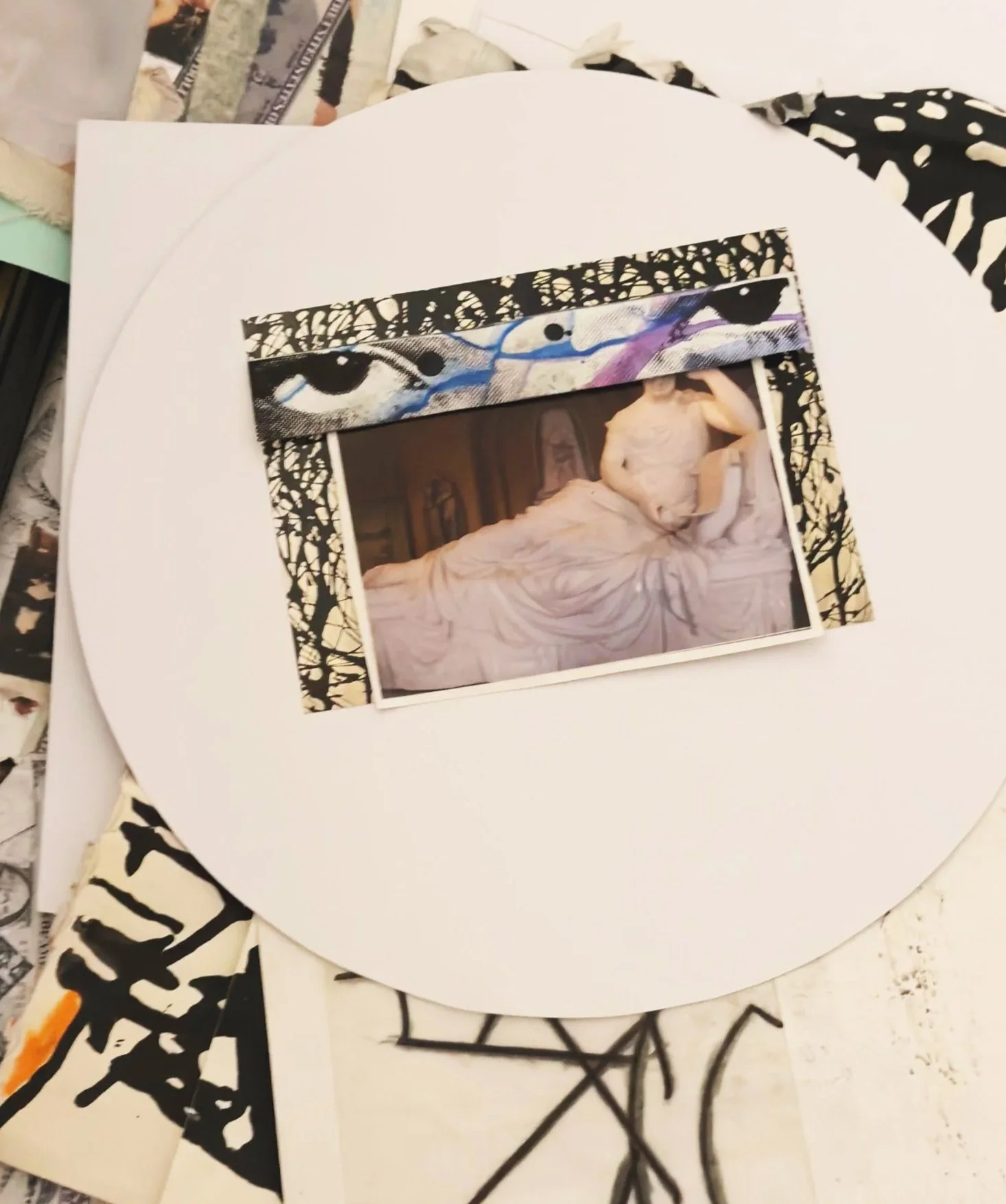
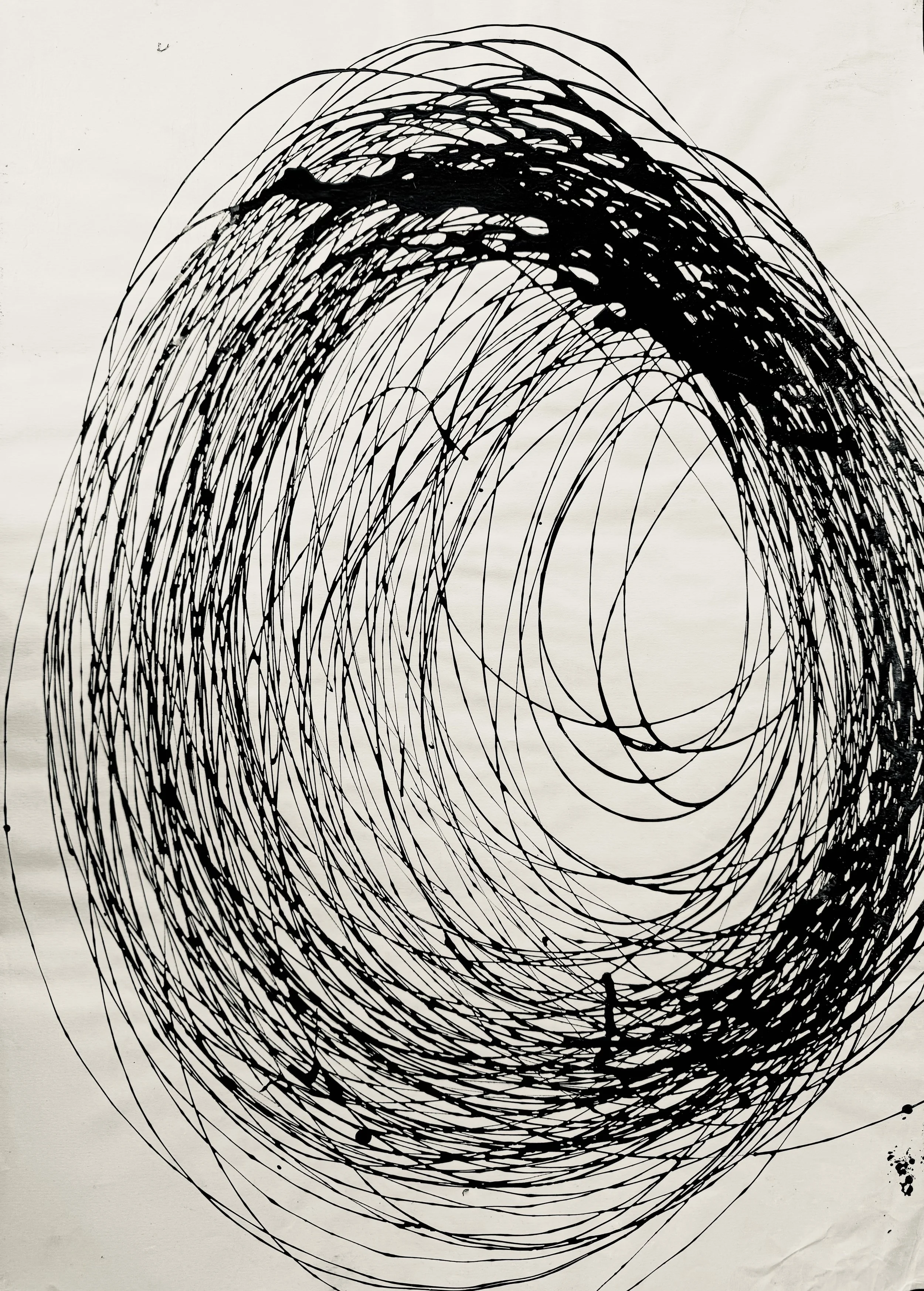
The circular format itself predated the exhibition. Several years earlier I had transformed a screen print into a collage, then into a circle, and fully intended to include it in Floating Forms. Living with the work, however, convinced me it needed company. As I began making new circles, I found myself returning to the original – not to preserve it, but to cut back into it. Fragments migrated into the newer collages, carrying earlier decisions into later ones. By the time the exhibition opened, the work I had originally planned to exhibit no longer existed as a single piece.

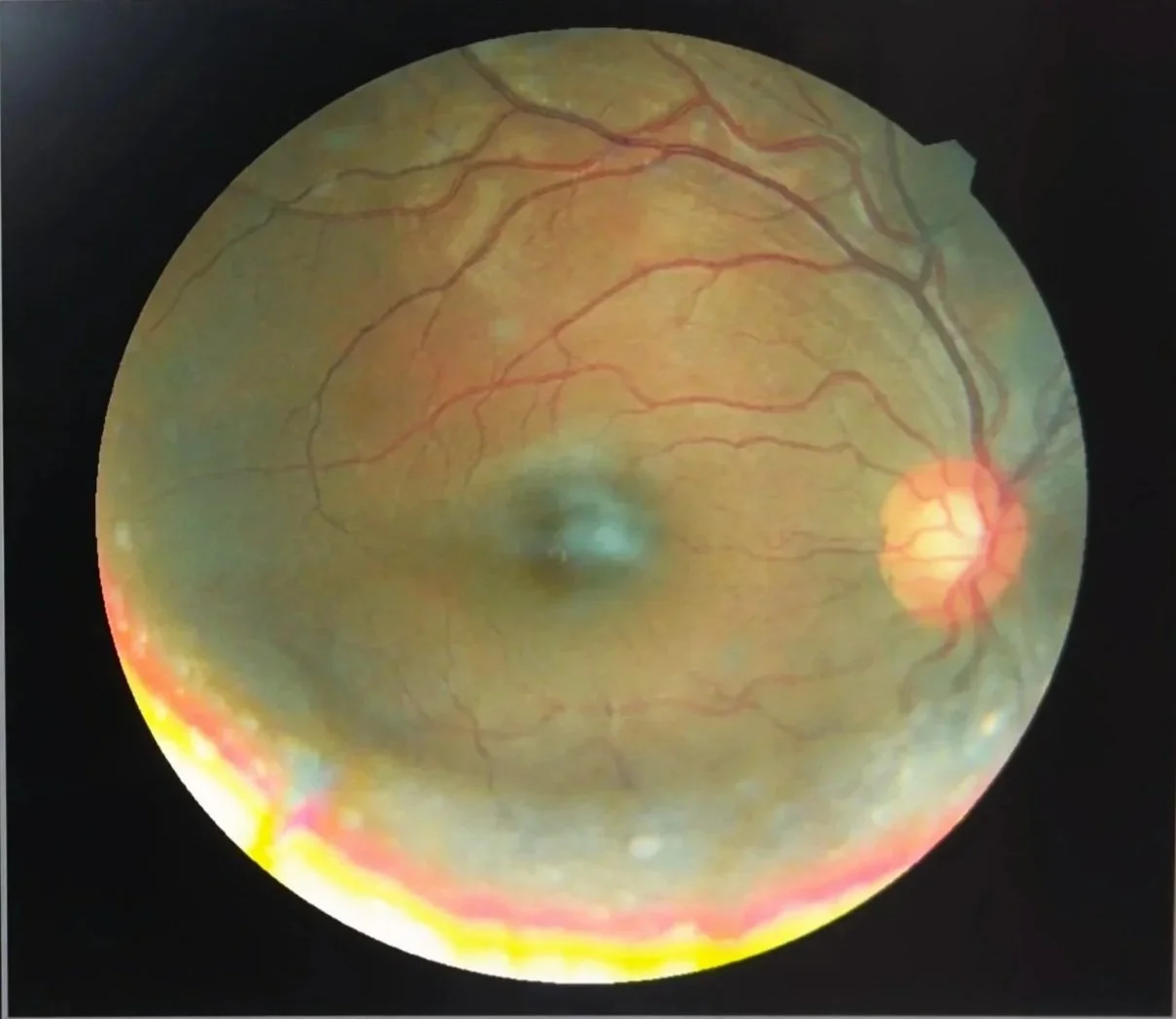
For a while I wasn't convinced the circular format could sustain an entire body of work and came close to abandoning it altogether. Around the same time, an optician's retinal scan unexpectedly reframed the project. I have lived with eye floaters for years, so I probably spend more time looking at my own eyes than most people. Seeing the retinal scan made the connection explicit. The eye became both subject and structure, giving the circles a conceptual coherence that I had previously struggled to articulate. Together, the six collages explored surveillance, scrutiny, urban space, conflict, accountability and personal experience through a shared visual language.

The exhibition confirmed the coherence of my visual language, but it also clarified for me that art, policy and research are not separate pursuits. Working to a public deadline forced ideas that might otherwise have remained unresolved into material form, reinforcing an iterative way of working that has long shaped my approach to policy development.

Dead Certain is a long project. The visual arguments I want to make demand technical capabilities I am still building – in printmaking, painting and collage at scale – and that development takes years. Floating Forms was the first public checkpoint in that longer arc. It let me test the visual language and the process with an audience, identify what was working and clarify what still needed to be built. I intend to keep sharing where I am at each stage – in conversation with others, and against the ideas – rather than waiting until the practice feels complete.

DOLLY'S CHOP SHOP TOWARDS A COLLAGE METHODOLOGY

Looking back over the six collages, I realised I had been repeating the same process without consciously setting out to do so. I don't think this is a finished methodology yet, but it worked well enough to produce a coherent body of work. The next stage of the practice is understanding where it holds, where it breaks down and what happens when it is pushed further.

  1. Starting with a question: The work rarely begins with an image. More often it starts with something that refuses to leave: a brief, a deadline, a policy problem, a memory, a conversation, a photograph or a feeling. The collage develops in response to that tension.

  2. Building an archive: Photographs, paintings, screen prints, drawings, research notes and older collages accumulate over time. Some pieces sit untouched for years before becoming useful. Others are made specifically to be cut apart. I treat the archive as raw material rather than as a collection to preserve.

  3. Finding a way to organise the work: Every collage eventually asks how it wants to be seen. During Floating Forms, that became the circle. The eye provided a way of containing a perspective rather than just illustrating one. It is currently the clearest way I have found of organising that relationship, but I don't expect it to be the last. Different questions will inevitably demand different forms.

  4. Cutting back into the work: This is usually where the piece begins to change. Finished paintings become raw material, fragments migrate between collages and compositions are dismantled before being rebuilt. Meaning often emerges through destruction rather than addition.

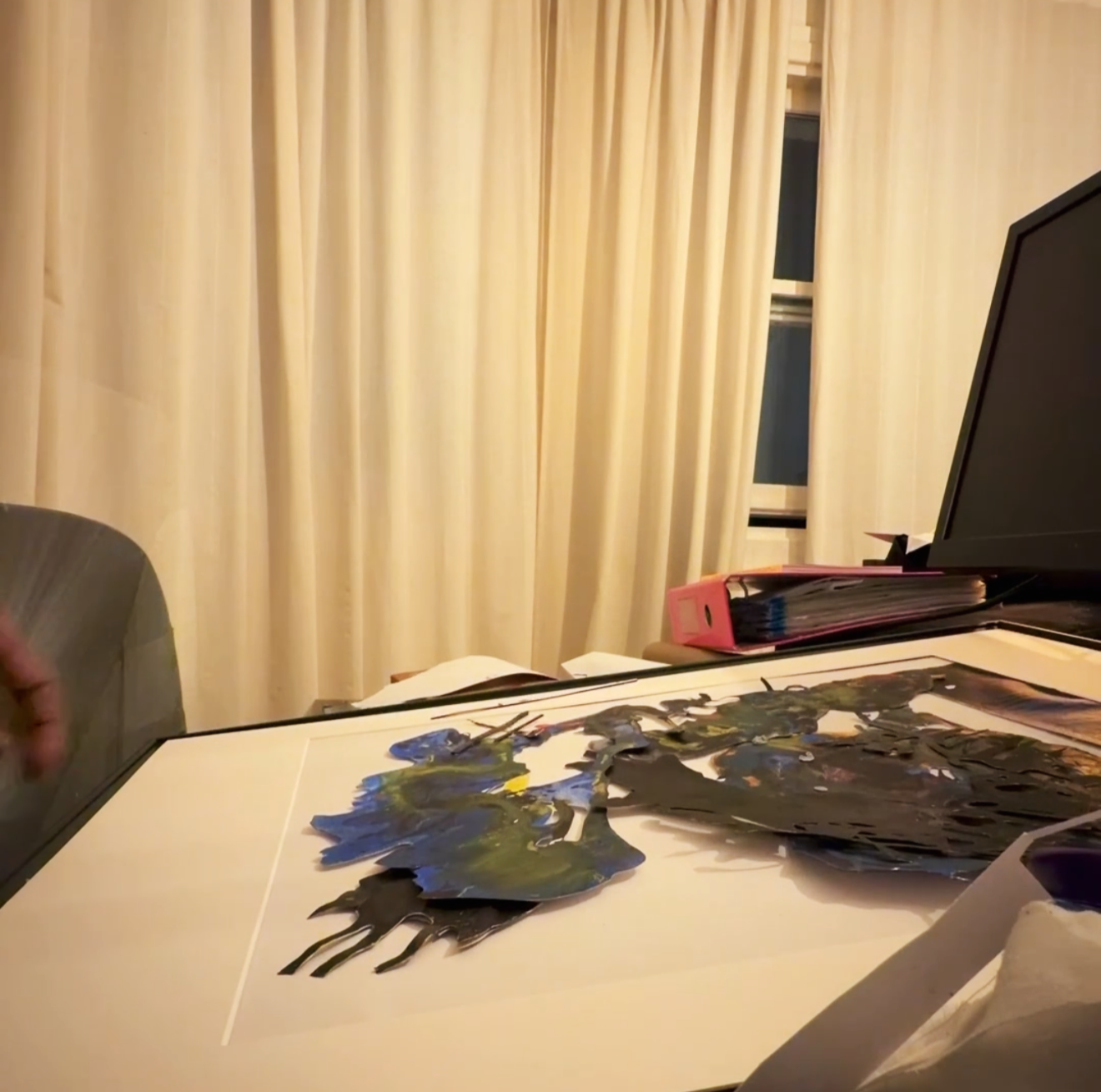
  5. Living with the composition: One thing that surprised me during Floating Forms was how important it became not to glue anything down too early. Fragments stayed on the wall with Blu Tack, allowing me to move them between works, rotate them, overlap them and live with different possibilities before committing. Living with the collages every day became part of the making. I solved some of the hardest compositional problems simply by walking past them on the way to the kitchen.

  6. Returning: Even now I don't think of most collages as permanently finished. Older works continue feeding newer ones, carrying traces of earlier decisions beneath the final surface. The archive and the practice increasingly feel like the same thing.

This is the process that produced the six collages shown here. Whether it continues to hold at architectural scale, across larger bodies of work and over longer periods of research is the question I now want to pursue.